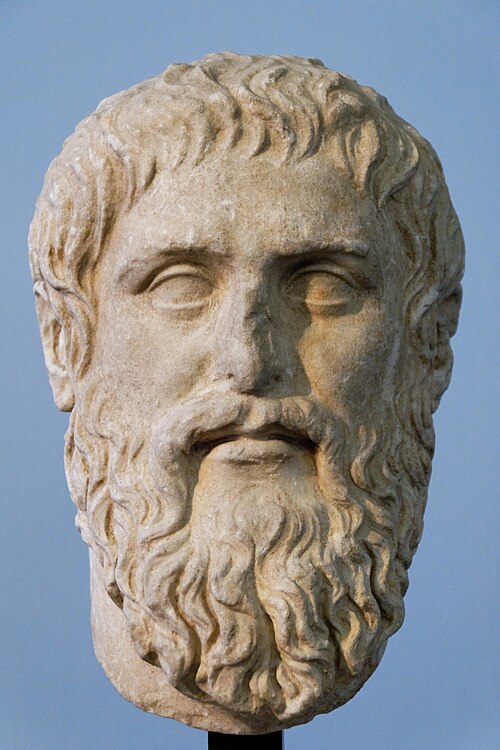
Life
Plato was born around 427 BC into one of the oldest families of Athens: his mother Perictione claimed descent from Solon's family, and her relatives Critias and Charmides belonged to the Thirty Tyrants who ruled Athens after its defeat in 404 BC. According to tradition his real name was Aristocles and 'Platon' was a nickname, 'the broad one', from his shoulders or his style. He grew up during the Peloponnesian War and, as a young man, became a follower of Socrates.
Socrates' trial and execution in 399 BC, carried out by the restored democracy, turned Plato away from Athenian politics. He left the city for a time, visiting Megara and possibly Egypt, and around 388 BC travelled to southern Italy and Sicily, where he met the Pythagorean Archytas and the tyrant Dionysius I of Syracuse; a story says the tyrant had him sold as a slave and friends ransomed him. Back in Athens, around 387 BC, he founded a school in the grove sacred to the hero Academus outside the walls: the Academy, which survived in one form or another for nine centuries.
He returned to Syracuse twice, in 367 and 361 BC, hoping to make the young Dionysius II a philosopher-ruler; both attempts failed badly and he was lucky to get home. He taught at the Academy until his death around 347 BC, aged about eighty. His most famous student, Aristotle, stayed there twenty years.
Works
Plato never speaks in his own voice: everything he wrote is in the form of dialogues, conversations in which Socrates, or occasionally another speaker, examines what people think they know. Some thirty-five dialogues survive, together with letters of debated authenticity. The early ones, such as the Απολογία Σωκράτους (Apology), Socrates' speech at his trial, and the Κρίτων (Crito), on why he refuses to escape prison, are our main picture of Socrates. The Φαίδων (Phaedo) describes his last hours and his argument that the soul is immortal.
The middle dialogues build Plato's own philosophy. The Συμπόσιον (Symposium) is a drinking party where each guest praises Eros; Aristophanes tells the myth of the split humans searching for their other half, and Diotima describes the ladder from bodily beauty to Beauty itself. The Πολιτεία (Republic), in ten books, asks what justice is and answers with an ideal city ruled by philosophers; it contains the ring of Gyges, which makes its wearer invisible, the allegory of the cave, where prisoners mistake shadows for reality, and the myth of Er about the soul's choice of its next life. The Φαίδρος (Phaedrus) pictures the soul as a charioteer with two horses and tells how the god Theuth offered writing to King Thamus.
Later came the Τίμαιος and Κριτίας, with the story of Atlantis, and the vast, unfinished Νόμοι (Laws). His prose, in Attic Greek, is the model that every later Greek writer measured against.
Legacy in Greece today
In Athens the site of the Academy is an archaeological park in the district still called Ακαδημία Πλάτωνος, with a small digital museum; on Panepistimiou street the Academy of Athens, the national academy founded in 1926, has Plato and Socrates seated in marble at its entrance. Every Greek student in the final year of Lyceum reads passages of the Protagoras and the Republic in the original for the national exams. Everyday Greek keeps his words: πλατωνικός έρωτας for love without touch, ο μύθος του σπηλαίου for any situation in which people mistake shadows for the truth, and Ατλαντίδα, which he invented. The readings on this site retell six of his myths in Modern Greek: start with the cave.
Did you know?
- The Academy stood in an olive grove outside Athens and gave its name to every academy in the world; the Athenian district around the site still bears the name.
- Atlantis appears nowhere before Plato's Timaeus and Critias; he presents it as a story Solon heard from Egyptian priests, and almost certainly made it up.
- In the Phaedrus he has an Egyptian king argue that writing will ruin memory, an argument preserved, of course, in writing.
- Three times he visited the tyrants of Syracuse hoping to create a philosopher-king; all three visits ended in failure or danger.
Key works
| Greek title | Title | Year |
|---|---|---|
| Απολογία Σωκράτους | Apology of Socrates | c. 390s BC |
| Πρωταγόρας | Protagoras | c. 390s BC |
| Συμπόσιον | Symposium | c. 385–370 BC |
| Πολιτεία | The Republic | c. 375 BC |
| Φαίδρος | Phaedrus | c. 370 BC |
| Τίμαιος και Κριτίας | Timaeus and Critias | c. 360 BC |
A line to remember
ὁ δὲ ἀνεξέταστος βίος οὐ βιωτὸς ἀνθρώπῳ.
In today's GreekΜια ζωή που δεν την εξετάζει κανείς δεν αξίζει να τη ζει ο άνθρωπος.
o de anexetastos vios ou viotos anthropo.
The unexamined life is not worth living for a human being.
From the original
The text as Plato wrote it, out of copyright, with our own translation beside it.
«Ἀπολογία Σωκράτους»The Apology of Socrates
Socrates has been found guilty and must propose his own penalty. Rejecting exile and silence, he explains why he cannot stop questioning people, and gives the line for which the speech is best remembered.
Ἀπολογία Σωκράτους 37e–38a (c. 390s BC) · Public-domain text, source: el.wikisource.org