Life
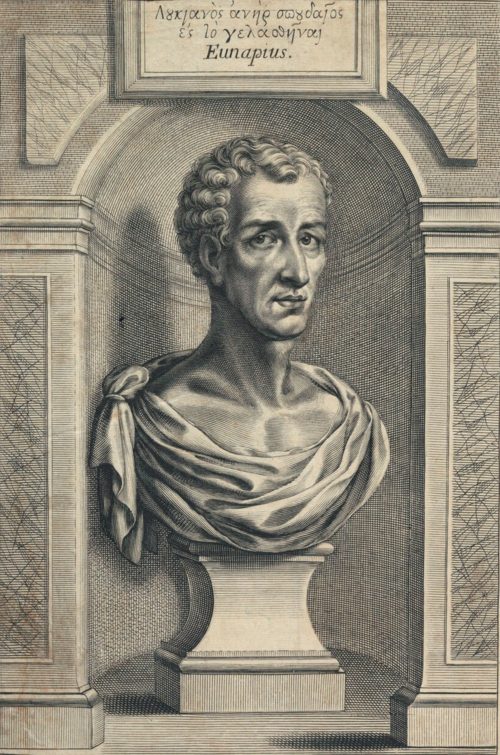
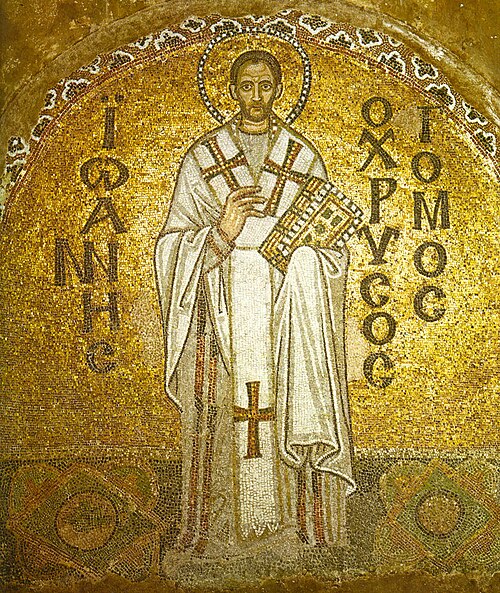
John was born around 347 in Antioch on the Orontes, the great city of Roman Syria, and raised by his mother Anthusa, widowed at twenty. He studied rhetoric under Libanius, the most famous pagan orator of the age, who is said to have wanted John as his successor «had the Christians not stolen him». Baptised in his early twenties, he spent several years as an ascetic in the mountains outside Antioch, ruining his health for life. He returned to the city, was ordained deacon in 381 and priest in 386, and for twelve years preached in the cathedral of Antioch.
Those Antiochene sermons made him famous across the Greek East. When the city rioted in 387, overturned the emperor's statues and waited in terror for punishment, John preached the Homilies on the Statues day after day to steady the people. In 398 the imperial court brought him, almost by force and in secret, to be Archbishop of Constantinople. He sold the episcopal palace's silver for the poor, disciplined his clergy and denounced the luxury of the rich and the vanity of the court.
The empress Eudoxia took his sermons as attacks on herself. With Theophilus, the patriarch of Alexandria, she had John condemned at the Synod of the Oak in 403 and exiled; an earthquake and a popular uprising brought him back within days, but in 404 he was exiled again, to Cucusus in the mountains of Armenia. In 407 he was ordered further, to Pityus on the Black Sea, and was marched there on foot until he collapsed and died at Comana in Pontus on 14 September 407. His relics returned to Constantinople in triumph in 438.
Works

More survives from Chrysostom than from any other Greek Father: some six hundred homilies, over two hundred letters and a number of treatises, filling eighteen volumes of Migne's Patrologia Graeca. The core is the exegetical preaching: series of homilies expounding, verse by verse, the Gospel of Matthew (ninety sermons), the Gospel of John, Genesis, the Psalms, Acts and all the letters of Paul, whom he loved above every other writer. The method is plain: explain the text, then turn to the congregation and apply it to how they live, with a frankness about money, slaves, the theatre and the poor that still startles. His Greek is the clear, rhythmical Attic of a pupil of Libanius, used by a man who wanted dockworkers to understand him.
Of the treatises, Περὶ ἱερωσύνης (On the Priesthood) is a dialogue on the weight and danger of the pastoral office that has been read by clergy ever since; the Homilies on the Statues of 387 are a record of a city in fear; and the letters from exile to the deaconess Olympias, his closest friend in Constantinople, are among the most moving personal documents of antiquity. Two texts carry his name without being his in the ordinary sense. The Θεία Λειτουργία τοῦ Ἁγίου Ἰωάννου τοῦ Χρυσοστόμου, the Divine Liturgy of St John Chrysostom, is the eucharistic service of the Byzantine rite as it settled after his time, attributed to him because of his authority. And the Κατηχητικὸς Λόγος, the Catechetical or Paschal Homily, a short, exultant sermon that invites the diligent and the lazy alike to the feast and ends by mocking death, is read aloud in his name at the Easter midnight service.
Legacy in Greece today
No Greek author is heard aloud more often. Every Sunday the Divine Liturgy of St John Chrysostom is celebrated in Greek in every Orthodox church, and the priest's exclamations and the people's responses, «Εἰρήνη πᾶσι», «Καὶ τῷ πνεύματί σου», are the one piece of ancient Greek that all Greeks know by ear. At Easter midnight the Catechetical Homily is read, and its «Ποῦ σου, θάνατε, τὸ κέντρον;» (Where, death, is your sting?) is part of the sound of Pascha. His feast is 13 November, the return of his relics 27 January, and on 30 January he is honoured with Basil the Great and Gregory the Theologian as one of the Τρεις Ιεράρχες (Three Hierarchs), the patrons of Greek education, a day on which schools hold celebrations. His last words, «Δόξα τῷ Θεῷ πάντων ἕνεκεν», are a common Greek inscription and saying, and in 2004 Pope John Paul II returned his relics from Rome to the Ecumenical Patriarchate in Constantinople.
Did you know?
- The nickname Χρυσόστομος, golden-mouthed, was not used in his lifetime; it became attached to him from about the sixth century onward.
- His teacher Libanius, a pagan, is reported to have said on his deathbed that John would have been his successor if the Christians had not taken him.
- He died on 14 September 407 while being marched on foot into a remoter exile; his last words, «Δόξα τῷ Θεῷ πάντων ἕνεκεν», are still a Greek saying.
- His relics, carried off to Rome after the Fourth Crusade, were returned to Constantinople by Pope John Paul II in 2004.
Key works
| Greek title | Title | Year |
|---|---|---|
| Ὁμιλίαι εἰς τοὺς ἀνδριάντας | Homilies on the Statues | 387 |
| Περὶ ἱερωσύνης | On the Priesthood | c. 390 |
| Ὁμιλίαι εἰς τὸ κατὰ Ματθαῖον Εὐαγγέλιον | Ninety homilies on the Gospel of Matthew | c. 390 |
| Ἐπιστολαὶ πρὸς Ὀλυμπιάδα | Letters to Olympias (from exile) | 404–407 |
| Θεία Λειτουργία τοῦ Ἁγίου Ἰωάννου τοῦ Χρυσοστόμου | The Divine Liturgy of St John Chrysostom (attributed) | |
| Κατηχητικὸς Λόγος εἰς τὸ Ἅγιον Πάσχα | Catechetical Homily for Easter (attributed) |
From the works


Public-domain pictures from Wikimedia Commons.
A line to remember
Μηδεὶς θρηνείτω πενίαν· ἐφάνη γὰρ ἡ κοινὴ βασιλεία. Μηδεὶς φοβείσθω θάνατον· ἠλευθέρωσε γὰρ ἡμᾶς ὁ τοῦ Σωτῆρος θάνατος.
In today's GreekΚανείς ας μη θρηνεί τη φτώχεια, γιατί φάνηκε η κοινή βασιλεία. Κανείς ας μη φοβάται τον θάνατο, γιατί μας ελευθέρωσε ο θάνατος του Σωτήρα.
Mideis thrineito penian: efani gar i koini vasileia. Mideis foveistho thanaton: ileftherose gar imas o tou Sotiros thanatos.
Let no one lament poverty, for the common kingdom has appeared. Let no one fear death, for the death of the Saviour has set us free.