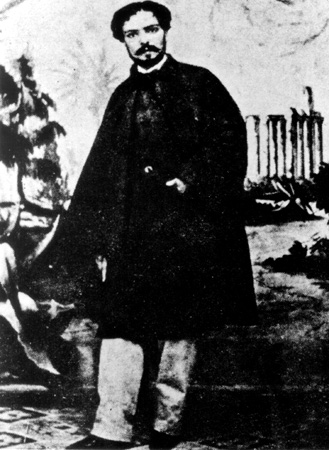
Life
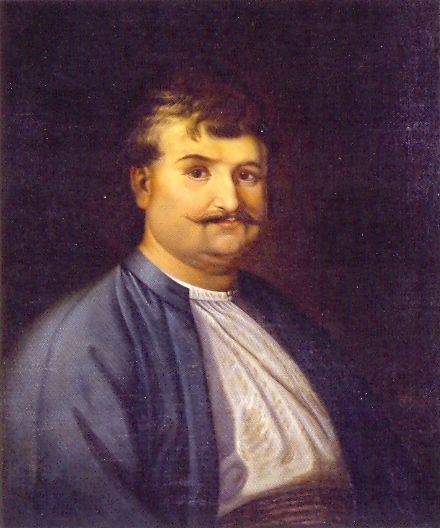
Roidis was born on 28 June 1836 in Ermoupoli on Syros, then the busiest port in Greece, into a rich family of Chiot origin. When he was five the family moved to Genoa, where his father ran the firm's business and served as Greek consul, and the boy grew up in Italian and French before returning to Syros to finish school. He went on to study in Berlin and travelled to Romania and Egypt on family business, reading voraciously in several languages. A hearing problem that began in his youth grew steadily worse until he was nearly deaf.
He settled in Athens in the early 1860s. The scandal of Η Πάπισσα Ιωάννα in 1866 fixed his public role: the ironist who takes nothing sacred, including the Greek state. In the 1870s he published the satirical weekly Ασμοδαίος and fought a famous duel of essays with Angelos Vlachos over the state of Greek poetry. In 1880 he was appointed director of the National Library, a post he lost and regained as governments changed.
In the 1880s a financial collapse wiped out the family fortune, and the elegant gentleman had to live by his pen and his modest library salary. He never married. He died in Athens on 7 January 1904, having written in his last decade the short stories that many consider his finest work.
Works
Η Πάπισσα Ιωάννα (Pope Joan, 1866) retells the medieval legend of a learned young woman who disguises herself as a monk, travels across Europe, seduces and studies her way to Rome and is elected pope, until she gives birth during a procession. Roidis calls it a 'medieval study' and footnotes it like a scholar, but every page is a satire on monks, miracles and, by reflection, the Greece of his own day. The Holy Synod condemned the book; Roidis replied with the mock-humble Επιστολαί ενός Αγρινιώτου (Letters of a Man from Agrinio). Lawrence Durrell later turned it into English.
His criticism is just as sharp. Τα Είδωλα (The Idols, 1893) dismantles the arguments for katharevousa, the artificial 'purified' written language, and argues that the people's spoken Greek is the only living one, all in flawless katharevousa, because, as he admitted, it was the only instrument he had learned to play. Essays such as Περί συγχρόνου ελληνικής ποιήσεως (On Contemporary Greek Poetry, 1877) explained why a small, poor, politics-obsessed country produced so little great writing.
In the 1890s he wrote short stories that are now the most read of his works: Ψυχολογία Συριανού συζύγου (Psychology of a Husband from Syros, 1894), Ιστορία ενός σκύλου (Story of a Dog) and Ιστορία μιας γάτας (Story of a Cat, both 1893), and Το παράπονο του νεκροθάπτου (The Gravedigger's Complaint, 1895), small, exact and quietly heartbreaking under the irony.
Legacy in Greece today
Η Πάπισσα Ιωάννα has never been out of print and is still the Greek novel most likely to be mentioned when the subject is censorship; Durrell's English version, The Curious History of Pope Joan, keeps it alive abroad. His animal stories and Ψυχολογία Συριανού συζύγου appear in school anthologies and in every collection of Greek short fiction. The adjective ροΐδειος, 'Roidian', is still used for elegant, merciless irony, and journalists quote his one-liners on Greek politics as if they were written yesterday. In Ermoupoli, on Syros, his name is on a street and his house is pointed out to visitors; in Athens, Ροΐδη streets exist in several districts. Reading him is the best cure for the idea that katharevousa was always dull.
Did you know?
- He argued for the demotic, spoken language in Τα Είδωλα while writing it in the most polished katharevousa of his generation, a contradiction he acknowledged with a smile.
- He was nearly deaf for much of his adult life, which friends said made his conversation even more precisely aimed.
- As director of the National Library he was dismissed and reinstated with changes of government, a fate he had satirised in his own articles.
- Lawrence Durrell, the author of The Alexandria Quartet, published his English adaptation of Pope Joan in 1954.
Key works
| Greek title | Title | Year |
|---|---|---|
| Η Πάπισσα Ιωάννα | Pope Joan | 1866 |
| Περί συγχρόνου ελληνικής ποιήσεως | On Contemporary Greek Poetry | 1877 |
| Τα Είδωλα | The Idols | 1893 |
| Ιστορία ενός σκύλου · Ιστορία μιας γάτας | Story of a Dog; Story of a Cat | 1893 |
| Ψυχολογία Συριανού συζύγου | Psychology of a Husband from Syros | 1894 |
| Το παράπονο του νεκροθάπτου | The Gravedigger's Complaint | 1895 |
A line to remember
Ἐν Ἑλλάδι ὑπάρχουσι δύο μόνον κόμματα: τὸ τῶν ἐχόντων καὶ τὸ τῶν μὴ ἐχόντων θέσιν.
En Elladi yparchousi dyo monon kommata: to ton echonton kai to ton mi echonton thesin.
In Greece there are only two parties: those who hold office and those who do not.
From the original
The text as Emmanouil Roidis wrote it, out of copyright, with our own translation beside it.
«Η Πάπισσα Ιωάννα»Pope Joan
The first lines of the novel proper, in Roidis's learned katharevousa: before telling the life of the legendary female pope, he mocks epic convention, serial novels and booksellers alike.
«Η Πάπισσα Ιωάννα» (1866), Part A, opening · Public-domain text, source: el.wikisource.org