Life
Anna was born on 1 December 1083 in the Porphyra, the purple-walled chamber of the Great Palace reserved for the births of reigning emperors' children, which made her πορφυρογέννητη, born in the purple, a title she never let her readers forget. Her father, Alexios I Komnenos, had seized the throne two years earlier and would hold it for thirty-seven years; her mother was Irene Doukaina. As a small child she was betrothed to Constantine Doukas, the son of a former emperor, and for a few years the pair were the designated heirs; the boy's death and the birth of her brother John in 1087 ended that prospect, and she never forgave it.
She received the finest education a Byzantine could have, in rhetoric, philosophy, the quadrivium of arithmetic, geometry, astronomy and music, and medicine, which she studied closely enough to describe her father's last illness like a physician. In 1097 she married Nikephoros Bryennios, a general and man of letters raised to the rank of caesar, with whom she had four children. When Alexios lay dying in August 1118 she and her mother tried to have Bryennios named successor; John forestalled them, and a conspiracy against the new emperor the following year, in which Anna was deeply involved, collapsed. Bryennios, the sources say, declined to act.
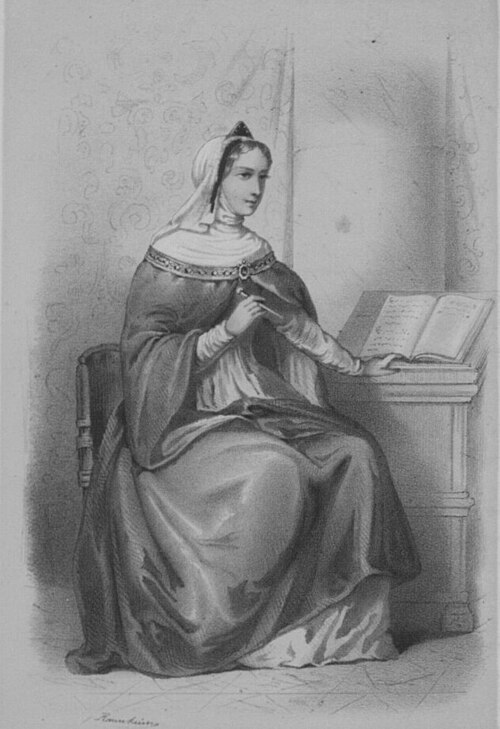
Her property was confiscated and later returned, and she retired to the convent of the Theotokos Kecharitomene, founded by her mother, where she gathered scholars around her and commissioned the first Byzantine commentaries on Aristotle in centuries. After Bryennios died in 1137, leaving his history of the years before 1081 unfinished, she took up the task herself. She was still writing in the late 1140s and died around 1153.
Works

The Αλεξιάς (Alexiad), its title echoing the Iliad, covers the years 1069 to 1118 and above all the reign of Alexios I, whom Anna presents as the saviour of an empire that in 1081 was close to collapse. Its fifteen books follow his wars against the Normans of southern Italy under Robert Guiscard and his son Bohemond, against the Pecheneg and Cuman nomads of the Danube, and against the Seljuk Turks in Asia Minor, and they describe in detail the arrival of the First Crusade at Constantinople in 1096–97: the unruly followers of Peter the Hermit, the oaths Alexios extracted from the Western princes, and Anna's fascinated hostility towards Bohemond, whose physique she describes with an attention no other medieval historian gives an enemy. She records the empire's religious quarrels too, including the trial and burning of the Bogomil leader Basil.
Anna wrote in an Atticizing Greek modelled on Thucydides and Polybius, full of Homeric tags and classical allusions, and she apologises when she must use a barbarian name or a common word. She is openly partisan, often inaccurate in chronology, and prone to lament her own misfortunes, but she had access to imperial documents, to veterans of the campaigns and to her own memory of the palace, and she is the only Byzantine author to give a full account of the crusaders from the inside. The last book, with its clinical description of the emperor's death from a disease of the lungs and heart, is also a daughter's farewell. Together with her husband's Ὕλη Ἱστορίας (Material for a History), which she set out to continue, the Alexiad is the chief source for the Komnenian restoration of Byzantium.
Legacy in Greece today
Anna Komnene is read today as the first woman historian in any language, and the Alexiad is on every reading list of the crusades beside the Latin chronicles it contradicts. In Greek it is available in a modern translation from the Agra publishing house, and the original Greek text is online. The Komnenian Byzantium she describes can be seen in Istanbul: the walls of the Blachernae quarter, where the Komnenoi moved the court, and the great church of Christ Pantokrator (now the Zeyrek Mosque), built by the brother she tried to unseat. In Greece, schoolchildren meet Alexios Komnenos and the First Crusade in the Byzantine history of lower secondary school, and «Άννα Κομνηνή» is a name they recognise; streets in several towns carry it. The site's C2 exercise on the vocabulary of Byzantine history and the page on Procopius, her great predecessor, are natural next steps.
Did you know?
- She was born in the Porphyra, the purple chamber of the Great Palace, and used the title πορφυρογέννητη throughout her history to remind readers of her claim.
- She studied medicine seriously enough to take part in the consultations over her father's final illness, and she records the physicians' disagreements.
- Her husband was also a historian; she continued his unfinished work, and the two books together cover Byzantium from the 1070s to 1118.
- She began writing in her sixties, in a convent, some thirty years after the events she describes.
Key works
| Greek title | Title | Year |
|---|---|---|
| Γέννηση στην Πορφύρα | Birth in the purple chamber as heir presumptive | 1083 |
| Γάμος με τον καίσαρα Νικηφόρο Βρυέννιο | Marriage to the caesar Nikephoros Bryennios | 1097 |
| Συνωμοσία κατά του Ιωάννη Β΄ | Failed conspiracy against her brother John II | 1118–1119 |
| Αποχώρηση στη μονή της Κεχαριτωμένης | Retirement to the Kecharitomene convent | c. 1119 |
| Αλεξιάς | The Alexiad, history of Alexios I in fifteen books | c. 1148 |
From the works


Public-domain pictures from Wikimedia Commons.
A line to remember
Ῥέων ὁ χρόνος ἀκάθεκτα καὶ ἀεί τι κινούμενος παρασύρει καὶ παραφέρει πάντα τὰ ἐν γενέσει…
In today's GreekΟ χρόνος, που κυλά ακράτητος και πάντα κάτι κινεί, παρασύρει και παίρνει μαζί του όλα όσα γεννιούνται…
Reon o chronos akathekta kai aei ti kinoumenos parasyrei kai paraferei panta ta en genesei…
Time, flowing on unchecked and always moving something, sweeps away and carries off everything that comes into being…
From the original
The text as Anna Komnene wrote it, out of copyright, with our own translation beside it.
«Ἀλεξιάς»The Alexiad
The first paragraph of the Alexiad: a meditation on time and oblivion, then the author's famous self-portrait, born in the purple and schooled in Aristotle and Plato, before she announces her subject, the deeds of her father Alexios I.
Ἀλεξιάς, Prologue 1 (c. 1148), the opening paragraph · Public-domain text, source: el.wikisource.org