Life
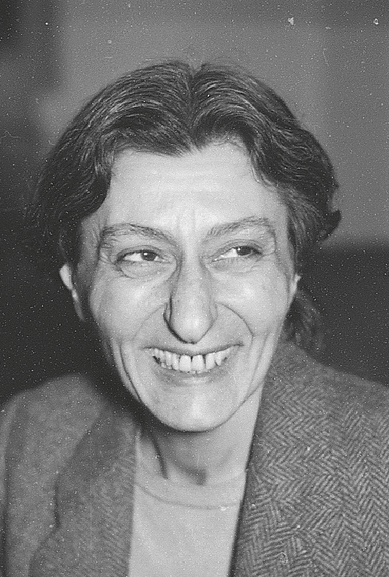
Katraki was born in 1914 in Aitoliko, a small town built on an island in the lagoon near Missolonghi, in western Greece. The landscape of water, reeds and stone, and the hard life of its fishermen, stayed with her for ever. In 1936 she entered the Athens School of Fine Arts, where she studied painting with Konstantinos Parthenis and discovered engraving, the art that would become her own, with Giannis Kefallinos, who was then renewing Greek printmaking. She graduated in 1940.
The war and the German Occupation shaped her as an artist and as a citizen. During those years she and her husband, the doctor Giorgos Katrakis, joined the resistance front EAM, and she made woodcuts of hunger, mourning and struggle, simple and direct images that could be reproduced and shared. She remained a woman of the Left, and the defeat of the Left in the Civil War and the persecutions of the following decades are present in her work.
In the 1950s and 1960s her art matured and her reputation grew, in Greece and abroad. In 1966 she showed two monumental works at the 33rd Venice Biennale, among them Η πτώση του Καραϊσκάκη (The Fall of Karaiskakis), and received the international Tamarind prize for lithography, a rare international recognition for a Greek printmaker. A year later, on 21 April 1967, the first day of the military coup, she was arrested and sent to the prison island of Gyaros with other opponents of the dictatorship; an international campaign won her release in 1968. After the return of democracy in 1974 she continued to work and exhibit in Athens, honoured as one of the major Greek artists of her generation, until her death in 1988.
Works

Katraki's first great body of work consists of woodcuts. In black and white, with deep cuts and strong contrasts, she portrayed the people of her time: women in black, workers, refugees, the dead and those who mourn them. There is nothing decorative in these images; like the folk lament, they speak with few, heavy words. Her figures are often frontal, motionless, almost like icons or archaic statues, and that stillness gives them their power.
From around 1950 she developed her most personal technique: engraving on stone. Instead of wood, she carved directly into slabs of sandstone and printed from them, or showed the engraved stones themselves. The material, rough and ancient, suited her subjects perfectly. Large heads and bodies emerge from the stone as if they had always been inside it, and the cracks and grain of the surface become part of the image. Mothers holding their children, men with bound hands, figures behind bars, crowds standing together: her themes are pain, resistance and human dignity, but also endurance and hope.
Her style combines several Greek traditions, the Byzantine icon, the folk carving of shepherds and stonemasons, the simplicity of early Greek sculpture, with a modern, almost abstract sense of form. Her images became closely associated with the memory of the Resistance and of political exile in Greece. Few Greek artists have expressed the collective experience of the twentieth century with such severity and such tenderness.
Legacy in Greece today
The best place to meet Katraki is her hometown: the Μουσείο Βάσως Κατράκη (Vaso Katraki Museum, officially a centre for the graphic arts) in Aitoliko, opened in 2006, holds the works she left to her birthplace: prints and engraved stones that show how her images were made. Her works are also in the National Gallery in Athens and in other Greek collections, and they appear often in exhibitions about the Resistance and about Greek printmaking. Many Greek engravers of the next generations consider her a model. A visit to Aitoliko, combined with nearby Missolonghi and its lagoon, is a beautiful way to see the landscape that shaped her, and a learner can practise describing one of her figures in Greek: who it is, what it expresses, what the stone adds.
Did you know?
- She engraved directly on stone, a technique she made her own from the 1950s.
- In 1966 she won the international Tamarind prize for lithography at the Venice Biennale.
- A year later, on the first day of the 1967 coup, the military junta arrested her and sent her to the prison island of Gyaros.
- Her hometown, Aitoliko, is built on an island in a lagoon, a landscape that marked her art.
Key works
| Greek title | Title | Year |
|---|---|---|
| Ξυλογραφίες της Κατοχής και της Αντίστασης | Woodcuts of the Occupation and the Resistance | 1940s |
| Χαρακτική σε πέτρα (ψαμμίτη) | Engravings on sandstone | from c. 1950 |
| Η πτώση του Καραϊσκάκη | The Fall of Karaiskakis (shown at the Venice Biennale) | 1966 |
| Διεθνές βραβείο λιθογραφίας Tamarind, 33η Μπιενάλε Βενετίας | International Tamarind lithography prize, 33rd Venice Biennale | 1966 |
| Μουσείο Βάσως Κατράκη, Αιτωλικό | Vaso Katraki Museum, Aitoliko (opened) | 2006 |
A line to remember
Η πτώση του Καραϊσκάκη
I ptosi tou Karaiskaki
The fall of Karaiskakis