Life
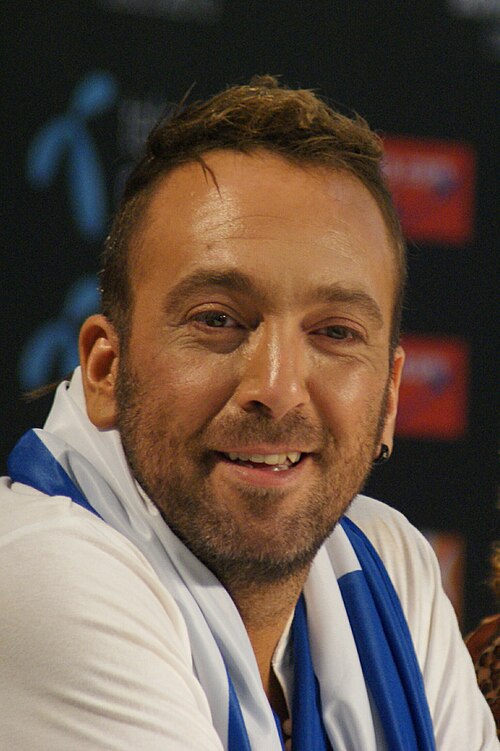
Giorgos Alkaios was born in Athens on 24 December 1971; record databases give his birth name as Georgios Vasileiou, and his name also appears as Alkeos. His first album, Με λίγο… τρακ (With a Little Stage Fright), was released in 1992 on RCA. It included Τι, Τι (What, What), a Greek version of a song by the Algerian singer Khaled with Greek lyrics by Evi Droutsa, which made him widely known. Through the 1990s he released an album almost every year: Αχ! Κοίτα με (Ah! Look at Me) in 1993, Δεν πειράζει (Never Mind) in 1994, Άνευ λόγου (Without Reason) in 1995, Εντός εαυτού (Within Oneself) in 1996 and Εν ψυχρώ (In Cold Blood) in 1997.
At the end of the decade he moved to the Columbia label, which issued Ήχοι σιωπής (Sounds of Silence) in 1998, Συρματόπλεγμα (Barbed Wire) in 1999, Προ των πυλών (At the Gates) in 2000 and Οξυγόνο (Oxygen) in 2001. Later albums appeared on Alpha Records and Virus Music, and in 2008 Το δικό μας παραμύθι (Our Own Fairy Tale) came out on the label Friends Music Factory. In 2010 he and Friends represented Greece at the Eurovision Song Contest in Oslo. Afterwards he stopped performing for many years. In December 2021 he sang on Greek television for the first time in eleven years and released the album Mosaic. New singles have followed, including Δεν με βολεύει (It Doesn't Suit Me), recorded with Panos Vlachos in 2026.
Works
Record catalogues place Alkaios in laïko and Europop: Greek popular melody, often with eastern-sounding ornaments, carried by dance rhythms and studio production. His titles are worth a second look. Άνευ λόγου, Εντός εαυτού, Εν ψυχρώ and Προ των πυλών are learned phrases inherited from Katharevousa, the formal language of earlier Greek administration and schooling. They keep old case endings, such as the dative ψυχρώ, yet Greeks still use them every day, often with a formal or slightly ironic tone.
OPA, the 2010 Eurovision entry, is sung in Greek. Its title is the exclamation ώπα, heard at Greek celebrations and dances. The official single credits the music to Alkaios and the lyrics to Giannis Antoniou and Friends; its recording features the Pontic lyra, played by Lazos Ioannidis. The song was chosen at the Greek national final on 12 March 2010. In Oslo it came second in its semi-final with 133 points, then finished eighth of 25 in the final on 29 May with 140 points. Alkaios has continued composing: on Mosaic, released on 24 December 2021, he wrote all the music and shared the lyrics with Evi Zevgara and Niki Spyropoulou.
Legacy in Greece today
Several of Alkaios's 1990s songs have returned in new versions. When he returned to television in December 2021, he opened with Με δυο μαρμάρινα φιλιά (With Two Marble Kisses) from Εντός εαυτού, and in 2024 he released summer re-recordings of it and of Τι, Τι. For learners, two tasks work well. First, watch the official Oslo performance of OPA, which is in Greek, and listen for the refrain and the Pontic lyra. Then write three original Greek sentences about the voice, the movement and the mood, without copying the lyrics. Second, take his learned titles and use one in a sentence of your own: Η απόφαση πάρθηκε εν ψυχρώ (The decision was taken in cold blood).
Did you know?
- Four of his album titles, Άνευ λόγου, Εντός εαυτού, Εν ψυχρώ and Προ των πυλών, are learned phrases with older Greek case forms.
- The recording of OPA features the Pontic lyra, a bowed instrument of the Pontic Greek tradition.
- OPA came second in its semi-final before finishing eighth in the 2010 final.
- He composed all the music on his 2021 album Mosaic.
Key works
| Greek title | Title | Year |
|---|---|---|
| Με λίγο… τρακ | With a Little Stage Fright | 1992 |
| Εντός εαυτού | Within Oneself | 1996 |
| Εν ψυχρώ | In Cold Blood | 1997 |
| Προ των πυλών | At the Gates | 2000 |
| OPA | OPA — Greek-language Eurovision entry | 2010 |
| Mosaic | Mosaic — album | 2021 |
A line to remember
Κάνω ένα άλμπουμ με 32 μουσικούς από όλο τον κόσμο.
Káno éna álboum me 32 mousikoús apó ólo ton kósmo.
I am making an album with 32 musicians from all over the world.