Life
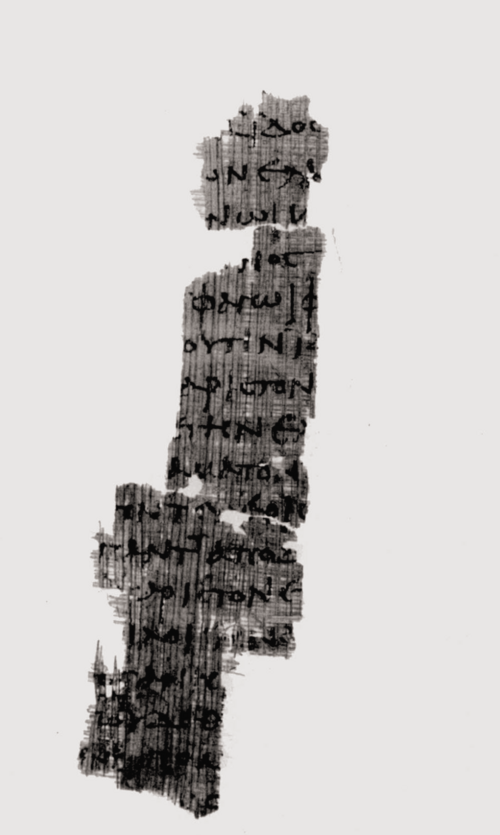
Almost everything we know about Exekias comes from his vases. No ancient author tells his life story, so there are no secure dates for his birth or death. Scholars place his work in Athens in the third quarter of the 6th century BC, roughly 550–525 BC, a time when the tyrant Peisistratos ruled the city for long periods. In Greek his name is Εξηκίας; in Latin letters it appears as Exekias or Execias. On the vases themselves it is usually written ΕΧΣΕΚΙΑΣ, with chi and sigma where later Greek uses the single letter xi.
Exekias signed his work in two ways. On two vases he wrote that he both painted and made them; on about ten or eleven others he signed only as potter, with the verb for “made”. Specialists attribute more vases to him by their style, and about forty pieces are linked to him today. Several of his vases also carry the words “Onetorides is handsome”, a praise inscription for a young Athenian that was fashionable at the time. Many of his vases were found not in Greece but in Etruscan tombs at Vulci in Italy, where Athenian pottery was valued and buried with the dead. This is why his best works are now in Rome, London, Munich and other museums outside Greece.
Works
Exekias worked in the black-figure technique: figures were painted with a glossy black slip on the orange clay, and fine details such as hair, cloaks and armour were incised with a sharp point. His lines are unusually precise, and his scenes are calm but full of tension.
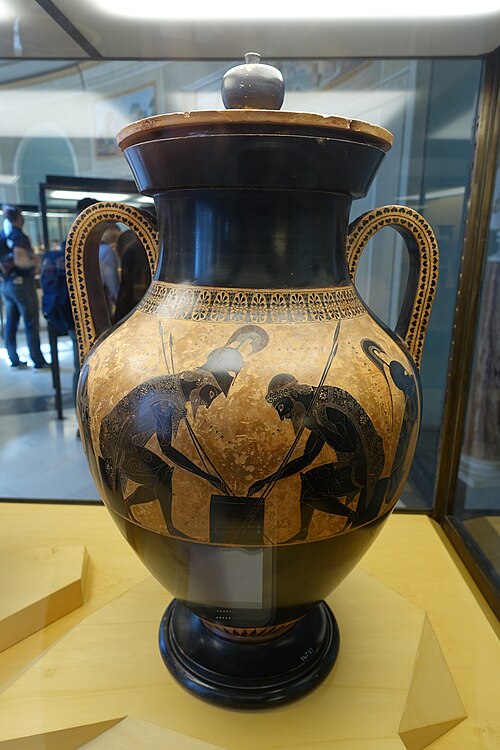
On the amphora in the Vatican (inventory 16757, c. 540–530 BC), Achilles sits on the left, still wearing his helmet, and Ajax sits on the right. Painted letters give their names, and each calls out a number: four for Achilles, three for Ajax, words that are τέσσερα and τρία in Modern Greek. No surviving ancient text tells this story; it is known mainly from vases. The other side shows the twins Castor and Pollux with their parents Leda and Tyndareus. On an amphora in the British Museum (c. 540 BC), Achilles kills the Amazon queen Penthesilea, and both names are written beside them. On an amphora in Boulogne-sur-Mer, Exekias shows Ajax alone, preparing the sword for his own death, rather than the act itself. His cup in Munich (inventory 8729) turns the inside into a sea: Dionysus travels in a ship, a vine with grapes grows from the mast, and dolphins swim around it. Large painted eyes decorate the outside.
Legacy in Greece today
In Greece, Exekias belongs to every history of ancient art. The Centre for the Greek Language’s online history of ancient Greek art calls him the most important painter of the whole black-figure style and reproduces his Vatican amphora. His most famous signed works, however, are in museums abroad, so most learners meet him through photographs. Try this with the photo of the Vatican amphora on this page. First say who sits where: Ο Αχιλλέας κάθεται αριστερά (Achilles sits on the left) and Ο Αίαντας κάθεται δεξιά (Ajax sits on the right). Then say their numbers: τέσσερα (four), τρία (three). Finally, keep three things apart: the painted picture, the ancient words written on the vase, and the modern museum label beside it.
Did you know?
- On his vases the name is spelled ΕΧΣΕΚΙΑΣ, with ΧΣ where later Greek writes Ξ.
- Later painters copied his scene of Achilles and Ajax at a board game on around 150 vases.
- The earliest surviving calyx krater, a wide mixing bowl for wine, is decorated by Exekias.
- His signature on the Vatican amphora speaks in the vase’s own voice: “Exekias painted and made me”.
Key works
| Greek title | Title | Year |
|---|---|---|
| Αχιλλέας και Πενθεσίλεια (αμφορέας) | Achilles and Penthesilea — amphora, British Museum | c. 540 BC |
| Αχιλλέας και Αίας παίζουν (αμφορέας) | Achilles and Ajax playing a board game — amphora, Vatican Museums | c. 540/530 BC |
| Ο Αίας ετοιμάζει την αυτοκτονία του (αμφορέας) | Ajax preparing his death — amphora, Boulogne-sur-Mer | c. 530 BC |
| Ο Διόνυσος στο πλοίο (κύλικα) | Dionysus in a ship — eye-cup, Munich | c. 530 BC |
A line to remember
Ἐχσεκίας ἔγραφσε κἀποίεσέ με
In today's GreekΟ Εξηκίας με ζωγράφισε και με έφτιαξε.
Ekhsekías égraphse kapoíesé me
Exekias painted me and made me.