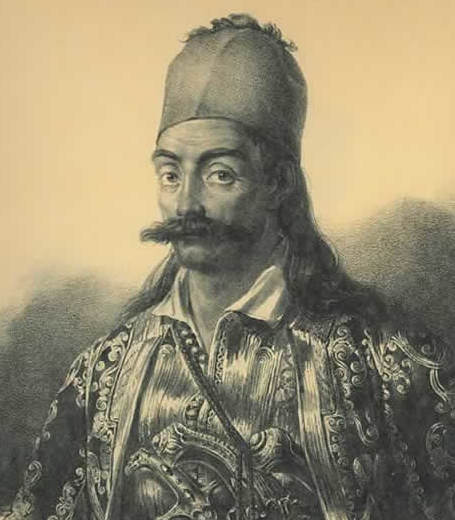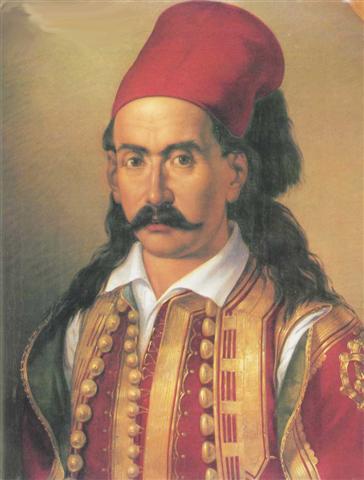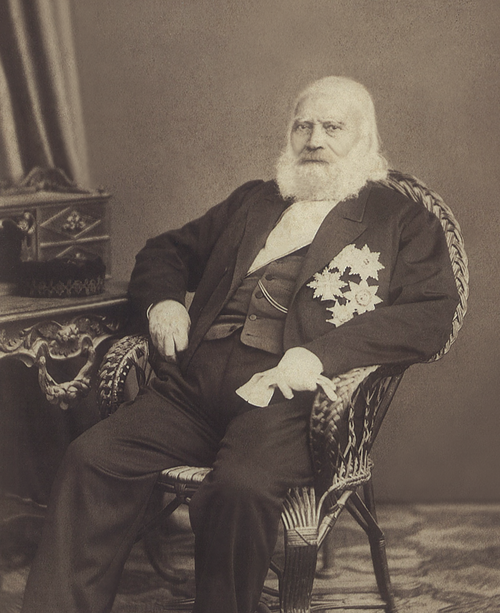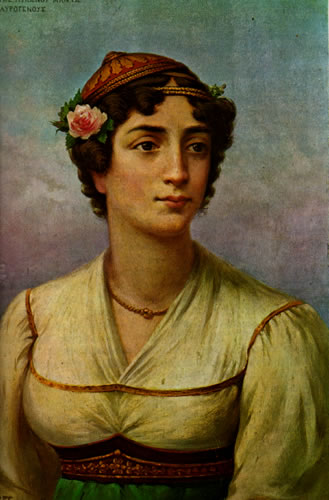
Life
Diakos was born around 1788 in the mountains of Phocis and Doris, north of Delphi; two villages, Artotina and Ano Mousounitsa, both claim him, and the second has since been renamed «Αθανάσιος Διάκος» in his honour. His family name is usually given as Massavetas or Grammatikos. As a boy he entered a monastery and became a deacon, a διάκος in Greek, and the title stuck to him as a surname. Tradition says he left the monastery after a quarrel with an Ottoman official and went up to the mountains, where he joined the klephts and later served as an armatolos, an armed guard under Ottoman authority, in the band of Odysseas Androutsos.
When the Revolution broke out in the spring of 1821, Diakos raised his men in the region of Livadeia. In late April an Ottoman army under Omer Vrioni and Köse Mehmed came south towards the Peloponnese, and the Greeks tried to stop it at the river Spercheios, near the old pass of Thermopylae. Diakos, with a few hundred men, held the bridge of Alamana. Most of the other Greek bands fell back; he stayed. After hours of fighting, wounded and with his sword broken, he was taken prisoner. In Lamia he was offered his life if he would change his faith and serve the Ottomans. He refused, and on 24 April 1821 he was executed, by tradition impaled or roasted on a spit. He was about thirty-three.
Works

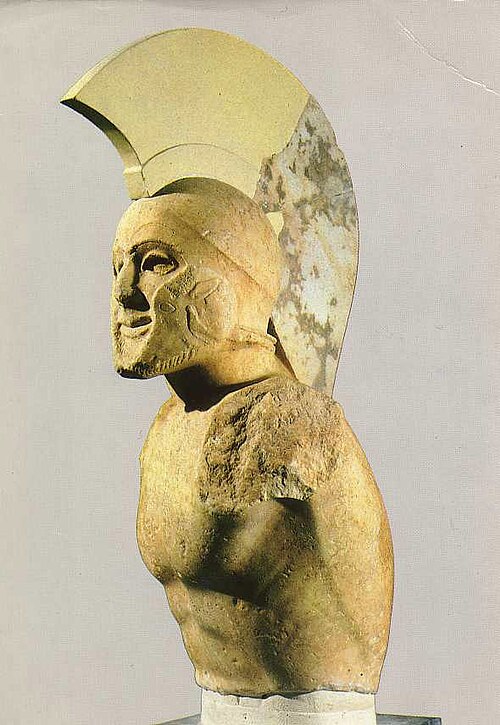
Diakos did not write books; his work is one battle and one death, and the way Greeks have told them ever since. Militarily, the fight at Alamana was a defeat: the Ottoman army passed the Spercheios and went on south. But it came only weeks after the first risings of March 1821, when nobody knew whether the Revolution would survive, and the story of a man who stood his ground at Thermopylae, the place of Leonidas and the three hundred, gave the uprising a hero from its very first days. Within months the news of his death was spreading through the villages, and Greeks began to speak of him as of a new Leonidas.
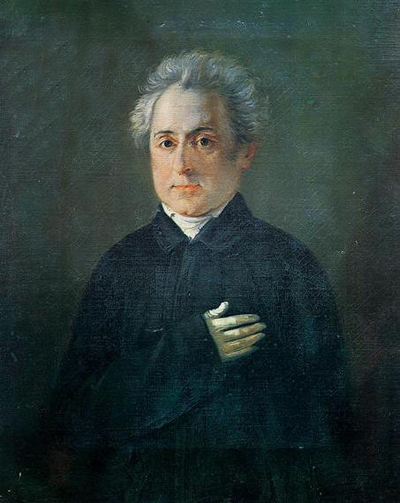
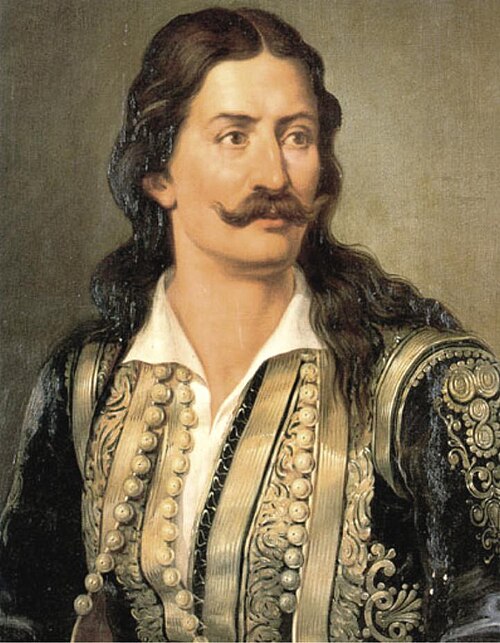
The folk tradition gave him his words. In the most famous κλέφτικο τραγούδι (klephtic song) about him, Diakos is led to his death on a spring morning and looks around at the flowering branches and the new grass. The song makes him say how badly Death has chosen the time: «Για δες καιρό που διάλεξε ο Χάρος να με πάρει». Another line tradition puts in his mouth is his answer to the offer to change his faith: «Γραικός γεννήθηκα, Γραικός θε να πεθάνω» (A Greek I was born, a Greek I shall die). In 1867 the poet Aristotelis Valaoritis wrote a long poem, Αθανάσιος Διάκος, and nineteenth-century painters showed him at the bridge with his broken sword. These images, more than the battle itself, are what made Diakos a national symbol.
Legacy in Greece today
In Lamia a statue of Diakos stands near the place where he was executed, and the town remembers him every April around the anniversary of his death. His birthplace in Phocis bears his name, and streets and squares called Αθανασίου Διάκου or simply Διάκου exist in almost every Greek town, including a well-known street near the Acropolis in Athens. Greek children meet him at school around 25 March, the national day, when they read the folk song of his last morning and the story of Alamana. A good thing to do: find the folk song «Του Διάκου» and read its first two lines, which a beginner can already understand, word by word. If you drive the old national road from Athens to Lamia, you cross the Spercheios valley where the battle took place.
Did you know?
- Διάκος is not a family name but a church title: he was a deacon in a monastery before he became a fighter.
- The bridge of Alamana is only a few kilometres from Thermopylae, which is why Greeks compared him with Leonidas.
- His native village in Phocis was renamed Athanasios Diakos after him.
- He died on 24 April 1821, barely a month after the Revolution began.
Key works
| Greek title | Title | Year |
|---|---|---|
| Μοναχός και διάκος | Monk and deacon in a monastery of Phocis | c. 1800s |
| Αρματολός με τον Οδυσσέα Ανδρούτσο | Armatolos in the band of Odysseas Androutsos | c. 1810s |
| Η μάχη της Αλαμάνας | The battle of the bridge of Alamana | 1821 |
| Ο θάνατος στη Λαμία | His execution in Lamia | 1821 |
From the works


Public-domain pictures from Wikimedia Commons.
A line to remember
Για δες καιρό που διάλεξε ο Χάρος να με πάρει, / τώρα π' ανθίζουν τα κλαδιά και βγάζει η γη χορτάρι
Gia des kairo pou dialexe o Charos na me parei, / tora p' anthizoun ta kladia kai vgazei i gi chortari
Look what a time Death has chosen to take me, / now, when the branches blossom and the earth puts out grass