Life
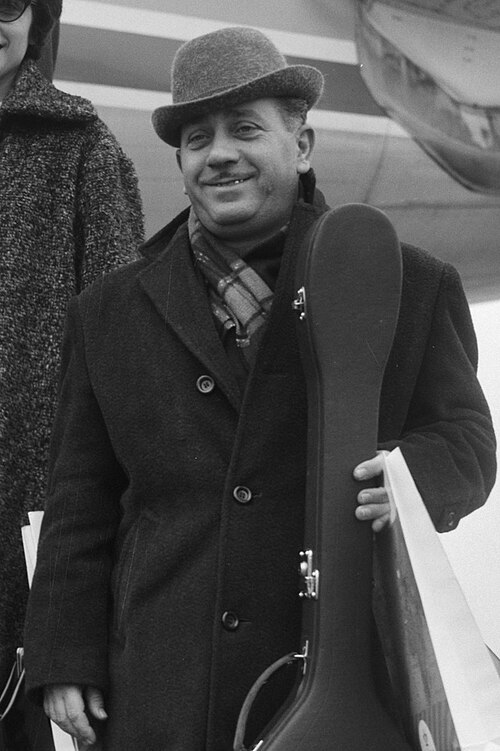
Artemios Ventouris Roussos was born in Alexandria on 15 June 1946, into one of the many Greek families of Egypt. As a boy he sang in the choir of the Greek Orthodox church, where he learned the Byzantine chant that coloured his voice for the rest of his life, and he studied music, playing the trumpet and the double bass. Like thousands of Egyptian Greeks, the family left Egypt after the Suez crisis and its aftermath, losing most of what they owned, and settled in Greece in the early 1960s.
In Athens the teenager played in beat groups in the clubs and hotels that entertained tourists. In 1967 he joined Vangelis Papathanassiou and the drummer Loukas Sideras to form Aphrodite's Child. On their way to London in 1968 they were stranded in Paris, and there, in the middle of the May events, their first single became a hit across Europe. The band split after its third album in 1972, and Roussos started a solo career that made him a star from France and Germany to the Netherlands, Britain and Latin America.
In June 1985 he was among the passengers of TWA Flight 847, hijacked to Beirut, and was held hostage for several days before being released. He kept touring and recording into the 2000s, singing in English, French, Greek and other languages. He died in Athens on 25 January 2015, at the age of 68.
Works

With Aphrodite's Child, Roussos sang Rain and Tears (1968), a slow ballad built on the melody of Pachelbel's Canon, and the band followed it with End of the World (1968), It's Five O'Clock (1969) and finally 666 (1972), an ambitious double album about the Apocalypse composed by Vangelis, which is now considered a classic of progressive rock. Roussos's voice, a high, vibrating tenor that could rise into falsetto, was the sound everyone remembered.
On his own he moved towards romantic, easy-listening pop. We Shall Dance (1971) was his first solo hit, and the album Forever and Ever (1973) made him famous across Europe with its title song and Goodbye, My Love, Goodbye. Then came Someday Somewhere, My Friend the Wind, Lovely Lady of Arcadia and Happy to Be on an Island in the Sun (1975), a sunny postcard of the Greek islands that was a big hit in Britain. In 1976 The Roussos Phenomenon became the first EP ever to reach number one in the UK singles chart.
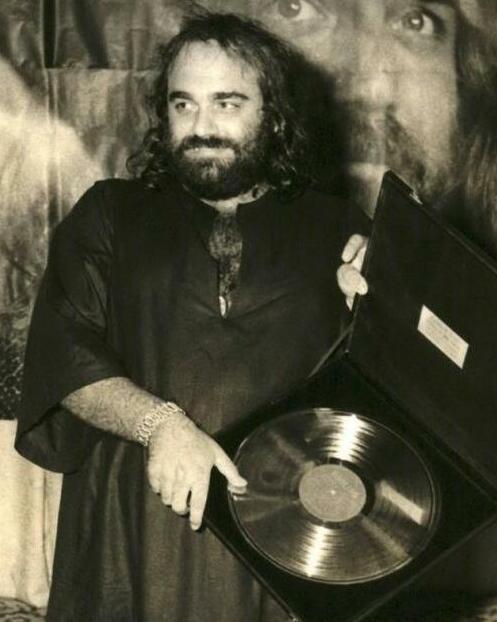
His image was as famous as his voice: the long hair and beard, the large frame, the colourful kaftans that hid it. Critics sometimes laughed at the sentimentality, but audiences loved the warmth, and for many people abroad in the 1970s Demis Roussos simply was the sound of Greece.
Legacy in Greece today
Start with two songs: Rain and Tears, to hear the young Roussos with Vangelis, and Forever and Ever, the ballad that made him a household name. Both are still played on Greek radio and at weddings and parties, and they are a good way to break the ice with Greek friends of your parents' generation. When he died in January 2015, Greek television and newspapers paid tribute to him for days, and fans in France, Germany and Belgium mourned him almost as one of their own. For Greeks of Egypt he remains a symbol of the lost Alexandria of their families. The album 666 is also worth discovering, as a reminder that the Greek pop of the 1970s could be bold and experimental.
Did you know?
- His full name was Artemios Ventouris Roussos; «Demis» is a short form of Artemios.
- Aphrodite's Child became famous in Paris almost by accident: the band was on its way to London in 1968 when it got stuck in France.
- In 1985 he was a hostage on the hijacked TWA Flight 847 in Beirut.
- His EP The Roussos Phenomenon (1976) was the first EP to top the UK singles chart.
Key works
| Greek title | Title | Year |
|---|---|---|
| Rain and Tears (Aphrodite's Child) | Rain and Tears | 1968 |
| We Shall Dance | We Shall Dance | 1971 |
| 666 (Aphrodite's Child) | 666 (album) | 1972 |
| Forever and Ever | Forever and Ever | 1973 |
| Goodbye, My Love, Goodbye | Goodbye, My Love, Goodbye | 1973 |
| Happy to Be on an Island in the Sun | Happy to Be on an Island in the Sun | 1975 |
From the works


Public-domain pictures from Wikimedia Commons.
A line to remember
Η Αλεξάνδρεια είναι μία πόλη, πολύ ελληνική.
I Alexandreia einai mia poli, poly elliniki.
Alexandria is a city, a very Greek one.