Life
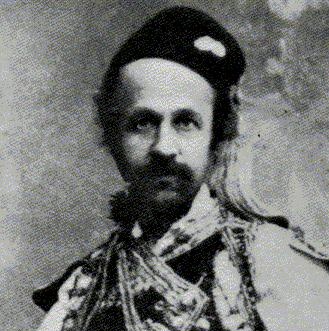
Theophilos was born around 1870 in Varia, a village just outside Mytilene on the island of Lesbos, into a poor family; his father is said to have been a shoemaker and his maternal grandfather a painter of icons. He had little schooling, was left-handed and shy, and from childhood drew on anything he could find. As a young man he left for Smyrna, where according to tradition he worked for a while as a doorkeeper at the Greek consulate and began to paint.
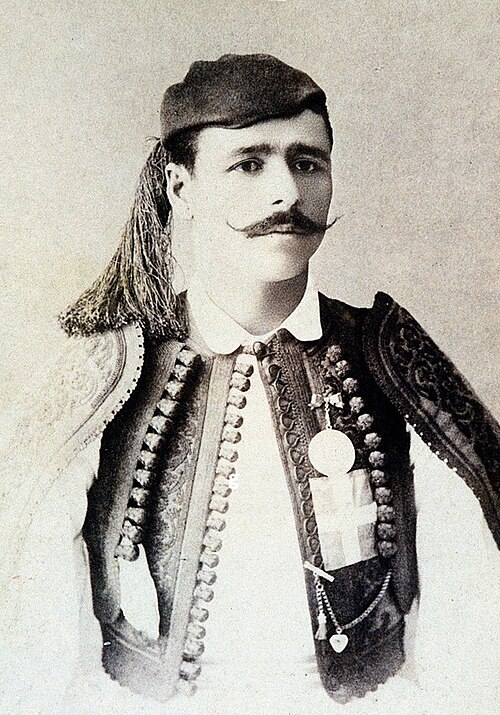
Around 1897 he crossed to mainland Greece and settled in the region of Volos and Mount Pelion, where he stayed for some thirty years. He owned almost nothing and lived by painting: a shopkeeper or farmer would give him food, a little money or a place to sleep, and Theophilos would cover a wall of the house, the café or the mill with battles, saints, landscapes and portraits. He always wore the fustanella, the pleated kilt of the fighters of 1821, and on feast days he staged his own historical pageants, dressing as Alexander the Great with the village children as his army. Many people treated him as a harmless eccentric.
In 1927 he returned to Lesbos. There, around 1929, he was discovered by Stratis Eleftheriadis, a Mytilene-born publisher and art critic famous in Paris under the name Tériade, who gave him cloth, paints and commissions and bought his work. Theophilos died in Varia in March 1934, before the Paris exhibitions, culminating at the Louvre in 1961, that made his name known abroad.
Works

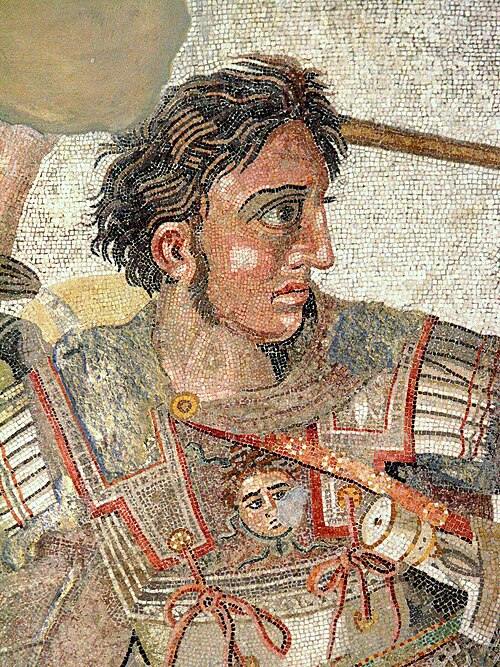
Theophilos painted what Greeks sang and told stories about. His favourite subjects were the heroes of the War of Independence, Kolokotronis, Athanasios Diakos, Katsantonis and Markos Botsaris, shown in fustanella in the middle of battle, and Alexander the Great, whom he painted again and again as a Greek folk hero with a shining helmet. Beside them he put scenes from the romance Ερωτόκριτος (Erotokritos), Adam and Eve, ancient gods, and the ordinary life he saw around him: harvests, fishermen, shepherds, dancers, a wedding, a baker at his oven, with the islands and mountains of Greece behind them.
His style is called naive or folk because he never learned the rules of academic painting: no perspective, figures in flat, bright colours, every leaf and flower drawn separately, and often a handwritten caption explaining who is who. Yet his sense of colour and composition is sure, and his pictures have the directness of Byzantine icons and the embroidered patterns of village costume, which were his real schools. The largest surviving work is the set of murals he painted in 1912 in the house of Giannis Kontos at Anakasia, above Volos, which is now a museum. Most of his wall paintings in Pelion were whitewashed or lost, and what we have today are mainly the portable works on cloth, wood and cardboard that he made in his last years for Tériade.
Legacy in Greece today
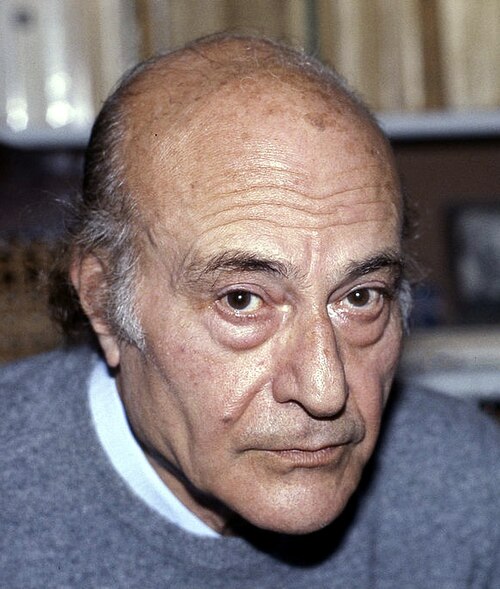
Two museums are devoted to him. The Theophilos Museum in Varia, built by Tériade and opened in 1965 near the painter's birthplace, holds some 85 of his paintings; a few steps away stands the Tériade Museum, and in Anakasia near Volos you can visit the Kontos house with the 1912 murals on its walls. Poets gave him his reputation: Odysseas Elytis wrote the essay Ο ζωγράφος Θεόφιλος (The Painter Theophilos) and Giorgos Seferis also wrote about him, both in 1947, and after them Theophilos became the model of a native Greek way of seeing. His pictures appear in school books, on posters and on postage stamps, and his Alexander, his Erotokritos and his dancing villagers are among the best-loved images of modern Greece.
Did you know?
- He never had a studio: most of his life's work was painted directly on the walls of cafés, shops, mills and houses in return for food and a bed.
- He wore the fustanella every day and on feast days dressed as Alexander the Great, leading the village children in mock battles.
- His work was shown at the Louvre in Paris in 1961, thanks to Tériade, the publisher of Matisse and Picasso, who came from the same town.
- The house he painted at Anakasia in 1912 is still standing and can be visited as a museum.
Key works
| Greek title | Title | Year |
|---|---|---|
| Τοιχογραφίες στο αρχοντικό Κοντού, Ανακασιά | Murals of the Kontos house, Anakasia | 1912 |
| Ο Αθανάσιος Διάκος | Athanasios Diakos | |
| Ο Μέγας Αλέξανδρος | Alexander the Great | |
| Ο Ερωτόκριτος και η Αρετούσα | Erotokritos and Aretousa | |
| Έργα σε πανί για τον Τεριάντ | Paintings on cloth for Tériade | 1929–1934 |
From the works


Public-domain pictures from Wikimedia Commons.
A line to remember
Εγώ Γραικός γεννήθηκα, Γραικός θε να πεθάνω.
Ego Graikos gennithika, Graikos the na pethano.
I was born a Greek, and a Greek I shall die.