Life
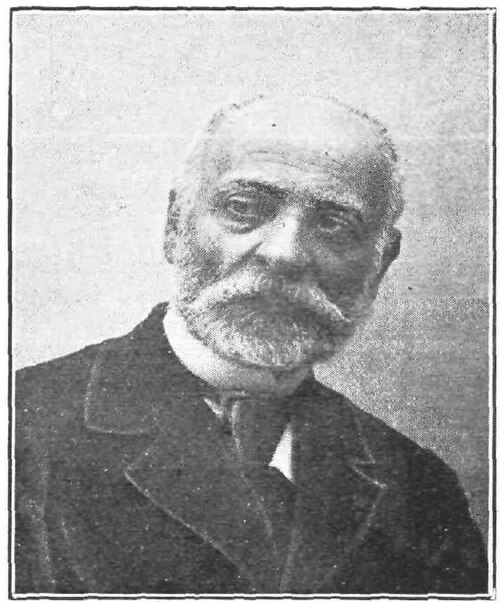
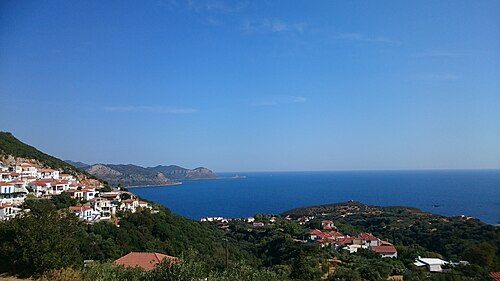
Aristarchus was born on Samothrace, an island in the northern Aegean, around 216 BC. The Byzantine encyclopedia known as the Suda calls him “Alexandrian by adoption, Samothracian by birth” and names his father, also called Aristarchus. As a young man he studied in Alexandria with the grammarian Aristophanes of Byzantium, one of the great scholars of the Library. Around the middle of the second century BC Aristarchus himself became head of the Library. The Suda also says that King Ptolemy VI Philometor made him tutor to his son. The Latin spelling Aristarchus and the Greek Αρίσταρχος name the same man, who should not be confused with Aristarchus of Samos, the astronomer of the previous century.
The Suda reports that about forty grammarians studied with him and that he argued many times with Crates of Mallos, the leading scholar of the rival royal library at Pergamon. After Ptolemy VIII took power around 145 BC, many scholars and teachers were driven out of Alexandria, as the ancient writer Athenaeus records; modern historians usually connect the end of Aristarchus’s work there with these events. He died in Cyprus. According to the Suda, he was ill with dropsy and starved himself to death at the age of seventy-two. These late stories are the main evidence for his life, so modern reference works give his dates only approximately.
Works

Aristarchus’s main work was the diorthosis, the careful correction of a text. For the Iliad and the Odyssey he compared older copies and earlier editions, above all that of Zenodotus, the first Alexandrian editor of Homer. When copies disagreed about a word, he chose the reading he thought Homer had written. He published an ekdosis (edition) together with hypomnemata (commentaries) explaining his choices, and ancient scholars knew of two Aristarchan editions.
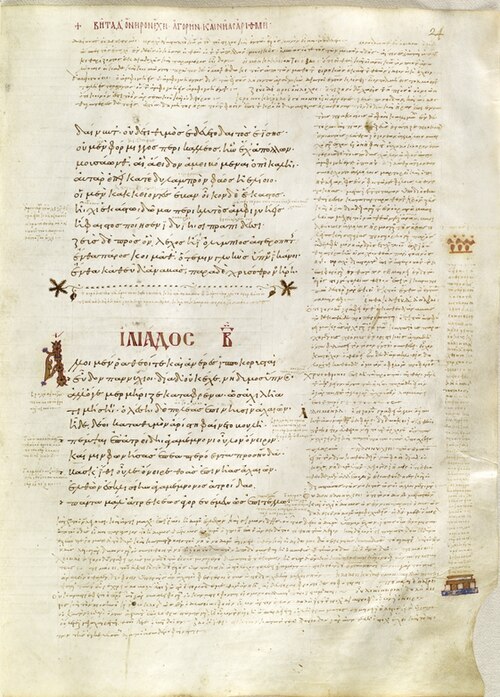
He did not simply remove lines he doubted. Instead he placed small signs in the margin. The obelos, a horizontal dash, marked a line he judged not to be Homer’s; the diple, shaped like “>”, pointed to something discussed in his commentary; the asteriskos marked lines repeated elsewhere. Readers could still read every line and see his judgement beside it. According to the Homeric scholia, he and Aristophanes regarded Odyssey 23.296 as the “end” of the poem, a note scholars still debate.
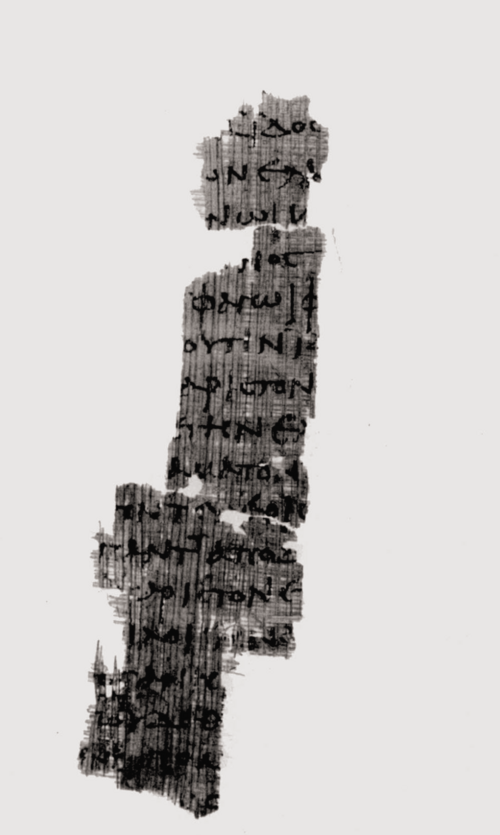
He also wrote commentaries on other authors. A papyrus whose final title names Aristarchus of Samothrace preserves part of a commentary on Book 1 of Herodotus, the only direct evidence that he worked on prose. His original books are lost. They survive indirectly through later scholars, especially the notes in the tenth-century Venetus A manuscript of the Iliad, which mention him more than a thousand times.
Legacy in Greece today
Aristarchus shaped the way Homer is read and printed. Greek and international editions of the Iliad and Odyssey still discuss his readings, and the Centre for the Greek Language’s online guide to Hellenistic literature presents him beside Aristophanes of Byzantium as a founder of Homeric philology. In Latin, Horace wrote fiet Aristarchus (“he will become an Aristarchus”), and his name became a byword for a strict critic.
Try his method on one ancient line. In Iliad 1.5, most manuscripts and modern editions read οἰωνοῖσί τε πᾶσι (“and to all the birds”). Athenaeus reports that Zenodotus wrote οἰωνοῖσί τε δαῖτα (“and a feast for the birds”). Find the one different λέξη (word), then say in Modern Greek: «Ο στίχος έχει μια παραλλαγή» (The line has a variant). Afterwards, open the digitised Venetus A from the Homer Multitext project and look for small signs in the margin.
Did you know?
- The ancient verb ἀθετέω (“to set aside”) gave scholars the term athetesis for rejecting a line; Modern Greek still says αθετώ μια υπόσχεση, “I break a promise”.
- Athenaeus reports that the Rhodian philosopher Panaetius called Aristarchus a μάντις, a “seer”, because he could easily divine the meaning of poems.
- The Suda credits him with more than 800 books of commentaries, a number modern scholars treat with caution.
- Aristarchus treated the Iliad and the Odyssey as the work of one poet, against scholars who gave the two epics to different authors.
Key works
| Greek title | Title | Year |
|---|---|---|
| Ἰλιάδος διόρθωσις (ἔκδοσις) | Edition of the Iliad — lost, known through the scholia | 2nd c. BC |
| Ὀδυσσείας διόρθωσις (ἔκδοσις) | Edition of the Odyssey — lost, known through the scholia | 2nd c. BC |
| Ὑπομνήματα εἰς Ὅμηρον | Commentaries on Homer — lost, quoted by later scholars | 2nd c. BC |
| Ὑπόμνημα εἰς Ἡροδότου Α΄ | Commentary on Herodotus, Book 1 — papyrus fragment (P. Amherst II 12) | 2nd c. BC |
A line to remember
Ἀρίσταρχος ὁ γραμματικός, ὃν μάντιν ἐκάλει Παναίτιος ὁ Ῥόδιος φιλόσοφος διὰ τὸ ῥᾳδίως καταμαντεύεσθαι τῆς τῶν ποιημάτων διανοίας
In today's GreekΟ γραμματικός Αρίσταρχος, που ο Ρόδιος φιλόσοφος Παναίτιος τον έλεγε μάντη, επειδή μάντευε εύκολα το νόημα των ποιημάτων.
Arístarchos ho grammatikós, hòn mántin ekálei Panaítios ho Rhódios philósophos dià tò rhaidíōs katamanteúesthai tês tôn poiēmátōn dianoías
Aristarchus the grammarian, whom the Rhodian philosopher Panaetius called a seer, because he easily divined the meaning of poems.