Life
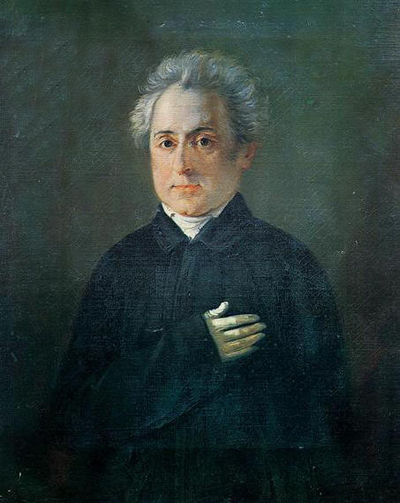
Solomos was born on Zakynthos on 8 April 1798, the son of Count Nikolaos Solomos and his young housekeeper Angeliki Nikli; the count married her on his deathbed, which made the boy legitimate and rich. Like many sons of the Ionian nobility he was sent to Italy, where he studied in Cremona and at the University of Pavia and started writing poetry in Italian. He returned to Zakynthos in 1818 to a world that spoke Greek in the street and Italian in the salons.
The Greek uprising of 1821 changed his direction. In May 1823, in a few weeks, he wrote the Hymn to Liberty in Greek; it was printed in 1825 in Missolonghi and in Paris, and made him famous across Europe. In 1824 he also wrote the Διάλογος (Dialogue), a defence of the spoken, demotic language against the scholars who wanted an artificial ancient-style Greek. In it he gives his creed: «Μήγαρις έχω άλλο στο νου μου πάρεξ ελευθερία και γλώσσα;» (Do I have anything else in mind but freedom and language?).
In 1828 he moved to Corfu, then the capital of the British-ruled Ionian Islands, and stayed there for the rest of his life, working slowly, rewriting endlessly and publishing almost nothing. His last years were clouded by family lawsuits and illness. He died in Corfu on 9 February 1857; his remains were later moved to Zakynthos.
Works
The Hymn to Liberty is a long poem that addresses Freedom as a woman rising from the bones of the Greeks, and then retells the first battles of the revolution. Its first two stanzas, «Σε γνωρίζω από την κόψη / του σπαθιού την τρομερή» (I know you by the terrible edge of your sword), are what every Greek sings. Solomos followed it with the Εις τον θάνατον του Λορδ Μπάιρον (Ode on the Death of Lord Byron, 1824) and a number of lyrical poems such as Η Φαρμακωμένη (The Poisoned Girl).
His mature works are different: dense, visionary and unfinished. Ο Κρητικός (The Cretan, 1833–34) is a shipwrecked Cretan rebel's account of the night he tried to swim his beloved to shore and saw a moonlit woman, the Φεγγαροντυμένη, rise from the sea. Οι Ελεύθεροι Πολιορκημένοι (The Free Besieged), worked on from 1826 to the 1840s in three successive drafts, is about the starving defenders of Missolonghi in the spring of 1826 and the beauty of the nature around them that tempts them to live; its line «Άκρα του τάφου σιωπή στον κάμπο βασιλεύει» (Deep silence of the grave reigns over the plain) is known by heart. Η Γυναίκα της Ζάκυθος (The Woman of Zakynthos) is a savage prose portrait of a hateful woman, and Ο Πόρφυρας (The Shark, 1849) describes a young English soldier killed by a shark in the harbour of Corfu. Solomos wrote in demotic Greek, the language of the people, at a time when this was a radical choice, and his friend Iakovos Polylas assembled the fragments and published them in 1859 as Άπαντα τα Ευρισκόμενα (Collected Surviving Works).
Legacy in Greece today
The simplest way to meet Solomos is to listen to the anthem: the first two stanzas of the Hymn to Liberty, with Mantzaros's music, were adopted by Greece in 1865 and by Cyprus in 1966, and they are sung at every school celebration on 25 March and 28 October and before every national team match. Greek pupils read Ο Κρητικός and Οι Ελεύθεροι Πολιορκημένοι in lyceum, and his line about «ελευθερία και γλώσσα» is quoted whenever the Greek language is discussed. On Zakynthos the main square is Πλατεία Σολωμού, with his statue and the Museum of Solomos and Eminent Zakynthians, where his tomb is; in Corfu town the house where he lived is a small Solomos museum. Streets named Οδός Σολωμού exist in almost every Greek town.
Did you know?
- Solomos wrote his first poems in Italian and never fully mastered written Greek; he kept Italian notes and drafts beside his Greek verses all his life.
- The Hymn to Liberty has 158 stanzas, but only the first two are sung as the national anthem.
- Greece and Cyprus share the same national anthem, which makes it one of the few anthems used by two sovereign states.
- He published almost nothing after 1830; most of his famous poems were printed only after his death, assembled from notebooks full of variants.
Key works
| Greek title | Title | Year |
|---|---|---|
| Ύμνος εις την Ελευθερίαν | Hymn to Liberty | 1823 |
| Διάλογος | Dialogue (on the Greek language) | 1824 |
| Η Γυναίκα της Ζάκυθος | The Woman of Zakynthos | 1826–1833 |
| Ο Κρητικός | The Cretan | 1833–1834 |
| Οι Ελεύθεροι Πολιορκημένοι | The Free Besieged | 1826–1844 |
| Ο Πόρφυρας | The Shark | 1849 |
A line to remember
Σε γνωρίζω από την κόψη / του σπαθιού την τρομερή, / σε γνωρίζω από την όψη / που με βία μετράει τη γη.
Se gnorizo apo tin kopsi / tou spathiou tin tromeri, / se gnorizo apo tin opsi / pou me via metraei ti gi.
I know you by the terrible edge / of your sword, / I know you by the look / that measures the earth with force.
From the original
The text as Dionysios Solomos wrote it, out of copyright, with our own translation beside it.
«Ὕμνος εἰς τὴν Ἐλευθερίαν»Hymn to Liberty
The first four of the poem's 158 stanzas. The first two are sung as the national anthem of Greece and of Cyprus; the next two tell how Liberty lay hidden in the bones of the Greeks, waiting through the silence of slavery.
Ὕμνος εἰς τὴν Ἐλευθερίαν (1823), stanzas 1–4 · Public-domain text, source: el.wikisource.org