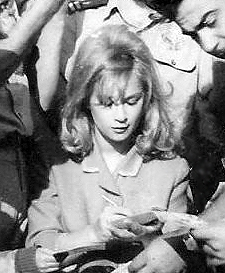
Life
Aliki Vougiouklaki was born on 20 July 1934 in Marousi, then a village outside Athens. Her father, Georgios, was executed by the German occupation forces when she was a child, and the family had little money. She entered the Drama School of the National Theatre, graduating in 1953, and made her first film, Το ποντικάκι (The Little Mouse), in 1954. Within a few years she was the leading actress of Finos Film, the studio that produced most of the Greek films of the period.
The turning point was Το ξύλο βγήκε από τον Παράδεισο (1959), Alekos Sakellarios's comedy about a spoilt schoolgirl and the young teacher who tames her. The teacher was played by Dimitris Papamichael, and the two became the golden couple of Greek cinema, on screen and off: they married in 1965, had a son, Giannis, in 1969, and divorced in 1975. Through the 1960s she made two or three films a year, nearly all of them box-office hits.
When Greek cinema declined in the 1970s she turned to the theatre, running her own company and starring in Greek productions of musicals such as My Fair Lady and Evita. She kept working until her last months. She died in Athens of cancer on 23 July 1996, three days after her sixty-second birthday, and her funeral drew enormous crowds.
Works

Vougiouklaki's films are light comedies and musicals, and their plots are simple: a mischievous girl, a stern man, songs, a kiss at the end. What made them special was her: the bleached blonde hair, the big eyes, the way she could switch from tantrum to tears to laughter in one scene, and a voice that carried the songs. In Το ξύλο βγήκε από τον Παράδεισο (1959) she is Liza, the rich schoolgirl who torments her teacher until she falls for him. In Μανταλένα (1960), with songs by Manos Hadjidakis, she is an island girl who takes over her dead father's boat; the film was Greece's entry at the Cannes Festival. Η Αλίκη στο Ναυτικό (Aliki in the Navy, 1961) has her disguised as a sailor, and Χτυποκάρδια στο θρανίο (Heartbeats at the School Desk, 1963) sends her back to school once more.
Υπολοχαγός Νατάσσα (Lieutenant Natassa, 1970), a wartime melodrama by Nikos Foskolos in which she plays a resistance fighter, showed that she could also carry a serious role; it sold more tickets than any Greek film before it. On stage she sang and danced in musicals for two decades and was still filling theatres in the 1990s. Her films are not deep, and critics often said so, but they are the shared memory of several Greek generations, and she knew it.
Legacy in Greece today
Vougiouklaki's films are broadcast on Greek television all year round, and on public holidays it is hard to avoid them; a learner can watch Το ξύλο βγήκε από τον Παράδεισο with Greek subtitles and follow most of it, since the dialogue is fast but simple. The songs from her films, especially those of Μανταλένα, are still sung. The nickname «η εθνική μας σταρ» (our national star) belongs to her alone, and her name is shorthand in Greek for a certain kind of blonde, charming, slightly spoilt heroine. Her son, Giannis Papamichael, is an actor. Her grave in the First Cemetery of Athens is still visited by admirers, and every July newspapers mark the anniversary of her death.
Did you know?
- She was twenty-five when she played the schoolgirl Liza in Το ξύλο βγήκε από τον Παράδεισο.
- Many of her characters were simply called Aliki, as in Η Αλίκη στο Ναυτικό; the public did not separate the actress from the role.
- She and Dimitris Papamichael, her husband from 1965 to 1975, starred together in a long series of films, and Greeks still speak of them as a couple.
- She died three days after her sixty-second birthday, in July 1996.
Key works
| Greek title | Title | Year |
|---|---|---|
| Το ποντικάκι | The Little Mouse | 1954 |
| Το ξύλο βγήκε από τον Παράδεισο | The Rod Came from Paradise | 1959 |
| Μανταλένα | Mantalena | 1960 |
| Η Αλίκη στο Ναυτικό | Aliki in the Navy | 1961 |
| Χτυποκάρδια στο θρανίο | Heartbeats at the School Desk | 1963 |
| Υπολοχαγός Νατάσσα | Lieutenant Natassa | 1970 |
From the works


Public-domain pictures from Wikimedia Commons.
A line to remember
Η εθνική μας σταρ
I ethniki mas star
Our national star