Life
Ioanna Mouschouri, always called Nana, was born on 13 October 1934 in Chania, Crete. When she was three the family moved to Athens, where her father worked as a projectionist in a cinema and the children grew up behind the screen, with the Occupation and then the Civil War outside. She studied classical singing at the Athens Conservatory for several years and dreamed of opera, but by her own account she was sent away when it became known that she was singing jazz in night clubs.
The jazz clubs led to Manos Hadjidakis, who gave her his songs to sing. At the Greek Song Festival of 1959 and 1960 she won with songs of his, and in 1960 she took first prize at the Mediterranean Song Festival in Barcelona. A German film about Greece brought her «Weiße Rosen aus Athen» (White Roses from Athens, 1961), which sold more than a million copies in Germany, and from 1962 she lived in Paris, which became her base for the rest of her career. In 1963 she represented Luxembourg at the Eurovision Song Contest.
She toured the United States with Harry Belafonte in 1966, hosted her own BBC television series in Britain from 1968, and for four decades sang in every major concert hall in the world. In 1993 she became a UNICEF Goodwill Ambassador, and from 1994 to 1999 she sat in the European Parliament for Greece. A long farewell tour in 2005–2008 turned out not to be the end: she returned to the stage and was still giving concerts past her ninetieth birthday.
Works

Mouskouri's Greek repertoire is built on the songs of Manos Hadjidakis, and through him on Nikos Gatsos's lyrics: «Χάρτινο το φεγγαράκι» (Little Paper Moon), «Κάπου υπάρχει η αγάπη μου» (Somewhere My Love Exists), «Τα παιδιά του Πειραιά» (The Children of Piraeus), the song from the film Never on Sunday that won the Oscar in 1961 and that she recorded in several languages. She also sang Mikis Theodorakis and traditional songs, and her Greek albums remain the easiest way for a foreigner to meet the classic Greek song of the 1950s and 1960s.
Abroad she worked language by language. In German she had «Weiße Rosen aus Athen» (1961); in French, where she is a household name, «À force de prier» (1963) and «Je chante avec toi Liberté» (1981), the chorus of the slaves from Verdi's Nabucco turned into a hymn to freedom; in English «Only Love» (1985), which reached number two in the British charts, and albums of folk songs, film themes and hymns. She also recorded in Spanish, Italian, Portuguese, Dutch, Hebrew and Welsh.
Her style never changed: a pure, almost choirboy tone, no vibrato tricks, perfect diction, and arrangements that put the melody first. Critics sometimes called it too sweet; audiences did not, and the sheer size of her catalogue, well over two hundred albums, has no equal among Greek performers.
Legacy in Greece today
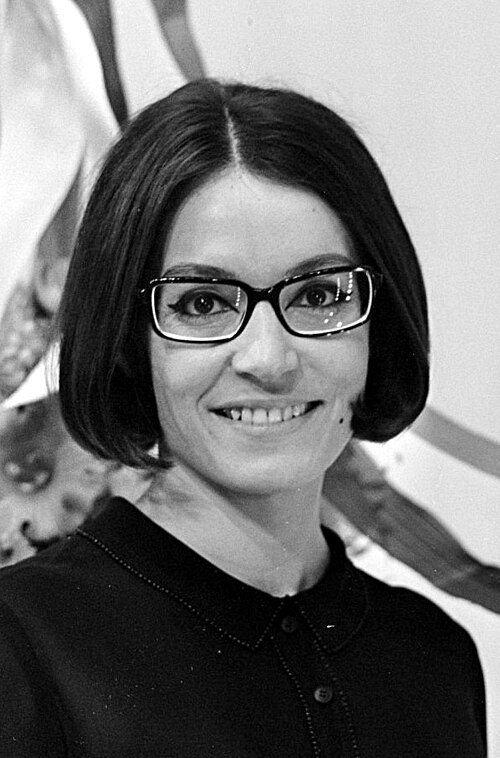
Mouskouri is a living artist, so her legacy is still being written. For a learner, the place to start is her Greek recordings of Hadjidakis: «Χάρτινο το φεγγαράκι» and «Τα παιδιά του Πειραιά» are sung slowly, every word clear, and the lyrics are short. Greek television and radio still play her, and her 2008 farewell concert at the Odeon of Herodes Atticus under the Acropolis was a national event. In Chania she is a celebrated daughter of the town, and in France and Germany her name is simply shorthand for Greek song. Her glasses, which she refused to take off on stage in the 1960s against all advice, became so famous that a pair of them is as recognisable an image of her as her voice.
Did you know?
- Her first name is Ioanna; Nana is the diminutive her family used.
- She represented Luxembourg, not Greece, at the 1963 Eurovision Song Contest, with the French song «À force de prier».
- She kept her glasses on stage from the start, against the advice of managers who thought they would ruin her career, and they became her trademark.
- In 1993 she succeeded Audrey Hepburn as a UNICEF Goodwill Ambassador, and a year later she was elected to the European Parliament.
Key works
| Greek title | Title | Year |
|---|---|---|
| Χάρτινο το φεγγαράκι | Little Paper Moon (Hadjidakis–Gatsos) | c. 1960 |
| Τα παιδιά του Πειραιά | The Children of Piraeus (Never on Sunday) | 1960 |
| Weiße Rosen aus Athen | White Roses from Athens | 1961 |
| À force de prier | By Dint of Praying (Eurovision, Luxembourg) | 1963 |
| Je chante avec toi Liberté | I Sing With You, Liberty | 1981 |
| Only Love | Only Love | 1985 |
From the works


Public-domain pictures from Wikimedia Commons.
A line to remember
Χάρτινο το φεγγαράκι, ψεύτικη ακρογιαλιά
Chartino to fengaraki, pseftiki akrogialia
A little paper moon, a make-believe seashore