Life
Bouboulina was born in May 1771 in a prison in Constantinople. Her father, Stavrianos Pinotsis, a sea captain from Hydra, had taken part in the failed Orlov revolt of 1770 and was being held there; her mother Skevo was visiting him when the baby came. The father died soon after, the mother remarried a man from Spetses, and the girl grew up on that small island off the eastern Peloponnese, then one of the richest shipping communities in the Aegean.
She married twice, both times to sea captains, and both times she was widowed when her husband was killed fighting pirates. The second, Dimitrios Bouboulis, died in 1811 and left her a fortune and several ships. She kept his name, took over the business and ran it herself, which was unheard of for a woman of her time, and she made it grow. When the Ottoman authorities tried to confiscate her property, she travelled to Constantinople and, according to tradition, won protection through the Russian ambassador. Around 1820 she had a large corvette with eighteen guns built on Spetses, the Αγαμέμνων (Agamemnon), and she is said to have joined the Filiki Etaireia, the secret society preparing the revolution.
When the War of Independence broke out in March 1821, she put her ships, her money and her sons into it. In the civil strife of 1824–25 she sided with Theodoros Kolokotronis, whose son Panos had married her daughter Eleni, and she was sent back to Spetses in disgrace. There, on 22 May 1825, she was shot dead at her own house during a quarrel with the Koutsis family, after her son had eloped with their daughter.
Works

Bouboulina's war was fought at sea. In March 1821 she raised the flag of revolt on the Agamemnon in the harbour of Spetses, and with her own small fleet she took part in the naval blockade of Nafplio, the strongest Ottoman fortress in the Peloponnese, which the islanders kept up for more than a year until the town fell in late 1822. Her ships also joined the siege of Monemvasia, which surrendered in the summer of 1821. The war cost her dearly from the start: her eldest son, Yiannis Giannouzas, was killed in fighting near Argos in 1821.
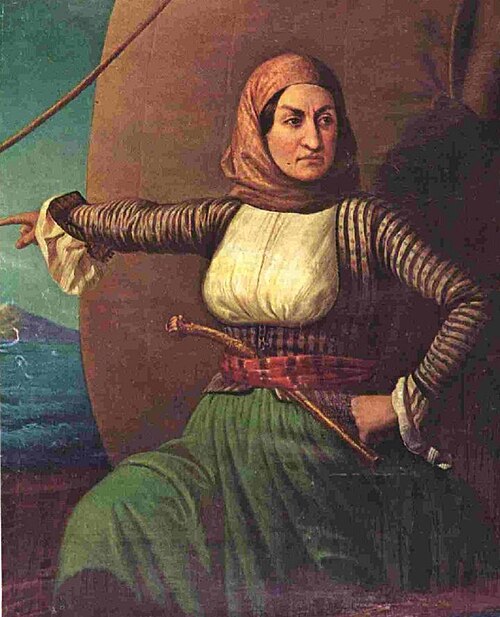
In September 1821 she was present at the fall of Tripolitsa, the Ottoman capital of the Peloponnese, where the Greek forces massacred much of the population. The tradition on Spetses holds that she rode into the city and personally protected the women of the pasha's household from the killing. Whether or not every detail is true, her reputation among the fighters was real: foreign philhellenes who met her wrote about her with astonishment, and her portrait by the Danish-born artist Adam Friedel, in a headscarf with a stern, unsmiling face, became the image of the revolution's woman warrior.
She paid for all of it herself. Ships, crews, gunpowder and food for the fighters swallowed most of her fortune, and when she died she had little left. What she did leave was the example: a Greek woman who, at fifty, commanded men at sea and was obeyed.
Legacy in Greece today
On Spetses her mansion above the old harbour is the Bouboulina Museum, run by her descendants, with her portrait, weapons and furniture; a bronze statue of her stands on the Dapia waterfront, and every September the island's Armata festival re-enacts the naval battle of 1822 by burning a ship in the bay. Almost every Greek town has an Οδός Μπουμπουλίνας (Bouboulina Street); the one in Athens, beside the National Archaeological Museum, is the best known. Her face was on the one-drachma coin from 1988 until the euro, and primary-school children dress up as her, headscarf and all, for the 25 March parade. In 2018 the Greek Navy gave her the posthumous rank of rear admiral. The name has even entered the language: a bold, commanding woman is called «μια Μπουμπουλίνα». The 1959 film Μπουμπουλίνα starred Irene Papas.
Did you know?
- She was born in a prison in Constantinople, where her mother was visiting her imprisoned father.
- Both of her husbands were sea captains killed by pirates; the second left her the ships and the name she became famous under.
- She fought the war at her own expense and spent most of her fortune on it.
- She was shot in a family quarrel on Spetses in 1825, four years before Greece became independent; in 2018 the Greek Navy named her a rear admiral.
Key works
| Greek title | Title | Year |
|---|---|---|
| Αγαμέμνων (πολεμικό πλοίο) | The warship Agamemnon, built on Spetses | c. 1820 |
| Ύψωση της σημαίας της Επανάστασης στις Σπέτσες | Raising the flag of revolt on Spetses | 1821 |
| Πολιορκία της Μονεμβασιάς | Siege of Monemvasia | 1821 |
| Άλωση της Τριπολιτσάς | Fall of Tripolitsa | 1821 |
| Ναυτικός αποκλεισμός του Ναυπλίου | Naval blockade of Nafplio | 1821–1822 |
From the works


Public-domain pictures from Wikimedia Commons.
A line to remember
Ελευθερία ή Θάνατος
Eleftheria i Thanatos
Freedom or death