Life
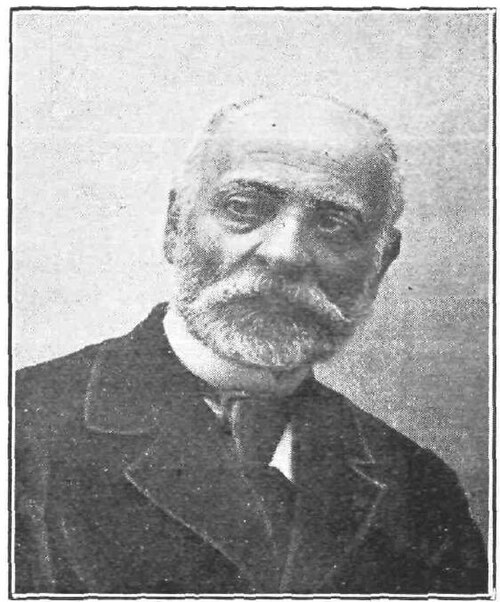
Volanakis was born in 1837 in Heraklion, Crete, which was then still under Ottoman rule. As a young man he went to Trieste, the busy Austrian port where many Greek merchants had their offices, and from 1856 worked there as a book-keeper in the sugar-trading house of his brother-in-law, Afentoulis. He drew ships and harbours even in the margins of his ledgers, and in 1860 Afentoulis paid for him to go to Munich, at that time the main school for Greek painters, to study at the Academy of Fine Arts, probably under Karl von Piloty.
In Munich he chose his subject for life: the sea. He made his name with a large painting of the naval battle of Lissa (1866), fought in the Adriatic between Austria and Italy, which won a competition announced by the Austrian emperor; the painting is today in the Museum of Fine Arts in Budapest. He stayed in Germany for many years, sending pictures to exhibitions and slowly building a reputation as a painter of ships.
In 1883 he returned to Greece and settled in Piraeus, the port of Athens, where he could watch ships every day. From 1883 to 1903 he taught at the School of Fine Arts in Athens, and many younger painters learned seascape from him. He was respected but never rich, and he had to sell many small pictures to make a living. He died in Piraeus on 29 June 1907, and only a handful of people came to his funeral.
Works

Volanakis belongs to the Munich School (Σχολή του Μονάχου), the group of nineteenth-century Greek painters trained in Bavaria, together with Nikolaos Gyzis, Nikiforos Lytras and Georgios Iakovidis. His colleagues painted village scenes, portraits and allegories; Volanakis painted water. He is the first Greek artist for whom the sea itself, its colour, its light and its moods, is the main subject.
His work has two sides. On one side are the great historical scenes: naval battles such as Salamis, painted for the Greek state, and the episodes of 1821 that every Greek child knows, such as the burning of a Turkish frigate by a Greek fireship (1882). These are big, dramatic canvases, full of smoke, flames and broken masts. On the other side, and more loved today, are the quiet pictures: sailing boats waiting for wind, the harbour of Piraeus at sunset, fishermen pulling their nets, ships at anchor in a golden evening light. Here the drawing is precise, because he knew every rope of a ship, but the real subject is the light on the water.
He painted hundreds of these pictures, many of them small, and they made the Greek seascape a genre of its own. His younger contemporary Ioannis Altamouras, and later Vassileios Chatzis, also made the Greek sea their subject, and together they form the first generation of Greek marine painters.
Legacy in Greece today
The best place to meet Volanakis is the National Gallery (Εθνική Πινακοθήκη) in Athens, which has a large group of his paintings, including calm harbour scenes such as the harbour of Volos (1875); the Naval Museum in Piraeus has his fireship painting of 1882. Others belong to Greek public and private collections and come up regularly at auction, where his seascapes are among the most sought-after Greek paintings of the nineteenth century. His naval battles illustrate Greek school books and the covers of books about the Revolution, and streets in several Greek towns carry his name, Οδός Βολανάκη. When Greeks look at a painting of a sailing ship on a shining sea, the word that often comes to mind is simply «Βολανάκης».
Did you know?
- He discovered his talent while working as a clerk in Trieste, drawing ships in his free time.
- He made his name with a painting of a naval battle between Austria and Italy, not a Greek one.
- He was one of the first Greek painters to make the sea his only great subject.
- He lived in Piraeus so that he could watch the ships of the harbour every day.
Key works
| Greek title | Title | Year |
|---|---|---|
| Η ναυμαχία της Λίσσης | The Naval Battle of Lissa (Museum of Fine Arts, Budapest) | c. 1869 |
| Το λιμάνι του Βόλου | The Harbour of Volos (National Gallery, Athens) | 1875 |
| Πυρπόληση τουρκικής φρεγάτας | The Burning of a Turkish Frigate (Naval Museum, Piraeus) | 1882 |
| Η ναυμαχία της Σαλαμίνας | The Battle of Salamis (commissioned by the Greek state) |
From the works


Public-domain pictures from Wikimedia Commons.
A line to remember
Ο πατέρας της ελληνικής θαλασσογραφίας
O pateras tis ellinikis thalassografias
The father of Greek seascape painting