
Counting without 1, 2, 3
The ancient Greeks did not write numbers with the digits 1, 2, 3 that we use today. Those came much later. Instead, the Greeks used letters as numbers. They had two systems: an older one and a newer one.
The older system was used in Athens, for example on stone inscriptions and in lists of money. Most signs were the first letter of a number word:
- Ι = 1, a simple stroke
- Γ (later written Π) = 5, from πέντε
- Δ = 10, from δέκα
- Η = 100, from ἑκατόν, because in old Athenian writing Η stood for the sound h
- Χ = 1000, from χίλιοι
- Μ = 10,000, from μύριοι
To write a number, you simply added the signs, a bit like Roman numerals: ΔΔΙΙΙ is 10 + 10 + 1 + 1 + 1 = 23. There were also joined signs for 50, 500 and 5000. Experts call this the acrophonic system, from ἄκρον, “tip”, and φωνή, “sound”: each sign is the first sound of its word.
Test yourself: 4 words from this page
1 / 4
What does this word mean?
Alpha is 1, beta is 2
The newer system gave a value to the letters of the alphabet, in order:
- α = 1, β = 2, γ = 3 … up to 9
- ι = 10, κ = 20, λ = 30 … up to 90
- ρ = 100, σ = 200, τ = 300 … up to 900
That makes 27 signs, but the alphabet had only 24 letters. So three old letters were kept: ϛ for 6, ϟ (koppa) for 90 and ϡ (sampi) for 900. A small stroke showed that the letters were a number: ρνζʹ is 100 + 50 + 7 = 157. For thousands, a stroke went in front, below the line: ͵α is 1000. The myriad, 10,000, was written with Μ.
When did this system begin? Historians do not agree. Smyth’s grammar of 1920 says it came into use after the 2nd century BC, but finds of inscriptions have pushed the date back, and some scholars think it began in Miletus, in Ionia, much earlier. Athens kept its old signs on inscriptions for a long time. The letter system was short and handy, so mathematicians used it for big calculations.
From measuring fields to proving theorems
The word γεωμετρία means “measuring the earth”, from γῆ, earth, and μετρῶ, “I measure”. Herodotus (2.109) thought the Greeks learned land measuring from Egypt, where officials measured the fields again when the Nile flood had carried land away. The Greeks added something new: they wanted to prove why a rule is always true.
Thales of Miletus (about 624–547 BC) is credited with five simple theorems of geometry, although ancient writers often gave famous men discoveries they did not make. Pythagoras of Samos (about 570–490 BC) gave his name to the theorem about right-angled triangles. The Babylonians knew the rule about 1000 years earlier, but Pythagoras may have been the first to prove it.
Euclid taught in Alexandria around 300 BC. His Elements, the Στοιχεῖα, has 13 books. It starts with definitions and five postulates and builds, step by step, a long chain of θεωρήματα, each with its ἀπόδειξις, its proof. The book shaped mathematics for more than 2000 years. Archimedes of Syracuse (287–212 BC) went further with curved shapes. In The Sand-Reckoner he even found a way to name numbers big enough to count the grains of sand that would fill the universe.
The same words in a Greek classroom today
A Greek pupil today studies μαθηματικά, an ancient word linked to μάθημα, “something learned”. In class, pupils meet many words that Euclid and Archimedes already used: αριθμός (number), τρίγωνο (triangle), κύκλος (circle), θεώρημα and απόδειξη. They learn the Πυθαγόρειο θεώρημα, the Pythagorean theorem.
Some words have changed a little. A digit is a ψηφίο, from ψηφίον, “a little pebble”; only later did the word come to mean a number. And απόδειξη has a second, everyday meaning: the receipt you get in a shop, a paper that proves you paid.
The letter-numbers have not disappeared either. Greeks still use them for order and rank: the years of school, the kings of history and the chapters of a book are numbered Α΄, Β΄, Γ΄.
Key dates
- c. 585 BCThales of Miletus is said to have predicted an eclipse of the Sun.
- c. 570 BCPythagoras is born on the island of Samos.
- 5th c. BCAthenian inscriptions record sums with the old signs Δ, Η and Χ.
- c. 300 BCEuclid writes the Elements in Alexandria.
- 287–212 BCLife of Archimedes of Syracuse, author of The Sand-Reckoner.
Eight words, then and now
| Ancient Greek | Greek today | Meaning |
|---|---|---|
| number | ||
| geometry, “earth-measuring” | ||
| theorem | ||
| proof (today also a receipt) | ||
| mathematics | ||
| digit (first “little pebble”) | ||
| triangle | ||
| circle |
 The Antikythera mechanism: an ancient Greek calculator
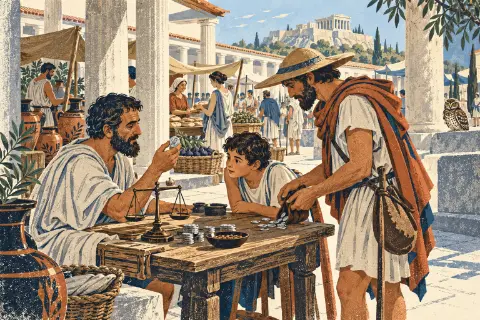 Money and coins in ancient Greece: the drachma and the owl