
Letters from the Phoenicians
Long ago, the Greeks had no alphabet. Around 800 BC, perhaps a little earlier or later, they learned one from the Phoenicians. The Phoenicians lived on the coast of today’s Lebanon, and they were traders who sailed all over the Mediterranean. They wrote with a short set of signs, and each sign stood for one sound.
The Greeks borrowed these signs and made them their own. Even the names stayed close: the Phoenician aleph, beth and gimel became the Greek ἄλφα, βῆτα and γάμμα. The historian Herodotus, writing in the 5th century BC, says that the Ionian Greeks called their letters Φοινικήια, “Phoenician” letters. He also tells the old story that Cadmus brought them to Greece from Phoenicia. Historians agree that the letters came from Phoenicia, but they still discuss exactly when and where the Greeks first learned them.
Test yourself: 4 words from this page
1 / 4
What does this word mean?
The big new idea: vowels
Phoenician writing showed only consonants, sounds like b, g or d. Readers had to guess the vowels, sounds like a, e or o. That worked well for the Phoenician language, but Greek needs its vowels: without them, many Greek words look the same.
So the Greeks had a clever idea. Some Phoenician letters stood for sounds that Greek did not use. The Greeks kept these letters and gave them a new job: to show vowels. Aleph, for example, was a short catch in the throat; in Greek it became ἄλφα, the sound a. Today these sounds are called φωνήεντα, vowels, and the others σύμφωνα, consonants. Because it wrote both, many scholars call the Greek alphabet the first true alphabet. Even the word “alphabet”, ἀλφάβητος, is Greek: it joins the names of the first two letters, alpha and beta.
Many Greek alphabets
The oldest Greek writing in letters comes from the 8th century BC. One famous example is a wine jug found near the Dipylon gate in Athens. Someone scratched a short text on it in early Greek letters, one of the oldest Greek inscriptions we know. Today the jug is in the National Archaeological Museum in Athens.
At first, Greek cities did not all write in the same way. Each region had its own local alphabet, with some different letter shapes and even some different letters. Early writers did not always write from left to right, either. Some wrote from right to left, like the Phoenicians, and some turned at the end of each line, like an ox ploughing a field. They used only capital letters, often with no spaces between words. Small letters came much later, with the scribes of the Byzantine period.
How Athens chose the Ionic letters
The Ionians lived on the coast of Asia Minor, in today’s Turkey, and on the islands nearby. Their alphabet had two letters that the old Athenian alphabet lacked: η, eta, for a long e, and ω, omega, for a long o. In old Athenian writing, the single letter E stood for both the short and the long e.
In 403/2 BC, Athens decided to write its official documents in the Ionic alphabet. This was a big step towards one alphabet for all Greeks. Later, the conquests of Alexander the Great, who died in 323 BC, spread the Ionic letters even further.
This alphabet has 24 letters, from άλφα to ωμέγα. Greek children still learn exactly these 24 letters at school today. The Latin alphabet, the one you are reading now, also comes from the Greek letters.
Key dates
- c. 800 BCThe Greeks adapt the Phoenician letters and add vowels (the exact date is debated).
- 8th c. BCA wine jug from the Dipylon in Athens gets one of the oldest Greek inscriptions.
- 5th c. BCHerodotus writes that the Greeks called their letters “Phoenician”.
- 403/2 BCAthens adopts the Ionic alphabet for its official documents.
- 323 BCAlexander the Great dies; his conquests have spread the Ionic alphabet far and wide.
Eight words, then and now
| Ancient Greek | Greek today | Meaning |
|---|---|---|
| first letter, alpha | ||
| alphabet | ||
| letter | ||
| writing, script | ||
| I write | ||
| vowel | ||
| consonant | ||
| inscription |
 Linear B: the oldest Greek writing
 Erasmian vs modern pronunciation of Ancient Greek
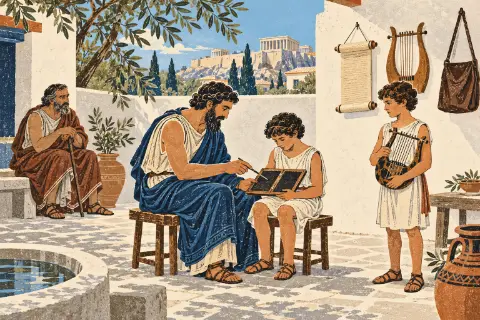 School and education in ancient Greece