
A question as big as the world
About 2,250 years ago, a Greek scholar called Eratosthenes lived in Alexandria, a large Greek city in Egypt. He was born around 276 BC in Cyrene, in today’s Libya. Around 240 BC he became head of the famous Library of Alexandria, a place full of papyrus rolls.
Eratosthenes loved maps. He wrote a work about the whole known world, the Γεωγραφικά. To draw a good map, he needed to know one thing: how big is the Earth, the γῆ? Greek thinkers already agreed that the Earth is round like a ball. A century earlier, Aristotle had noticed that the Earth casts a round shadow on the Moon during an eclipse. But nobody had found a way to measure its size.
Of course, no one could walk all the way round the world. So Eratosthenes used three simple things: the Sun, a stick and geometry.
Test yourself: 4 words from this page
1 / 4
What does this word mean?
A stick with no shadow
Far to the south of Alexandria lay the town of Syene, today’s Aswan. People said that at noon on the longest day of the year, the summer solstice around 21 June, the Sun stood straight above Syene. An upright stick there cast no shadow, no σκιά, at all. The geographer Strabo later wrote that the sunlight even reached the bottom of a well there.
On the same day at noon, Alexandria was different. There the pointer of a sundial, called a γνώμων, still cast a short shadow. Eratosthenes measured the angle, the γωνία, of that shadow. It was one fiftieth of a full circle, about 7 degrees in today’s units.
Why was there a shadow in one city and none in the other? Because the Earth is curved. The Sun is so far away that its rays arrive in parallel lines, but the round Earth meets them at a different angle in each place.
From one angle to the whole Earth
Now comes the clever part. Eratosthenes reasoned like this: if the shadow in Alexandria makes one fiftieth of a circle, then the distance from Alexandria to Syene must also be one fiftieth of the whole way round the Earth.
The distance between the two cities was given as about 5,000 στάδια. A stadion was a Greek unit of length: the length of the running race in a stadium. So the sum was simple:
- 5,000 stadia × 50 = 250,000 stadia
That was his answer for the περίμετρος, the distance round the Earth. Some later writers, such as the Roman author Pliny, give 252,000 stadia instead. Eratosthenes’ own book, On the Measurement of the Earth, is lost. We know his method mainly from Cleomedes, a Greek teacher of astronomy who explained it centuries later. We do not know exactly how the 5,000 stadia were measured.
How close was he?
Was Eratosthenes right? He came close, but historians disagree about how close. The problem is the stadion. Greek cities used stadia of different lengths, and we do not know for sure which one he meant.
- If his stadion was about 157 metres, as some scholars think, his result is between 39,000 and 40,000 kilometres, very near the real figure of about 40,000.
- If it was about 180 metres, as others think, his result is about 45,000 kilometres, more than a tenth too big.
His starting facts were not perfect either. Syene is not exactly under the tropic, the τροπικός κύκλος, and it is not exactly south of Alexandria. The 5,000 stadia were only an estimate.
Still, his method was sound, and that is what made him famous. Today, school classes in many countries repeat his experiment with a stick and its shadow.
Key dates
- 5th c. BCHerodotus writes that γεωμετρία came to Greece from Egypt.
- c. 276 BCEratosthenes is born in Cyrene, in today’s Libya.
- c. 240 BCHe becomes head of the Library of Alexandria.
- c. 194 BCEratosthenes dies in Alexandria.
- 1st c. ADThe Roman writer Pliny records his result as 252,000 stadia.
Eight words, then and now
| Ancient Greek | Greek today | Meaning |
|---|---|---|
| the Earth; land | ||
| measure; (today also) metre | ||
| shadow | ||
| sundial pointer (today: set square) | ||
| angle; corner | ||
| distance all round | ||
| tropic (circle) | ||
| geography |
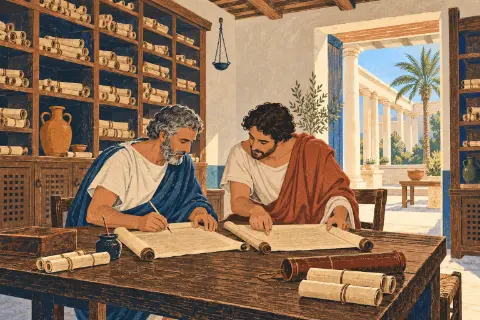 The Library of Alexandria
 The Antikythera mechanism: an ancient Greek calculator