
The assembly: the citizens decide
Most details on this page come from the Constitution of the Athenians (Ἀθηναίων Πολιτεία), a 4th-century BC work attributed to Aristotle or his school. Unless stated otherwise, they describe Athens in that century, and bare references such as 43.3 are to this text.
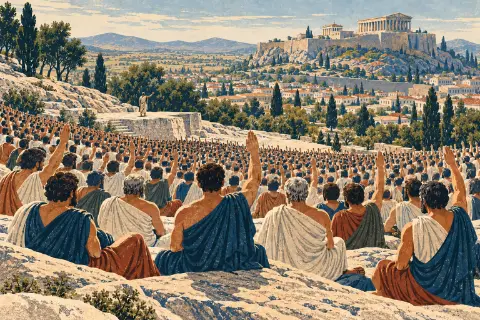
The assembly, the ἐκκλησία, was open to adult male citizens: men with citizen parents on both sides, registered in their deme at eighteen (42.1). As a rule it met on the Pnyx, a hill south-west of the Acropolis. It met four times in each prytany, a tenth of the year (43.3), so about forty times a year. One of those meetings was the sovereign one, the κυρία ἐκκλησία, which voted on whether officials were governing well and dealt with food supply and defence (43.4).
The herald opened the debate with the question τίς ἀγορεύειν βούλεται; (“who wishes to speak?”), as Demosthenes recalls in On the Crown (18.170). The regular speakers were known as ῥήτορες. Votes were normally taken by show of hands, χειροτονία, but a law quoted by Andocides (1.87) required 6,000 citizens voting in secret for a measure aimed at one individual. Attendance came to be paid: first one obol, then three (41.3), and by the time of this text a drachma, or nine obols for the sovereign meeting (62.2).
Test yourself: 4 words from this page
1 / 4
What does this word mean?
The Council of 500: nothing without its preparation
The text traces the Council, the βουλή, back to Solon’s body of 400 (8.4), but some historians doubt that this body existed. Cleisthenes raised it to 500, fifty from each of his ten new tribes (21.3). Councillors, βουλευταί, were chosen by lot (43.2) and could serve only twice (62.3), and Xenophon (Memorabilia 1.2.35) implies a minimum age of thirty. Their pay was five obols (62.2). The Council met every day except holidays (43.3), in the Bouleuterion in the Agora.
The fifty men of each tribe took turns to preside for 35 or 36 days. These πρυτάνεις dined at public expense in the Tholos and called the Council and the people together (43.2–3). One of them, drawn by lot, was their head, the ἐπιστάτης. For a night and a day he held the keys of the temples storing the state’s money and records, and the state seal, and he could never serve again (44.1).
The Council’s great power was preparation. The people could vote on nothing that the Council had not first considered and the prytaneis had not published; a proposer who broke the rule faced a γραφὴ παρανόμων (45.4). Decrees, ψηφίσματα, therefore opened with the formula ἔδοξε τῇ βουλῇ καὶ τῷ δήμῳ, “the Council and the people decided” (Andocides 1.96). Its judicial power was limited, though. It had once been able to fine, imprison and execute, until the people removed this and gave the jury-courts the last word (45.1).
The people’s courts: jurors, lot and ballots
The Constitution says that the people ran everything “by decrees and by jury courts” (41.2). In the 5th century BC Athens had 6,000 jurors, δικασταί (24.3). A juror had to be over thirty, free of debt to the treasury and not disfranchised (63.3). Pericles was the first to pay them (27.3–4), and the fee in the text’s own day was three obols (62.2).
Courts were filled by lot, κλήρωσις. Each juror had a boxwood ticket with his name, his father’s name, his deme and a letter from alpha to kappa (63.4). Stone allotment machines, κληρωτήρια, have been found in the Agora and nearby, but be careful in an exam answer: N. Papazarkadas (Center for Hellenic Studies, Harvard) notes that the surviving examples date from the mid-2nd century BC and that none can be confidently placed in the 4th.
Private claims up to 1,000 drachmas went before 201 jurors, larger ones before 401 (53.3). When a penalty had to be set, each side spoke for a fixed measure of water, the ancient timer (69.2). To vote, a juror took two ballots, one pierced and one solid, and dropped the one that counted into a metal jar and the other into a wooden one (68.2–4). The count was public, and a tie meant the defendant won (69.1). Bronze ballots of the 4th century BC have been found in the Agora.
The Areopagus: from guardian of the laws to murder court
The oldest council sat on the Ἄρειος πάγος, the rock of Ares, north-west of the Acropolis. Its members were former archons, and they sat for life (3.6). The Constitution says that it once guarded the laws and handled most of the city’s greatest affairs (3.6, 8.4), and that it led the state for about seventeen years after the Persian Wars (25.1).
In the archonship of Conon, 462/1 BC, Ephialtes removed its “added” powers, τὰ ἐπίθετα, and gave them to the Five Hundred, the people and the jury-courts (25.2). The same text also says that Pericles took away some of its functions (27.1). Our main account was written more than a century later, so read it with care. What remained were trials for deliberate killing and wounding, poisoning and arson (57.3). The Foundation of the Hellenic World adds that its powers were gradually restored in the 4th century BC.
Its origins belong to myth. In Aeschylus’ Eumenides (681–690), Athena founds the court on the πάγος Ἄρειος for the first trial for bloodshed, and explains the name by the Amazons’ sacrifices to Ares there. The modern court’s history tells another legend: that the gods tried Ares himself on the hill. Neither story gives a reliable foundation date.
Key dates
- c. 594 BCAccording to the sources, Solon creates a Council of 400 and leaves the Areopagus to guard the laws
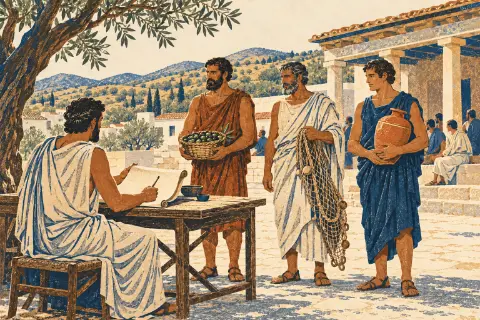
- 508/7 BCCleisthenes creates ten tribes and a Council of 500
- 487/6 BCThe nine archons are chosen by lot from 500 candidates
- 462/1 BCEphialtes strips the Areopagus of its “added” powers
- 5th c. BCPericles introduces pay for jurors
- 4th c. BCThe Constitution of the Athenians describes the system, with pay for the assembly
- 1834A royal decree founds the modern Areios Pagos as Greece’s Supreme Court
Eight words, then and now
| Ancient Greek | Greek today | Meaning |
|---|---|---|
| council (today: parliament) | ||
| assembly (today: church) | ||
| law court | ||
| juror (today: judge) | ||
| choosing by lot (today: draw) | ||
| public speaker, orator | ||
| decree (today: resolution) | ||
| presiding councillor (today: university rector) |
 How Athenian democracy worked
 Cleisthenes and the birth of democracy (508 BC)
 Ostracism: voting someone out of Athens