
A city that needed the sea
Athens had many people and not enough grain, so food had to come from far away by ship. In the 4th century BC the orator Demosthenes told the Athenians that they imported more grain (σῖτος) than any other people. He said that the Black Sea sent them as much grain as all other places together. Grain also came from Sicily and Egypt.
Ships brought many other goods too. In a speech written down by the historian Thucydides, Pericles boasts that the produce of the whole world comes into Athens. A place where goods arrived and were sold was an ἐμπόριον, a trading port. A person who bought and sold goods far from home was an ἔμπορος, a merchant. Greeks still use both words today: εμπόριο means trade, and έμπορος still means a merchant.
At first the Athenians kept their ships at Phaleron, a bay open to the wind and waves. A better place was close by: the Piraeus (Πειραιεύς).
Test yourself: 4 words from this page
1 / 4
What does this word mean?
Three harbours and two long walls
Around 493 BC the Athenian leader Themistocles began to fortify the Piraeus. Thucydides says he liked the place because it had three natural harbours. From 483 BC he also persuaded the Athenians to build a large fleet. Each harbour had its own job:
- Κάνθαρος, the largest, served mainly trade. The central port of today stands in the same place.
- Ζέα, now called Πασαλιμάνι, was probably the main base for warships. Inscriptions of the 4th century BC list 196 ship sheds here. These long roofed buildings, called νεώσοικοι, held warships that had been pulled out of the water.
- Μουνιχία, now called Μικρολίμανο, had 82 ship sheds.
In the 5th century BC the architect Hippodamus of Miletus planned the town in regular blocks. Historians disagree on the exact date. Between 461 and 457 BC the Athenians built the Long Walls, about 6 kilometres long, from the city to the port. Thanks to these walls, food could reach Athens from the sea even when an enemy army stood outside. When Athens lost its long war against Sparta in 404 BC, the walls were pulled down. Conon rebuilt them in 393 BC.
On board a merchant ship
A merchant ship (πλοῖον) moved slowly, with a best speed of about six knots, or 11 kilometres an hour. Many ships carried a cargo (φορτίον) of 100 to 150 tons. The largest carried about 400 tons. Ships sailed mainly in summer, roughly from May to October.
Merchants usually borrowed money to buy goods and then rented space on a ship. Many ship owners were foreigners, not Athenians. The interest on these loans was high, but a merchant repaid the money only if the cargo arrived safely. Storms and pirates were real dangers. Historians warn that we know rather little about these people.
At the Piraeus, merchants showed their goods in a market place called the δεῖγμα. Today δείγμα means a sample. Off Kyrenia in Cyprus, divers found a Greek trading ship from about 300 BC. It held hundreds of clay jars (ἀμφορεῖς), most of them from Rhodes, almonds still in their shells, and at least 27 millstones. Nothing shows that it was going to the Piraeus, but it shows what a real cargo looked like.
Sulla, the marble lion and a new start
In 86 BC the Roman general Sulla captured the Piraeus and burned it, and this time the walls were not rebuilt. The port shrank, but ships still used its safe water. By the Middle Ages sailors called it Porto Leone, the port of the lion, because a huge marble lion stood at the entrance. In 1687–1688 a Venetian fleet took the lion away to Venice.
In 1834 Athens became the capital of the new Greek state, and the port began to grow again. In the following years, people from islands such as Chios and Hydra settled there. Today the Port of Piraeus describes itself as the natural port of Athens and Greece's main gateway. Ferries leave from it for the islands, and container ships and cruise ships come from all over the world.
Key dates
- 493 BCThemistocles begins to fortify the Piraeus (the date is approximate).
- 483 BCThemistocles starts the shipbuilding programme that makes Athens a sea power.
- 461–457 BCThe Long Walls join Athens to its port.
- 5th c. BCHippodamus of Miletus lays out the town of the Piraeus in regular blocks.
- 404 BCAthens loses the war against Sparta, and the Long Walls are pulled down.
- 393 BCConon rebuilds the walls, and the port recovers.
- 86 BCThe Roman general Sulla captures and burns the Piraeus.
- 1834Athens becomes the capital of Greece, and the port begins to grow again.
Eight words, then and now
| Ancient Greek | Greek today | Meaning |
|---|---|---|
| merchant | ||
| trading port; today, trade | ||
| cargo | ||
| ship | ||
| sailor | ||
| harbour (returned through Turkish liman) | ||
| grain; today, wheat (from σιτάριον) | ||
| two-handled storage jar |
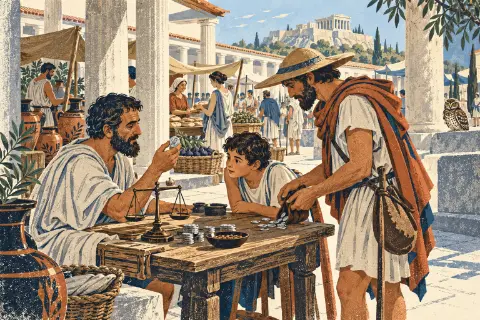 Money and coins in ancient Greece: the drachma and the owl
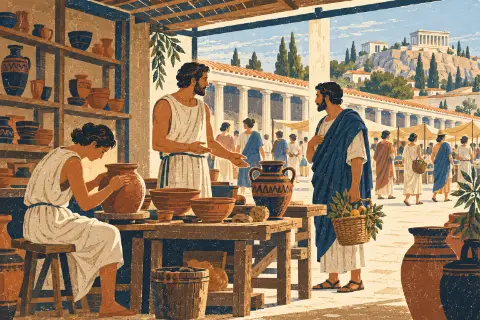 Citizens, metics and slaves in ancient Athens