
How the alliance began
After the victories of 480–479 BC the war against Persia went on at sea. In 478 the Spartan Pausanias led the Greek fleet to Byzantium, but his behaviour turned the allies against him. Thucydides (1.95–96) says that they gave the leadership, the ἡγεμονία, to Athens willingly, and that Sparta let it go, afraid that other commanders would be corrupted in the same way.
“Delian League” is a modern name. Thucydides simply speaks of the Athenians and their allies, ξύμμαχοι, the spelling he uses for σύμμαχοι. The Aristotelian Constitution of the Athenians (23.4–5) says that Aristides assessed the first payments in the archonship of Timosthenes, and that he swore the oaths to the Ionians, to have the same friends and enemies, with lumps of iron sunk in the sea to seal them. As reported there, the oath does not name Persia. Thucydides calls ravaging the Persian king's land a πρόσχημα, a declared aim or pretext, and the word leaves Athens' real intentions open.
Test yourself: 4 words from this page
1 / 4
What does this word mean?
Ships, φόρος and the treasury on Delos
Thucydides 1.96 is the key passage. Athens fixed which cities would provide ships and which money. A new Athenian office, the Ἑλληνοταμίαι, “Treasurers of the Greeks”, received the φόρος: “for this is what the bringing of the money was called” (οὕτω γὰρ ὠνομάσθη τῶν χρημάτων ἡ φορά). The first assessment came to 460 talents, though scholars debate what that total covered. The common treasury, ταμιεῖον, was on Delos, and the meetings, ξύνοδοι, were held in the sanctuary. Historians usually write “tribute”, although Thomas Martin suggests that “dues” is closer to the official language, as long as we remember that the payments were compulsory and permanent.
Thucydides (1.99) blames the allies for what followed. To avoid service abroad, most agreed to pay money instead of sending ships. The Athenian navy grew on their money, while they lost their experience of war. By the start of the Peloponnesian War only Chios and Lesbos still provided ships, and Pericles could count on an average of 600 talents a year (Thucydides 2.13).
From allies to subjects
Thucydides (1.97) says the allies were αὐτόνομοι at first. Then Naxos revolted and was forced back by siege, “the first allied city to be enslaved contrary to established practice” (1.98). He gives no year; modern estimates run from about 470 to 467 BC. Thasos revolted around 465 over its mainland markets and mine, and in the third year of the siege it gave up walls, ships and mine (1.100–101). The chief causes of revolt, ἀποστάσεις, were unpaid tribute, missing ships and refusal to serve (1.99).
After a heavy defeat in Egypt, the treasury moved to Athens. The usual date is 454/3 BC, when the inscribed lists begin, though the move may have been earlier, and Thucydides (1.96–118) never mentions it. The reason was either safety from Persia or control of the allies: Plutarch (Pericles 12) records both views. He also reports from Theophrastus that the Samians proposed the move and that Aristides called it unjust but advantageous (Aristides 25), a story hard to fit with 454 if Aristides died about 465, as Martin dates him.
Later revolts were punished harder: Samos (441–439 BC) lost walls, ships and hostages after a nine-month siege (1.117), and Mytilene (428–427) lost its land and over a thousand men (3.50). Force also reached beyond the alliance: Melos, which refused to obey Athens and stayed neutral (5.84), was besieged, and in 416 its men were killed and women and children enslaved (5.116).
The evidence: stones and speeches
Inscriptions give us what Thucydides does not. The Athenian Tribute Lists do not actually record the whole tribute, only the sixtieth, one mina per talent, given to Athena. The “first stone”, 3.8 metres high and now in 184 fragments, covers 454/3 to 440/39 BC. Thasos, for example, paid 3 talents until 448/7 and 30 from 443; whether this has anything to do with its old revolt is unclear. These sixtieths are usually thought to have helped pay for the buildings of Pericles, and Plutarch's critics complain that allied money was “gilding” the city. Decrees show tighter control: Kleinias' decree (425/4 BC or a little later) orders sealed tablets for every payment, and another imposed Athenian coins, weights and measures, although its date is uncertain. In 413, says Thucydides (7.28), Athens imposed a 5% tax on sea trade instead of tribute.
Thucydides' Athenians are frank about it. Their motives were “fear, then honour, later advantage” (1.75), and his Pericles tells them that they hold their rule, ἀρχή, “like a tyranny” (2.63). When Athens surrendered in 404, Sparta left it twelve ships (Xenophon, Hellenica 2.2.20), and the alliance did not survive.
Key dates
- 478/7 BCThe allies give Athens the leadership; Aristides assesses the first φόρος
- c. 470–467 BCNaxos revolts and is forced back by siege (approximate date)
- c. 465 BCThasos revolts; it surrenders in the third year of the siege
- 454/3 BCThe treasury is in Athens; the first list of Athena's sixtieth is inscribed
- 441–439 BCSamos revolts and surrenders after a nine-month siege
- 428–427 BCMytilene's revolt on Lesbos is crushed
- 416 BCAthens takes Melos and kills its men
- 404 BCAthens surrenders to Sparta and the alliance ends
Eight words, then and now
| Ancient Greek | Greek today | Meaning |
|---|---|---|
| tribute (today: tax) | ||
| alliance | ||
| treasury (today: also cash desk) | ||
| treasurer (today: also cashier) | ||
| assembly (today: synod, summit) | ||
| leadership, hegemony | ||
| revolt (today: distance) | ||
| rule, empire (today: beginning, authority) |
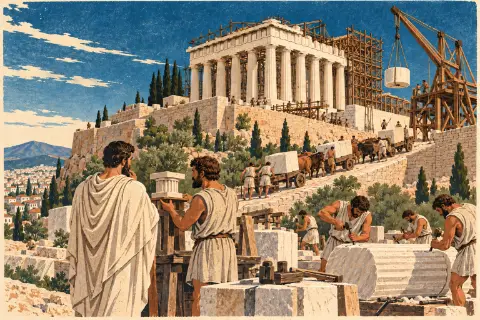 The age of Pericles: Athens in its golden age
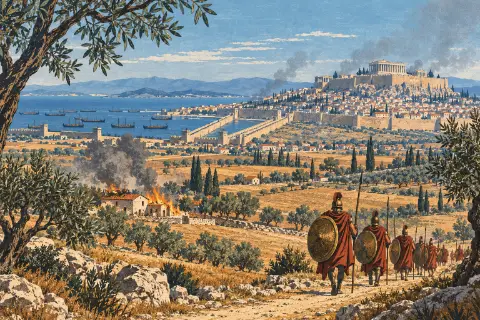 The Peloponnesian War (431–404 BC)