
A ship with three rows of oars
The word τριήρης means a ship with three rows of oars. A trireme had these three rows on each side, one above the other. The top rowers were the θρανῖται. Below them sat the zygians, and at the bottom sat the thalamians.
A crew had about 200 people, and about 170 of them were rowers. The others were officers, sailors, 10 soldiers and 4 archers. A flute player gave the rhythm, so that all the oars moved together.
The man in charge was the τριήραρχος, the trierarch. In Athens he was a rich citizen. He had to equip the ship and look after it, and he could command it in war. For the rowers there was also the κελευστής, an officer who gave them their orders. Greek still uses this word: today a κελευστής is a petty officer in the navy, about the same rank as a sergeant in the army.
Test yourself: 4 words from this page
1 / 4
What does this word mean?
Who rowed, and how they lived
Who were the rowers? Our sources do not give one answer. A Greek Ministry of Culture page says they were probably all free Athenian citizens. In Thucydides (1.143), Pericles speaks of citizens, metics (foreigners who lived in Athens) and foreign sailors. Thucydides also mentions slaves with the Athenian fleet in Sicily (7.13).
Rowing was paid work. For the great fleet sent to Sicily in 415 BC, Athens paid each sailor one drachma a day, and the captains gave extra money to the top rowers (6.31).
Rowers carried their own things. Thucydides (2.93) tells of Peloponnesian sailors who had to walk to the sea with an oar, a cushion and a leather oar loop each.
His most exciting story is from 427 BC. Athens voted to kill the men of Mytilene, on Lesbos, and then changed its mind. A second trireme raced after the first. The crew ate barley mixed with wine and oil while they rowed, and they slept in turns. They arrived just in time (3.49).
The ram, and how the trireme began
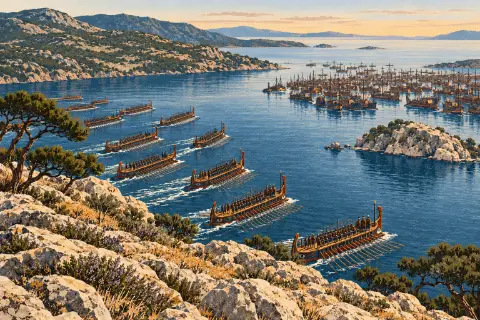
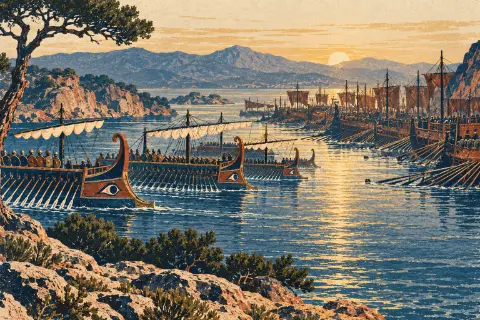
The front of a ship was the πρῷρα, and the back was the πρύμνη. At the front, the trireme carried its weapon, the ram or ἔμβολον: a sharp wooden point covered with bronze. The crew rowed fast and hit the side of an enemy ship, to sink it. The trireme also had sails, but in battle the oars mattered most. Xenophon (Anabasis 6.4.2) says that a trireme could row from Byzantium to Heraclea in one long day.
Who invented it? Thucydides (1.13) reports that Corinth was said to be the first place in Greece to build triremes. He also says that Ameinocles, a Corinthian shipbuilder or ναυπηγός, made four ships for Samos, about 300 years before the end of the Peloponnesian War. That is about 700 BC. Historians still disagree: some date the first triremes later, and some think that the Phoenicians were first.
In 483/482 BC, the Athenians found a rich vein of silver at Lavrion. Themistocles persuaded them to spend the money on ships. By 480 BC Athens had 200 ships, the largest navy in Greece, just in time for the Battle of Salamis.
Building a trireme again
For a long time, scholars argued about the trireme. Many doubted that a ship with oars on three levels could really work. In 1982 the historian John Morrison, the naval architect John Coates and Frank Welsh set up the Trireme Trust to test the idea. They used ancient texts and pictures, such as the carved Lenormant relief.
The Hellenic Navy decided to build the ship. Greek carpenters worked at a shipyard in Keratsini, near Piraeus, from 1985 to 1987. The ship is 36.9 metres long and 5.5 metres wide. In August 1987 she was named Ολυμπιάς.
Between 1987 and 1994, volunteers rowed her in six sea trials, with 170 oars on three levels. The trials showed that she could be rowed well and fast. In 1993 she also visited the River Thames in England.
Her sea trials are over. In 2017 the Trireme Trust said that she was no longer strong enough for experiments. A Greek news report says that in 1997 the Navy decided to use her only as an exhibit. Even so, she carried the Olympic Flame in 2004, and the Navy’s museum says that she still joins celebrations and makes trips with visitors. The Navy still looks after her.
Key dates
- c. 700 BCBy Thucydides’ count, the Corinthian shipbuilder Ameinocles makes four ships for Samos.
- 483/482 BCSilver is found at Lavrion, and Themistocles wants it spent on ships.
- 480 BCGreek triremes fight the Persian fleet at Salamis.
- 427 BCA second Athenian trireme reaches Mytilene just in time.
- 1987The Hellenic Navy’s new trireme is named Olympias.
- 1993Olympias visits the River Thames in England.
- 2004Olympias carries the Olympic Flame to the port of Piraeus.
Eight words, then and now
| Ancient Greek | Greek today | Meaning |
|---|---|---|
| ancient three-level warship | ||
| captain of a trireme | ||
| oar; κουπί is its diminutive | ||
| ship’s ram; today also piston | ||
| front of a ship | ||
| back of a ship | ||
| sailor | ||
| rowers’ officer; today navy rank |
 The Battle of Salamis: the sea battle that saved Greece
 The Persian Wars (490–479 BC)