
From defeat to the rule of the Thirty
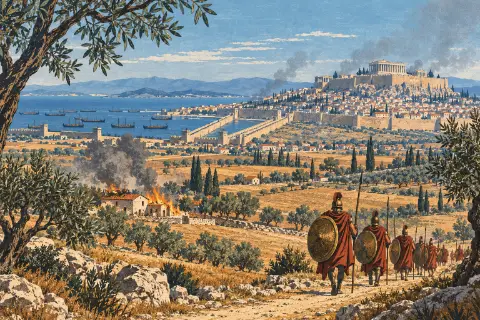
Athens lost the Peloponnesian War in 404 BC. Once the Long Walls and the walls of Piraeus had been pulled down, the people voted to choose thirty men to turn the ancestral laws into a constitution (Xenophon, Hellenica 2.3.2, 2.3.11); the Athenaion Politeia (34.3) says Lysander's support for the oligarchs forced that vote. The constitution never appeared. The Thirty appointed a Council and officials of their own choosing, added Ten to control Piraeus and Eleven to run the prison (Athenaion Politeia 35.1), and through Lysander obtained a Spartan garrison, a φρουρά, under the governor Callibius.
Many citizens were pleased at first, because the new rulers brought down the συκοφάνται, men who lived by informing and malicious accusation (Xenophon 2.3.12; Ath. Pol. 35.3). The main sources call the rulers simply οἱ τριάκοντα. Xenophon makes Critias compare their rule to a τυραννίς (2.3.16), but the name Thirty Tyrants, already used by Polycrates in the 4th century BC (Aristotle, Rhetoric 1401a), seems to have become standard only later, through writers such as Diodorus and Justin.
Test yourself: 4 words from this page
1 / 4
What does this word mean?
Terror, the Three Thousand and Theramenes
The killings soon turned on the wealthy and the well-born, partly to seize their property. The Athenaion Politeia counts not fewer than 1,500 dead (35.4). A speaker in Xenophon claims that the Thirty killed almost more Athenians in eight months than the Peloponnesians had in ten years of war (2.4.21), which is rhetoric, not a count. Lysias says his brother Polemarchus received their usual order to drink κώνειον, hemlock, without a trial (12.17). Plato's Socrates says that he was ordered, with four others, to fetch Leon of Salamis for execution, and that he simply went home (Apology 32c–d).
To widen their support the Thirty enrolled three thousand citizens. Anyone off that list could be put to death by the Thirty alone. Theramenes, one of their own number, objected, so Critias struck his name off and condemned him (Xenophon 2.3.51). The accounts differ on the order of events. Xenophon puts the garrison early and Theramenes' death before the seizure of Phyle. The Athenaion Politeia (37) puts Phyle first, then the death, then about 700 Spartan troops.
Phyle, Munichia and the fall of the Thirty
In winter Thrasybulus set out from Thebes with about seventy men and seized the fort of Phyle (Xenophon 2.4.2; Ath. Pol. 37.1). His force grew to about 700 and then about 1,000 (2.4.5, 2.4.10), and it moved by night to Piraeus. At the battle of Munichia, Critias fell, with Hippomachus, another of the Thirty, and Charmides, one of the Ten of Piraeus (2.4.19).
The men in the city now deposed the Thirty and elected ten others, while the survivors of the Thirty withdrew to Eleusis (2.4.23–24). The war did not end there. The oligarchs appealed to Sparta and Lysander moved against Piraeus, but King Pausanias, a rival of his policy, led an army to Attica himself and steered both sides towards peace, with mediators sent from Sparta: fifteen in Xenophon (2.4.38), ten in the Athenaion Politeia (38.4).
An oath not to remember wrongs
The core clause survives in the Athenaion Politeia (39.6): «τῶν δὲ παρεληλυθότων μηδενὶ πρὸς μηδένα μνησικακεῖν ἐξεῖναι», no one may hold the past against anyone. The Thirty, the Ten, the Eleven and the former governors of Piraeus were excluded, unless they gave εὐθύναι, an account of their office. Those who wished could move to Eleusis, which stayed separate until about 401 BC (40.4). Xenophon reports the ὅρκοι not to bear grudges only at that later reconciliation (2.4.43), though in 403 his Thrasybulus already holds the men of the city to what they had sworn (2.4.42); the Athenaion Politeia puts the terms in 403.
How far it held is debated. The Athenaion Politeia says Archinus had one offender executed without trial, and that no one broke the terms again (40.2). Yet Lysias prosecuted Eratosthenes, one of the Thirty, and Aeschines later claimed that Socrates died for having taught Critias (1.173). Scholars disagree on the phrase itself: Carawan reads μὴ μνησικακεῖν as finality in legal claims, while Joyce defends the traditional reading as an amnesty.
The word itself is missing. In these passages Xenophon and the Athenaion Politeia use μνησικακεῖν, not ἀμνηστία. LSJ first records ἀμνηστία as amnesty in a Milesian inscription of the 2nd century BC. In 44 BC Cicero recalled Athens' example and said he had used its Greek word (Philippics 1.1).
Key dates
- 404 BCAthens surrenders; the walls come down and the Thirty are chosen.
- 404/403 BCThe Three Thousand are enrolled; Theramenes is executed; Thrasybulus seizes Phyle in winter.
- 403 BCCritias falls at Munichia; the Thirty are deposed and Ten elected.
- 403 BCWith Pausanias of Sparta, the two sides make peace and democracy returns.
- 401/400 BCEleusis is reunited with Athens; its generals are killed at a meeting.
- 399 BCSocrates is tried and executed; Aeschines later links this to Critias.
Eight words, then and now
| Ancient Greek | Greek today | Meaning |
|---|---|---|
| thirty | ||
| tyrant, harsh ruler | ||
| rule by a few | ||
| informer; today, slanderer | ||
| hemlock | ||
| oath | ||
| bear a grudge | ||
| amnesty; first, forgetfulness |
 The Peloponnesian War (431–404 BC)
 How Athenian democracy worked