
One, few or many: the ways to rule a Greek city
Ancient Greece was not one country. Each city-state had its own form of government, its πολίτευμα, and it could change over time. The Greeks had clear words for the choices:
- Monarchy (μοναρχία): one person rules, from μόνος “alone” and ἀρχή “rule”. A king was a βασιλεύς.
- Aristocracy (ἀριστοκρατία): “the best”, οἱ ἄριστοι, hold power, κράτος. In practice these were noble families.
- Oligarchy (ὀλιγαρχία): a few, ὀλίγοι, rule, and they were usually rich.
- Tyranny (τυραννίς): one man takes power outside the law.
- Democracy (δημοκρατία): the people, the δῆμος, hold power.
In the 4th century BC Aristotle put these in pairs (Politics 3, 1279a–b). A good government works for the whole community, a bad one for its own rulers. Kingship goes bad as tyranny, aristocracy as oligarchy, and what he calls “constitutional government” as democracy, which he describes as rule in the interest of the poor. Readers today are often surprised to find democracy on his bad list.
Test yourself: 4 words from this page
1 / 4
What does this word mean?
What a tyrant really was
To us a tyrant is a cruel ruler. In early Greek use the word described how a man got power, not how he used it: a τύραννος ruled without a legal right. The Liddell–Scott lexicon calls the word a loan, probably Lydian or Phrygian; its exact origin is unknown. Some were harsh. Herodotus (5.92) says that Periander of Corinth asked Thrasybulus of Miletus for advice, and that Thrasybulus just walked through a field cutting the tallest ears of corn. Periander understood: get rid of the leading citizens.
The best-known case is Peisistratus of Athens. Herodotus (1.59) says he wounded himself and his mules, drove into the agora and claimed enemies had attacked him. Despite Solon's warning, the Athenians voted him a guard, armed with clubs. With it he seized the Acropolis, about 560 BC. Yet, Herodotus adds, he kept the existing officials and laws. The Constitution of the Athenians (16), by Aristotle or a pupil, says he lent money to poor farmers, and that people called his rule the golden age of Cronus. Driven out twice, he held power for only 19 of his last 33 years (ch. 17; the Politics says 17).
Few tyrannies lasted. Aristotle (Politics 5, 1315b) gives 100 years for the longest, at Sicyon, 73½ for Corinth, and says most were short. At Athens the tyranny ended in 510 BC, when the Spartan king Cleomenes, with Athenian help, drove out Peisistratus' son Hippias.
Aristocrats and oligarchs: rule by the few
Many cities were run by a small group. In early Athens the top offices went “by birth and wealth” (Constitution of the Athenians 3.1). In Corinth, Herodotus says, an oligarchy of the Bacchiad clan ran the city and married only among themselves, until Cypselus, traditionally about 657 BC, overthrew them and became tyrant.
Was that aristocracy or oligarchy? The line is not sharp. For Aristotle aristocracy serves the common good and oligarchy serves the rich, and the real difference between oligarchy and democracy is wealth and poverty. Labels could be argued over: he reports that some called Sparta a democracy, because of its shared upbringing and common meals, and others an oligarchy, because officials were elected and not picked by lot (Politics 4, 1294b). Evidence for most Greek oligarchies is sparse, so much remains uncertain.
Even democratic Athens fell to oligarchy twice. In 411 BC the Four Hundred took power from the assembly. In 404 BC, after the defeat by Sparta, a Spartan-backed group of thirty ruled. They killed at least 1,500 people, according to the Constitution of the Athenians (35.4). Exiles led by another Thrasybulus, an Athenian, fought back, and democracy returned in 403 BC. These men were an oligarchy, yet they are remembered as the “Thirty Tyrants”: by then τύραννος had become an insult.
The same words in Greek today
These words are all still in the Triantafyllidis dictionary of Modern Greek, which shows how they have moved. Πολίτευμα is the normal word for a country's form of government, with the example «Το πολίτευμα της Ελλάδας είναι η κοινοβουλευτική δημοκρατία». The state itself is the Ελληνική Δημοκρατία. Μοναρχία now belongs to Greek history: in the referendum of December 1974, about 69% of voters rejected the monarchy.
Other words have drifted. A τύραννος can now be anyone who bullies others, as in «είναι ένας τύραννος μέσα στο σπίτι», and the word hides in τυραννόσαυρος, the dinosaur. Ολιγαρχία also means a small group holding much of a country's wealth, the οικονομική ολιγαρχία. Αριστοκρατία is also a social class, and in joking speech a stuck-up person is «βαριά αριστοκρατία». The building blocks survive too: ἄριστος gives άριστα, the top mark at school, and ὀλίγος became λίγος, “few, little”.
The biggest surprise is δορυφόρος. It was a tyrant's armed guard, and Herodotus takes care to say that Peisistratus' men were not δορυφόροι but club-bearers. Today it means a satellite, a modern sense modelled on French and English satellite.
Key dates
- c. 657 BCTraditional date: Cypselus overthrows the Bacchiads and becomes tyrant of Corinth
- c. 560 BCPeisistratus seizes the Acropolis of Athens
- 546 BCAfter exile, Peisistratus returns with an army and takes power for good
- 527 BCPeisistratus dies; his sons inherit the tyranny
- 510 BCHippias is driven out of Athens
- 411 BCThe oligarchy of the Four Hundred at Athens
- 404–403 BCThe rule of the Thirty at Athens, then democracy is restored
- 1974A Greek referendum rejects the monarchy
Eight words, then and now
| Ancient Greek | Greek today | Meaning |
|---|---|---|
| ruler who seized power | ||
| rule of the few | ||
| rule of the best | ||
| rule of one person | ||
| rule of the people | ||
| king | ||
| armed guard; now a satellite | ||
| form of government |
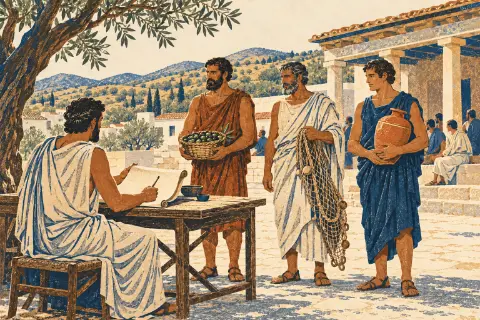 Cleisthenes and the birth of democracy (508 BC)
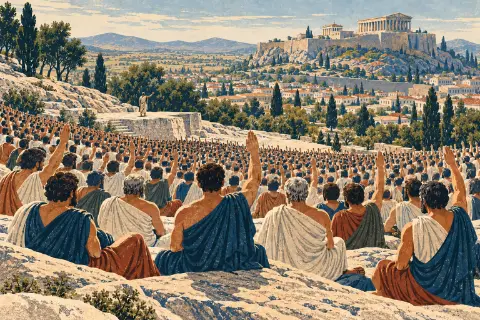 How Athenian democracy worked
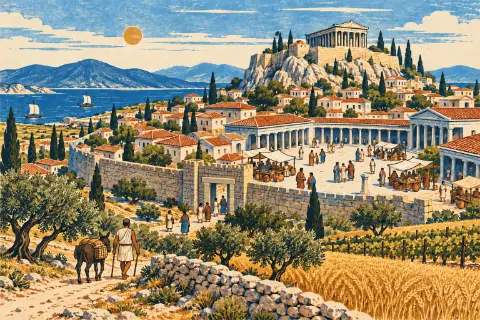 The Greek polis: what was a city-state?