
Four schools, four places
Between the 4th and the 3rd century BC, Athens became the city of philosophy. Young men came from all over the Greek world to listen to famous teachers. Four of these teachers started schools that lasted for centuries.
A school then was not a building with desks and a bell. It was a group of people, a teacher and his pupils, who met in the same place to talk, read and ask questions. So each school was named after the place where it met:
- the Ἀκαδημία, a park with a gymnasium, where Plato taught;
- the Λύκειον, another gymnasium, where Aristotle taught;
- the Στοά, a covered hall with painted walls in the agora, where Zeno taught;
- the Κῆπος, a garden, where Epicurus lived with his friends.
The names of these places are still Greek words today, and some of them have travelled into many other languages.
Test yourself: 4 words from this page
1 / 4
What does this word mean?
Plato’s Academy
The Academy was a shady park about 1.5 kilometres north-west of the city centre. It had a gymnasium, running tracks, altars and olive trees. Its name came from a local hero, Ἑκάδημος or Akademos. Plato began to teach there around 387 BC, and he also owned a small garden in the area. The date is approximate: no ancient text records the exact year.
Plato taught by asking questions and by discussion, the way his own teacher Socrates had done. Mathematics mattered a great deal in the school. A famous story says that the words “Let no one who does not know geometry enter” were written over the door, but this story appears only about 750 years after Plato, and most historians think it is invented.
Aristotle came to the Academy at about 17 and stayed for some twenty years, until Plato died in 347 BC. How long the school itself lasted is debated. It is often said that it ran from Plato until the emperor Justinian closed it in 529 AD, but historians point out that Plato’s school seems to have stopped around 86 BC, when the Roman general Sulla besieged Athens, and that the later Platonists of Athens were a new school.
Aristotle’s Lyceum: philosophers on a walk
The Lyceum was a gymnasium east of the city walls, between the rivers Ilissos and Eridanos. It took its name from a sanctuary of Ἀπόλλων Λύκειος, Apollo Lykeios. Athenians trained and met there long before Aristotle.
In 335 BC Aristotle came back to Athens and set up his school in the Lyceum. According to Diogenes Laertius, he taught while walking up and down the περίπατος, a covered walk, with his pupils. His followers were later called the Peripatetics, the περιπατητικοί. Scholars are not sure whether the name comes from the walkway itself or from the habit of teaching on foot.
The Lyceum was a place of research. Its members studied plants, animals, the weather, medicine, politics and the history of philosophy, and they collected many books. After Aristotle, his colleague Theophrastus led the school. In 86 BC Sulla’s army destroyed much of the Lyceum.
In 1996, during building work in central Athens, ancient walls were found near Rigillis Street. The excavator identified them as a palaestra of the Lyceum. The site opened to visitors in 2014, but it has not yet been fully published.
Zeno’s Stoa and Epicurus’ Garden
Around 300 BC, Zeno of Kition, a merchant from Cyprus, began to teach in the agora, inside the Ποικίλη Στοά, the Painted Stoa. It was named after its wall paintings by Polygnotus. His listeners were called Στωικοί, the people of the Stoa. The Stoics taught that ἀρετή, virtue, is the only true good, and that a wise person lives in agreement with nature and stays calm whatever happens. Later leaders such as Cleanthes and Chrysippus made the school famous, and Romans like Seneca read it centuries later.
Epicurus came back to Athens in 307/306 BC and bought a house with a garden, the Κῆπος. His friends lived there with him and ate simply. For Epicurus the goal of life was ἡδονή, pleasure, but he did not mean parties. In his letter to Menoeceus he explains that pleasure means “no pain in the body and no trouble in the soul”. That peace of mind he called ἀταραξία. Friendship mattered most of all, and he also wrote letters to women friends such as Leontion and Themista.
The two schools were rivals, but both asked the same question: how can a person live a happy life?
Key dates
- c. 387 BCPlato begins to teach in the Academy, a park and gymnasium outside Athens.
- c. 367 BCAristotle, about 17 years old, comes to study at the Academy.
- 335 BCAristotle sets up his school in the Lyceum.
- 307/306 BCEpicurus returns to Athens and buys the house and Garden where his school meets.
- c. 300 BCZeno of Kition begins to teach in the Painted Stoa in the agora.
- 86 BCSulla’s army besieges Athens; much of the Lyceum is destroyed and trees in the Academy are cut down.
- 529 ADA law of Justinian acts against pagan teachers; the Platonist Damascius later leaves Athens.
- 1996Remains identified as part of the Lyceum are found near Rigillis Street in Athens.
Eight words, then and now
| Ancient Greek | Greek today | Meaning |
|---|---|---|
| Aristotle’s school (now: upper secondary) | ||
| Plato’s school; academy | ||
| covered walk (now: a stroll) | ||
| Stoic; calm in hardship | ||
| garden | ||
| virtue | ||
| pleasure | ||
| peace of mind |
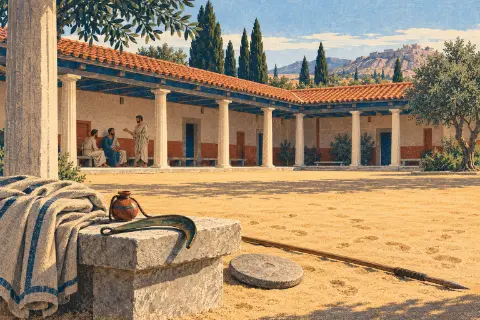 The gymnasium and palaestra in ancient Greece
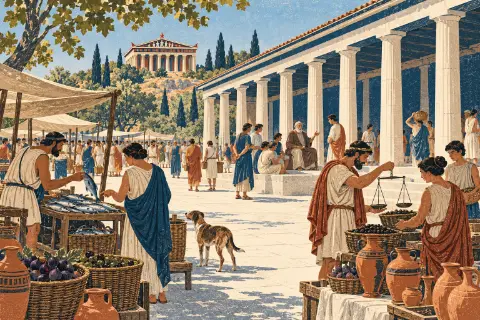 The Agora of Athens
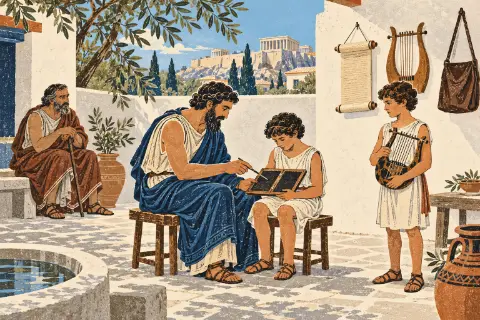 School and education in ancient Greece