
An island that would not join
Melos (Μῆλος, today Μήλος) was one of two Cycladic islands outside the Athenian alliance when the Peloponnesian War began: Thucydides lists “all the Cyclades except Melos and Thera” (2.9.4). He calls the Melians colonists of Sparta who at first stayed neutral, until Athenian ravaging of their land pushed them into open war (5.84.2). In 426 BC Nicias raided the island with sixty ships and failed to win it over (3.91). An Athenian tribute assessment of 425/4 BC (IG I³ 71) still lists Melos, at 15 talents.
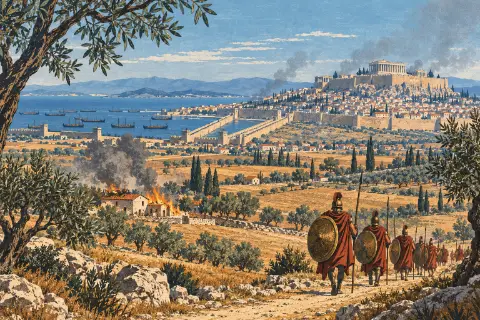
In summer 416 BC the Athenians returned with 38 ships, about 1,500 allied hoplites and over 300 archers. For the Athenian hoplites, the Greek edition on Perseus reads 1,200, while Crawley’s translation has 1,600, so check your own edition. Before doing any damage, the generals Cleomedes and Tisias sent envoys. The Melians kept them away from the people, τὸ πλῆθος, and let them speak only to “the officials and the few” (5.84.3). The Athenians comment on this at once (5.85) and propose answering point by point instead of giving one long speech. That is why the text reads as a dialogue.
Test yourself: 4 words from this page
1 / 4
What does this word mean?
Justice, interest and hope
The Athenians refuse “fine names” (μετ’ ὀνομάτων καλῶν): no talk of defeating the Persians, no talk of wrongs. Then comes the famous sentence (5.89): δίκαια μὲν ἐν τῷ ἀνθρωπείῳ λόγῳ ἀπὸ τῆς ἴσης ἀνάγκης κρίνεται, δυνατὰ δὲ οἱ προύχοντες πράσσουσι καὶ οἱ ἀσθενεῖς ξυγχωροῦσιν. Crawley’s English, “the strong do what they can and the weak suffer what they must”, is memorable but free: ξυγχωροῦσιν means that they yield or concede.
The Melians accept the ground of interest, τὸ ξυμφέρον, and argue that a shared standard of fairness protects anyone in danger, Athens too if it ever falls (5.90). They ask to be friends, but allies of neither side (5.94). The Athenians answer that friendship with Melos would look like weakness and hatred like power (5.95). They call hope, ἐλπίς, a comfort in danger that ruins those who stake everything on it (5.103). The Melians trust the gods and Sparta (5.104). The Athenians reply that gods and men rule wherever they can, a law they did not make (5.105). Finally they offer alliance, tribute and safety (5.111). The Melians answer that they will not give up in a moment the freedom of a city seven hundred years old (5.112).
The siege and how Greeks remembered it
The Athenians walled the city in. The Melians twice took part of the wall (5.115, 5.116), and Thucydides reports no Spartan help. After reinforcements under Philocrates and some treachery inside, they surrendered in the winter of 416/5 BC. The Athenians killed all the grown men they captured, enslaved the women and children, and later sent 500 colonists (5.116). Thucydides adds no comment, and his next sentence turns to Athens’ plan to conquer Sicily (6.1).
Later Greeks did not forget. In 405 BC, after the defeat at Aegospotami, Athenians feared suffering what they had done to the Melians (Xenophon, Hellenica 2.2.3), and Lysander gave the island back to as many Melians as he could gather (2.2.9), so some had survived. Isocrates had to defend Athens against the charge (Panegyricus 100). Plutarch (Alcibiades 16) and the speech Against Alcibiades ([Andocides] 4.22) blame Alcibiades for supporting the decision; Thucydides does not mention this. Aristophanes’ Birds (186) has the phrase λιμῷ Μηλίῳ, “by Melian hunger”, usually taken as an allusion to the siege, though some scholars question the link.
Did it happen, and whose view is it?
Thucydides says that his speeches keep to the general sense of what was said (1.22). He was in exile for twenty years after Amphipolis (5.26.5), and he does not tell us how he learned of a closed meeting. Dionysius of Halicarnassus (On Thucydides 37–41) found it inconceivable that Athenians spoke like this, and George Grote also treated the dialogue as a composition. Brian Bosworth (1993) argues that something like a dialogue took place, its gist passed on by the Athenian side, and that Thucydides shaped it. For him the text is less about the morality of empire than about the choice facing a small state.
Modern international relations often quotes 5.89 as the founding line of Realism, including on Russia’s invasion of Ukraine. Neville Morley (2026) calls it “a giant interpretative leap” to assume that Thucydides endorsed the Athenian thesis, since the dialogue has two sides and leaves the judgement to the reader. The idea itself was also argued in other forms: in Plato’s Republic (338c) Thrasymachus defines justice as τὸ τοῦ κρείττονος συμφέρον, the advantage of the stronger. That is a different claim from 5.89, and exam answers should keep them apart.
Key dates
- 426 BCNicias raids Melos with sixty ships; the island does not come over.
- 425/4 BCAn Athenian tribute assessment lists Melos at 15 talents.
- 416 BCThe Athenian force lands; the envoys meet the Melian officials.
- 416/5 BCMelos surrenders: the men are killed, the women and children enslaved.
- 405 BCLysander returns the island to the Melians he can gather.
- 1820The statue now in the Louvre as the Venus de Milo is found on Melos.
Eight words, then and now
| Ancient Greek | Greek today | Meaning |
|---|---|---|
| justice, right; law | ||
| strength; legal force | ||
| power, military force | ||
| interest, advantage | ||
| hope | ||
| slavery (δουλειά: job) | ||
| safety; today also insurance | ||
| the island of Melos (Milos) |
 The Peloponnesian War (431–404 BC)