
The occasion, and whose words these are
Thucydides introduces the speech with a description of the ceremony (2.34). Following an ancestral custom, the πάτριος νόμος, the bones of the fallen lay in a tent for three days. Then wagons carried ten cypress coffins, one for each tribe, and one empty, decked bier for the missing. Citizens and foreigners could join the procession, and the women of the families lamented at the grave. The dead were laid in the public cemetery, the δημόσιον σῆμα, in «the most beautiful suburb of the city», outside the walls on the road towards the Academy; only the men of Marathon had been buried where they fell. A speaker chosen by the city then gave the praise, the ἔπαινος. For these first dead of the war the choice fell on Pericles, who spoke from a high platform so that the crowd could hear.
The words, however, are Thucydides'. In 1.22 he explains that he could not remember speeches exactly, so he made each speaker say what the situation demanded, while keeping as close as possible to the general sense, the ξύμπασα γνώμη, of what was really said. How close the Epitaphios stays to Pericles is debated. Plutarch (Pericles 8.6) quotes a different funeral speech Pericles gave after the Samian War, which shows the genre was his, but not this wording.
Test yourself: 4 words from this page
1 / 4
What does this word mean?
Structure: from the ancestors to the constitution
Pericles opens (2.35) with the difficulty of speaking well about brave men: listeners who knew them find the praise too weak, others suspect exaggeration out of envy. He then honours the ancestors and the fathers who won the empire in a few lines (2.36), and turns to what interests him more: the way of life and the form of government that made Athens great.
- 2.37: the constitution «is called δημοκρατία» because it is run for the many, not the few. In private disputes all are equal before the law; in public life a man is preferred for his merit, and poverty does not keep him out. Citizens obey the officials, the laws, and the unwritten laws, the ἄγραφοι νόμοι.
- 2.38: festivals and sacrifices all year round, and goods from every land.
- 2.39: an open city, without the Spartan expulsions of foreigners, and courage that comes from character rather than from harsh training.
The praise of the dead themselves only comes later. The speech is first of all a portrait of the city they died for.
φιλοκαλοῦμεν: the core passage (2.40–41)
Chapter 40 opens with the most quoted sentence of the speech: «φιλοκαλοῦμέν τε γὰρ μετ᾽ εὐτελείας καὶ φιλοσοφοῦμεν ἄνευ μαλακίας», «we love beauty with economy and we love wisdom without softness». Wealth is for use, not for boasting, and the shame is not in admitting poverty but in doing nothing to escape it.
Then comes the famous claim about public life. The same men look after their household and the city, and even those busy with their work know politics well enough, «for we alone regard the man who takes no part in these things not as quiet, ἀπράγμων, but as useless, ἀχρεῖος». Note the word: the Greek text does not call him an ἰδιώτης, although this is often said today. Debate, Pericles adds, is not an obstacle to action but its necessary preparation.
In 2.41 he sums up: the whole city is «the school of Greece», τῆς Ἑλλάδος παίδευσις. Athens needs no Homer to praise it, because it has left everywhere lasting memorials, μνημεῖα, of harm and of good. Readers should remember that this is a war speech: the same chapter boasts that subjects cannot complain of being ruled by unworthy masters.
Consolation, the women, and the plague
Only now does Pericles praise the dead (2.42–43). Their ἀρετή in battle wiped out any private faults, since they helped the community more than they had harmed it as individuals. He asks the living to look at the city's power every day and to become its lovers, ἐρασταί. Freedom, ἐλευθερία, is the condition of happiness, and courage the condition of freedom.
The consolation that follows (2.44–46) is strikingly cool. Parents still young enough should have more children; the old should count their good years as gain. Sons and brothers will hardly be judged equal to the dead, because the living are envied. To the widows Pericles gives a single sentence (2.45): their greatest glory is to be least talked about among men, in praise or in blame. Modern readers often quote this line to show who was outside the «school of Greece». The city, he ends, will raise the orphans at public expense until they come of age.
Thucydides then places the plague immediately after the speech: «such was the funeral» of that winter, and a few days after the Spartans invaded in summer 430 BC, the disease broke out (2.47). Pericles himself died in 429 BC. The contrast between the ideal city and its suffering is part of the historian's design.
Key dates
- 440–439 BCSamian War; Pericles gives an earlier funeral speech (Plutarch, Pericles 8.6)
- 431 BCThe Peloponnesian War begins between Athens and Sparta
- 431/430 BCWinter: state funeral for the first dead; Pericles delivers the Epitaphios (Thuc. 2.34–46)
- 430 BCSummer: the plague breaks out in Athens (Thuc. 2.47–54)
- 429 BCPericles dies, two and a half years into the war (Thuc. 2.65)
Eight words, then and now
| Ancient Greek | Greek today | Meaning |
|---|---|---|
| funeral oration (also Good Friday's bier) | ||
| private individual | ||
| useless (today: vile, wicked) | ||
| lover of beauty | ||
| democracy | ||
| freedom | ||
| education, schooling | ||
| excellence, virtue |
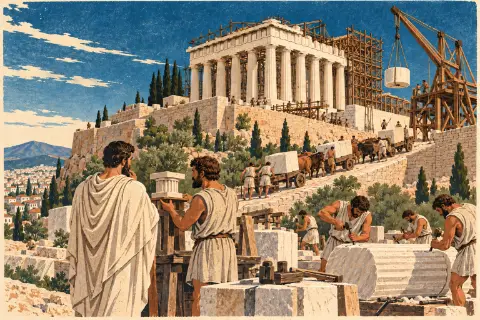 The age of Pericles: Athens in its golden age
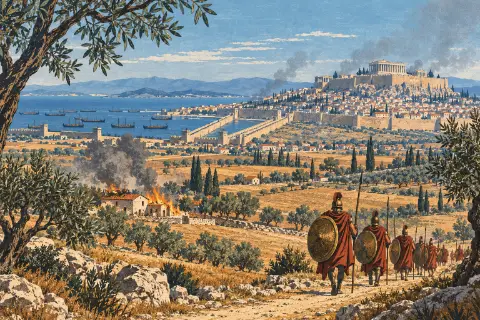 The Peloponnesian War (431–404 BC)
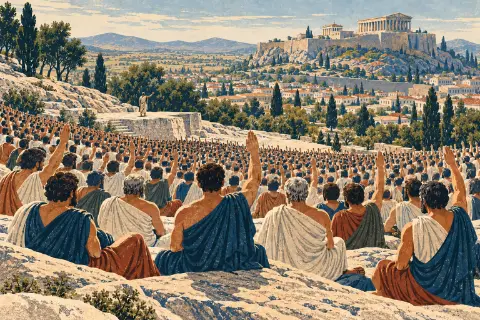 How Athenian democracy worked