
A wedding in Athens, step by step
Most of what we know about Greek weddings comes from Athens in the 5th and 4th centuries BC, and from the pictures on Athenian vases. A wedding, the γάμος, lasted about three days. Athenians preferred winter, and many weddings took place in the month of Γαμηλιών, which was sacred to Hera, the goddess of marriage.
Before the wedding, a girl often gave her toys, a lock of hair or other personal things to the gods, because she was leaving childhood behind. Then came the bath, the λουτρόν. The water came from a special spring and was carried in a tall vase, the λουτροφόρος, which means “bath carrier”.
Next came a feast at one of the two houses, with songs and dances. After sunset, the bride’s father gave her to the groom, and this was probably when she drew back her veil. A procession with torches took her to her new home, where she became part of the family at the hearth. At first light the next day, family and friends woke the couple, and the wedding gifts, the ἐπαύλια, were brought.
Test yourself: 4 words from this page
1 / 4
What does this word mean?
The pledge and the dowry
For students of law and history, the key word is ἐγγύη, the pledge. It was a spoken agreement between the future husband and the woman’s father or guardian, her κύριος. The bride was normally not present, and the law did not require her consent. A law quoted in a speech from the Demosthenes collection (46.18) says that children are legitimate when their mother was pledged by her father, by a brother with the same father, or by her father’s father.
Legitimate birth mattered because of citizenship. On a proposal by Pericles, dated to 451/0 BC, only a child of two citizen parents could share in the city (Constitution of the Athenians 26).
The dowry, the προίξ, went with the bride, and only in exceptional cases did a girl marry without one. If the marriage ended, it normally had to go back: a law quoted in another speech (59.52) says that a man who sends his wife away must return the dowry or pay interest on it. Demosthenes gives real sums (27.4–5). His dying father planned to marry his widow to one guardian with 80 minae, and Demosthenes’ five-year-old sister to another with two talents.
How old were they? What the sources say
Ancient writers give different ages, and they offer advice or single cases, not statistics. Hesiod (Works and Days 695–698) tells a man to marry at about thirty, and a woman in the fifth year after puberty. Aristotle (Politics 7, 1335a) recommends about eighteen for women and thirty-seven for men. In Xenophon’s Oeconomicus (7.5), a rich Athenian says that his wife was “not yet fifteen” when she came to his house. A modern overview from the Foundation of the Hellenic World adds that men could marry from eighteen and often did so after their military service, which ended at twenty. These sources agree that brides were young and that many grooms were older, but we cannot calculate an average.
Most of the detail on this page comes from Athens, and other cities could be very different. Plutarch (Lycurgus 15), writing centuries later, says that Spartans married by carrying off the bride, who was not a small girl but fully grown. A woman called the νυμφεύτρια cut her hair short and dressed her in a man’s cloak and sandals, and the groom then visited her in secret. This is a late account, so it should be read with care.
How we know, and what the words became
The oldest picture is in Homer: on the shield of Achilles, brides are led from their chambers through the city by torchlight, with a loud wedding song, the ὑμέναιος (Iliad 18.491–496). Thucydides (2.15.5) says that in his day Athenians still used water from the spring Ἐννεάκρουνος before weddings. A λουτροφόρος could also stand on a grave: one speech (Demosthenes 44.18) points to one on a man’s tomb as the sign that he died unmarried. The words themselves went on, often with new jobs:
- λουτρόν → λουτρό: today, above all the bathroom of a house.
- θάλαμος → θάλαμος: once an inner room or bedroom, now also a hospital ward.
- ἐγγύη → εγγύηση: a guarantee, including the warranty on something you buy.
- στέφανος → στεφάνι, through the small form στεφάνιον: today the crowns placed on the couple’s heads in a church wedding. Athenian grooms wore a crown of mint and sesame and brides a veil over a crown, but a shared word does not prove an unbroken custom.
- προίξ → προίκα: a strong institution in Greece until the family law of 1983, and now legally abolished.
Key dates
- c. 470 BCAn Athenian vase by the Pan Painter shows a bride with a λουτροφόρος on her way to the spring.
- 451/0 BCOn Pericles’ proposal, Athens limits citizenship to children of two citizen parents.
- 450–425 BCA λουτροφόρος now in Boston shows a groom leading his bride by the hand to her new home.
- c. 410 BCA wedding bowl now in Athens shows women bringing gifts to a bride, the ἐπαύλια.
- 1983The new Greek family law brings the dowry to an end as a legal institution.
Eight words, then and now
| Ancient Greek | Greek today | Meaning |
|---|---|---|
| wedding; marriage | ||
| bride; son’s or brother’s wife | ||
| groom; daughter’s or sister’s husband | ||
| dowry | ||
| marriage pledge; today a guarantee | ||
| bath; today also bathroom | ||
| bedroom; today also hospital ward | ||
| wreath; today a wedding crown |
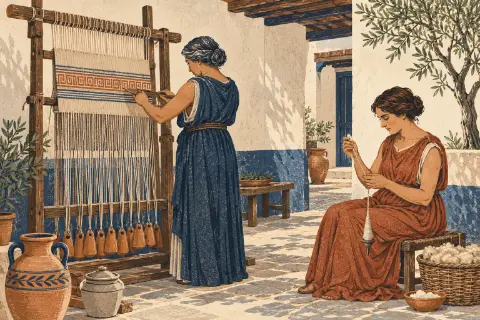 Women in ancient Greece
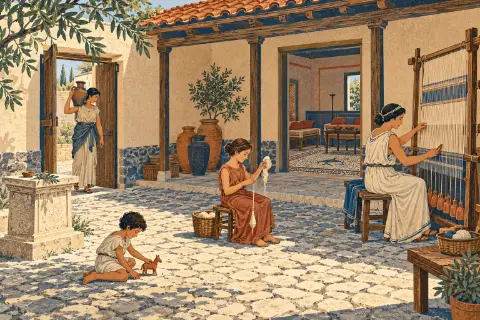 The house and family in ancient Greece