
Girls who ran and wrestled
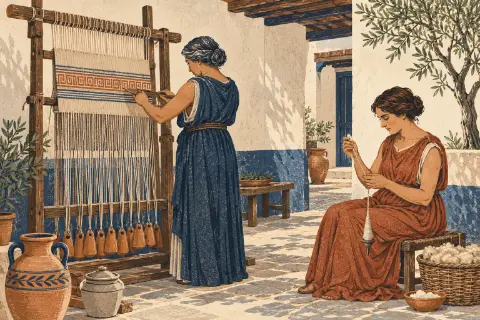
In most Greek cities, girls stayed indoors and learned to work with wool. Sparta was different. Xenophon, an Athenian who spent time with the Spartan king Agesilaus, says that Spartan girls had to train their bodies just as boys did, with races and contests of strength. Slave women, he says, could make the clothes.
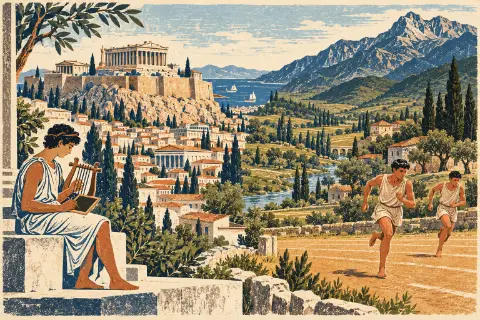
Plutarch, writing centuries later (Lycurgus 14), adds details: girls ran, wrestled and threw the δίσκος and the javelin. Both writers give the same reason: strong mothers would have strong children. The verb for this training was γυμνάζω, and Greeks still use it at the gym.
At some festivals, Plutarch says, girls danced and sang in light clothing in front of the young men, with the kings and elders watching. They made fun of any young man who had behaved badly and praised the brave ones. Other Greek writers found all this shocking, or fascinating.
Test yourself: 4 words from this page
1 / 4
What does this word mean?
Gorgo and the sayings of Spartan mothers
The best-known Spartan woman is Gorgo, daughter of King Cleomenes and wife of Leonidas. Herodotus tells two stories about her. At about eight or nine she warned her father that a foreign visitor offering him money would corrupt him (5.51). Later, when a message arrived hidden under the wax of a blank tablet, she alone guessed the trick (7.239). Herodotus adds, “as I have been told”.
A collection in Plutarch’s Moralia, the Sayings of Spartan Women (a woman of Laconia was a Λάκαινα), gives many short, hard sentences. In one (241f), an unnamed mother hands her son his ἀσπίς and says: “Child, either this or upon this”, ἢ τὰν ἢ ἐπὶ τᾶς. A soldier running away would drop his heavy shield, so the words seem to mean: come back as a winner or dead. Ancient writers themselves disagreed about the second half: did it mean fallen on the shield, or carried home on it?
Some Greek websites say that Gorgo spoke these words to Leonidas. Plutarch’s collection does not; a report in the later writer Stobaeus gives the saying to Gorgo. These stories were written down long afterwards, and some, such as mothers killing cowardly sons, may show what others liked to imagine about Sparta.
Land, dowries and marriage
Plutarch says that because men were so often away at war, women ran their homes alone, and husbands called them δέσποιναι, “mistresses” (Lycurgus 14). The strongest evidence comes from Aristotle, writing in the fourth century BC: nearly two-fifths of the land belonged to women, because many daughters inherited and families gave large dowries, each a προίξ (Politics 2, 1270a). He disapproved. He also claimed that women had too much influence and caused more confusion than the enemy during the Theban invasion of 370/69 BC. He was a critic, not a neutral witness.
Plutarch also says that Lycurgus shared out the land in equal plots, each a κλῆρος (Lycurgus 8). Many historians now doubt this. Stephen Hodkinson argues that the writers of the classical period show private, unequal holdings, passed on to children of both sexes, and that the equal plots are a later invention.
Marriage was unusual too. According to Plutarch (Lycurgus 15), a bride was “carried off”, had her hair cut short and put on a man’s cloak and sandals. Her young husband went on living with his comrades and visited her in secret. Xenophon (Constitution of the Lacedaemonians 1.7–9) adds that an older husband could bring a younger man into his home to father children.
Kyniska, and what we cannot know
Kyniska, daughter of King Archidamus and sister of King Agesilaus, bred horses and, Pausanias says (3.8.1), was the first woman to win an Olympic victory. She won with her ἅρμα, a chariot, as owner of the horses; the scholar Moretti suggested the Games of 396 and 392 BC, but the dates are estimates. Pausanias saw her monument at Olympia, with chariot, charioteer and a statue of her (6.1.6). A base with verses in her name has been found: they call her the only woman in Greece to have won this crown.
Why did she compete? Pausanias says she longed to win. Plutarch (Agesilaus 20) says her brother persuaded her, to show that a chariot victory proved only wealth, not excellence. We cannot be sure which is right.
That is the problem with all of this page. No Spartan woman’s own account survives, and the main writers were non-Spartan men using women to praise or attack the Spartan system. As Sarah Pomeroy, who wrote the first full book on the subject, found, the evidence is fragile. Spartan women probably did have more freedom than Athenian women, but “free” is our word, not theirs. Xenophon still saw motherhood as a free woman’s most important task.
Key dates
- 480 BCLeonidas, Gorgo’s husband, dies at Thermopylae.
- 396 BCSuggested date of Kyniska’s first Olympic chariot victory.
- 392 BCSuggested date of her second victory.
- 370/69 BCTheban invasion of Laconia; Aristotle later blames Spartan women for the confusion.
- 4th c. BCAristotle: nearly two-fifths of Spartan land is held by women.
- 2016The football club of modern Sparta puts «Η ΤΑΝ Η ΕΠΙ ΤΑΣ» on its new emblem.
Eight words, then and now
| Ancient Greek | Greek today | Meaning |
|---|---|---|
| to train the body | ||
| discus (today also a record) | ||
| shield | ||
| child (formal today) | ||
| mistress (today: the Virgin Mary) | ||
| dowry | ||
| plot of land (today also clergy) | ||
| chariot (today also a tank) |
 Sparta: life in the warrior city
 Women in ancient Greece
 Athens and Sparta compared