
Two sayings at the door of a temple
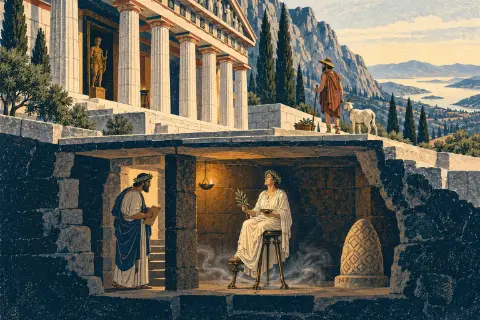
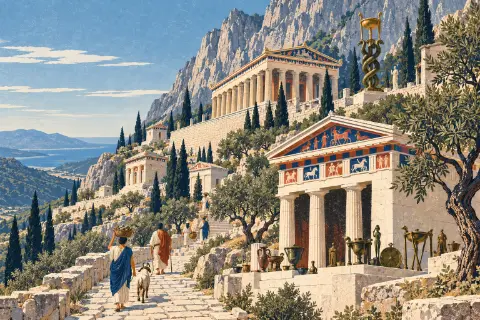
Visitors to the temple of Apollo at Delphi could read short pieces of advice in its vestibule, the entrance room. The two best known are γνῶθι σαυτόν, “know yourself”, and μηδὲν ἄγαν, “nothing in excess”. Sayings like these are called maxims: one short sentence, easy to remember, that gives advice for life.
Look at how small they are. Μηδέν means “nothing” and ἄγαν means “too much”, so the message is: do not overdo anything. Γνῶθι is an order, “know!”, and σαυτόν means “yourself”.
The Greeks connected these sayings with the Seven Sages, the wise men (σοφοί) remembered from early Greek history. Thales, Solon of Athens and Chilon of Sparta were among them. The word σοφός still means “wise” in Greek, and a modern Greek dictionary gives «οι επτά σοφοί της αρχαιότητας», the seven sages of antiquity, as an example of how to use it.
Test yourself: 4 words from this page
1 / 4
What does this word mean?
Who really said them?
The ancient sources tell a neat story. Plato (Protagoras 343a–b) names seven sages: Thales, Pittacus, Bias, Solon, Cleobulus, Myson and Chilon. He says they came together and dedicated “know yourself” and “nothing overmuch” to Apollo at Delphi. Pausanias (10.24.1) repeats this and says the maxims were written in the fore-temple.
Then the story gets messy. Pausanias notes that Plato has Myson where others have Periander. Diogenes Laertius (1.40–41) says the sages’ sayings are “attributed now to one now to the other”, and that nobody agrees on the list. He gives “know yourself” to Thales, while reporting that Antisthenes gave it to Phemonoe. “Nothing too much” goes to Chilon in a verse he quotes (1.41) and to Solon elsewhere (1.63).
So the sayings are well attested, but their authors are not. Direct evidence is limited too: the Greek Ministry of Culture’s site for Delphi says that what we know of the temple’s interior comes mainly from ancient authors.
More sayings, and two that need care
Other lines have lasted too, and one has become a motto. The last two below are the ones to treat with care.
- μέτρον ἄριστον, “measure is best”, is given to Cleobulus of Lindos by Stobaeus (3.1.172) and Diogenes Laertius (1.93). A folklore archive at the University of Southern California records the longer form pan metron ariston, παν μέτρον άριστον. The ancient passages cited here do not have παν.
- ἡ δ᾽ ἀρχὴ λέγεται ἥμισυ εἶναι παντός, “the beginning, it is said, is half of the whole”, is a proverb quoted by Aristotle (Politics 1303b). The dictionary lists it today as «η αρχή είναι το ήμισυ του παντός».
- μέγα γὰρ τὸ τῆς θαλάσσης κράτος, “for power at sea is a great thing”, comes from a speech of Pericles in Thucydides (1.143.5). In 2018 the President of Greece called the words, without γάρ, the emblem of the Hellenic Navy.
- τα πάντα ρει, “everything flows”, is still quoted in Greek as Heraclitus’ saying, but none of his surviving fragments contains it. Plato (Cratylus 402a) gives πάντα χωρεῖ καὶ οὐδὲν μένει, “everything moves on and nothing stays”.
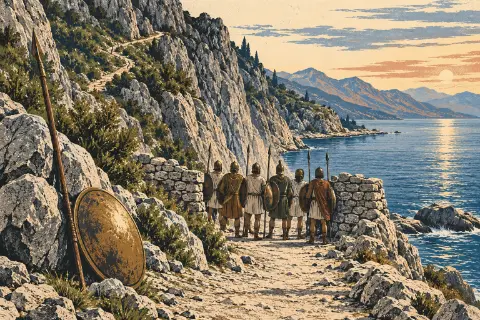
- μολὼν λαβέ, “come and take them”, is Leonidas’ reply to Xerxes in Plutarch (Sayings of Spartans). Herodotus does not report the exchange. The words now stand on the monument at Thermopylae.
What the words are doing now
A Greek reader can recognise most of these words, but several have moved. Μηδέν is now above all the number zero. The Triantafyllidis dictionary says that sense came through French, while the old meaning “nothing” lives on in εκ του μηδενός, “out of nothing”. Πάντα today means “always”. The same dictionary traces it to a medieval phrase for “all the time”, not to the “everything” of τα πάντα ρει.
Μέτρο is the metre on a ruler, a sense taken from French. It is also the avoidance of excess: the dictionary’s example is «πίνει με μέτρο», “he drinks in moderation”. Άριστος means “excellent”, and άριστα is the top mark at school. Ρέω means “to flow”, as in «ο ποταμός ρέει ορμητικά», “the river flows fast”. The old σαυτόν has gone, and today you would say «γνώρισε τον εαυτό σου». Its modern word εαυτός grew from ancient ἑαυτόν.
The spelling changed too. Since the vote in Parliament in January 1982, Greek has been written with one accent mark, so μηδὲν ἄγαν now appears as μηδέν άγαν.
Key dates
- 594 BCSolon, one of the Seven Sages, is archon at Athens.
- c. 560 BCChilon of Sparta, also named as a sage, is active.
- c. 500 BCHeraclitus of Ephesus is active.
- c. 330 BCThe temple of Apollo at Delphi that visitors see today is completed.
- 1955The Leonidas monument at Thermopylae is set up.
- 1982The Greek Parliament votes for one-accent spelling.
Eight words, then and now
| Ancient Greek | Greek today | Meaning |
|---|---|---|
| zero (anciently: nothing) | ||
| too much (today: υπερβολικά) | ||
| oneself | ||
| always (anciently: all) | ||
| to flow | ||
| measure, moderation | ||
| excellent, the best | ||
| wise |
 The Oracle of Delphi and the Pythia
 Delphi: the navel of the world
 Thermopylae: the 300 at the pass (480 BC)