
Going up: Cyrus, the King and Cunaxa
The Greek title is Κύρου Ἀνάβασις, «the going-up of Cyrus». An ἀνάβασις is a march up from the coast into the interior, and the book opens with the verb itself: when Darius II lay dying, Cyrus «went up», ἀναβαίνει, to his father (1.1.2). After Artaxerxes II became king, Cyrus planned to take the throne from his elder brother, and he recruited Greek soldiers under false pretexts, many of them from the Peloponnese (1.1.6).
Xenophon gives exact figures. At Celaenae Cyrus counted about eleven thousand hoplites and two thousand peltasts (1.2.9); at the review before the battle, 10,400 hoplites and 2,500 peltasts (1.7.10). The name «the Ten Thousand» is a rounded label. The figures he reports for the King's army, 1,200,000 men, are not credible, and modern historians reject them.
The battle was fought in 401 BC north of Babylon. The Greeks won on their wing, but Cyrus charged his brother with the cry «I see the man», wounded him and was killed (1.8.26–27). Xenophon never names the place: the name Cunaxa is attested only in Plutarch's Life of Artaxerxes.
Test yourself: 4 words from this page
1 / 4
What does this word mean?
The retreat: Xenophon takes command
Without Cyrus the Greeks were stranded deep inside the empire. The satrap Tissaphernes invited their generals to his quarters, seized them, and the captains waiting outside were cut down (2.5.31–32). Only now does Xenophon introduce himself, in the third person: an Athenian who had come «neither as general nor as captain nor as soldier», but at the invitation of his friend Proxenus (3.1.4). He had consulted Socrates, who sent him to Delphi (3.1.5–7), and on the night of despair he dreamt of a thunderbolt striking his father's house (3.1.11). Before dawn the officers chose new commanders, and Xenophon was elected in place of Proxenus (3.1.47).
The march north led through the mountains of the Carduchians and the snows of Armenia. Xenophon measures it in σταθμοί, the stages of a day's march, and in παρασάγγαι, the Persian unit of distance. The Greeks reached the sea at Trapezus, a Greek colony of Sinope (4.8.22), and at Cerasus a count gave 8,600 survivors (5.3.3). A summary at the end, which some editors consider a later addition, totals 215 stages and 1,150 parasangs for the ἀνάβασις and the κατάβασις, in a year and three months (7.8.26).
«θάλαττα θάλαττα»: reading 4.7.21–25
A local guide promised to bring the army within five days to a place «from which they will see the sea» (4.7.20). On the fifth day they reached a mountain called Θήχης. When the vanguard reached the top and saw the sea, «a great shout arose», κραυγὴ πολλὴ ἐγένετο (4.7.21). Xenophon, with the rearguard, thought that new enemies were attacking in front. As the noise grew, he mounted a horse and rode forward with the cavalry, «and soon they hear the soldiers shouting θάλαττα θάλαττα and passing the word along» (4.7.24).
- ἀκούουσι βοώντων: the historic present, and ἀκούω with the genitive of the people heard.
- θάλαττα: Attic ττ where Ionic and most other dialects have σσ (Smyth §78).
- παρεγγυώντων: the word passed down the column, as in 4.7.25.
On the summit the men embraced their generals and captains in tears, then piled stones into a great cairn, a κολωνός, and dedicated hides, sticks and captured shields on it (4.7.25–26). Where Theches was is still debated: since many peaks behind Trabzon show the sea, Tuplin and Brennan (2023) argue that any identification remains conjecture.
Xenophon as narrator, and why the text matters
Xenophon, son of Gryllus, was born in the Attic deme of Erchia around 430–425 BC. He writes about himself almost always in the third person, as «Xenophon the Athenian». In the Hellenica (3.1.2) he refers readers who want the story of Cyrus' march and the return to the sea to an account «by Themistogenes of Syracuse». Plutarch already read this as a pen name, and many scholars agree that the Anabasis first circulated under it, which would also explain the detached third-person voice. That is a hypothesis, not a fact; it is also possible that the work appeared book by book.
The detachment should not be mistaken for neutrality. Xenophon gives himself long speeches and the best decisions, and later books answer accusations made against him in the army (5.6–8). Yet the Anabasis is valued as a historical source for its precise distances and its descriptions of peoples, rivers and villages across the Persian empire. For students of Greek it combines clear Attic prose with a strong narrative, which makes its battles, assemblies and the scene on Theches a common choice for translation practice.
Key dates
- c. 430 BCXenophon is born in the deme of Erchia, Attica (between about 430 and 425)
- 401 BCCyrus marches inland from Sardis with his Greek mercenaries (Anabasis 1.2)
- 401 BCBattle of Cunaxa: Cyrus is killed; Tissaphernes later seizes the Greek generals (1.8, 2.5)
- 4th c. BCXenophon writes the Anabasis, perhaps first circulated under the name Themistogenes (Hellenica 3.1.2)
Eight words, then and now
| Ancient Greek | Greek today | Meaning |
|---|---|---|
| ascent, march inland | ||
| descent, march to the coast | ||
| sea (Attic θάλαττα) | ||
| soldier | ||
| general | ||
| captain (leader of a company) | ||
| stage of a march; today station | ||
| parasang, Persian distance unit |
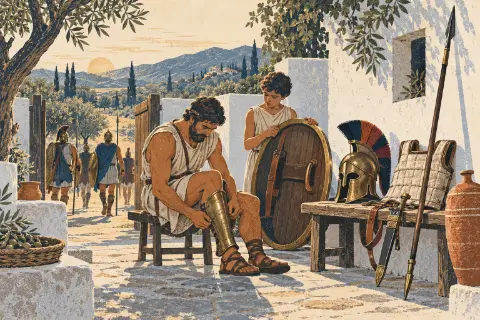 The hoplite: a Greek soldier's equipment
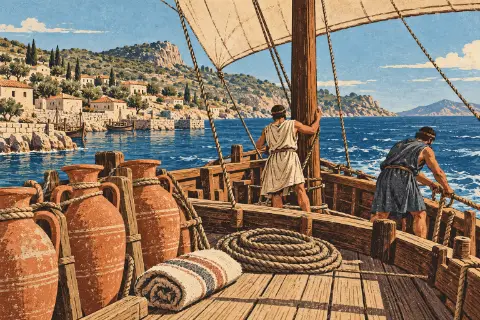 Greek colonies around the Mediterranean and the Black Sea
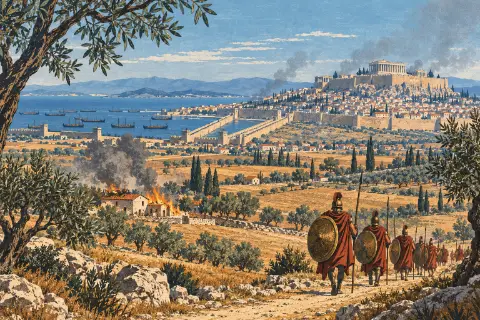 The Peloponnesian War (431–404 BC)