
A deadly disease in a crowded city
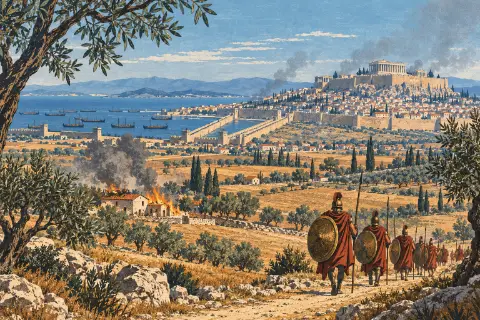
In 431 BC war broke out between Athens and Sparta, with their allies. On the advice of Pericles, the leading Athenian, the country people moved inside the city walls. They brought their families and furniture, and they sent their sheep and cattle to Euboea (Thucydides 2.14). Many had no home in the city, so they lived in stuffy huts in the hot season (2.52).
Early in the summer of 430 BC the Spartans and their allies invaded Attica again. Only a few days later a disease, ἡ νόσος, appeared in Athens. It started in the port of Piraeus, and some people said that the enemy had poisoned the wells. According to what Thucydides heard, it had begun in Ethiopia, beyond Egypt, and then reached Egypt and Libya (2.48).
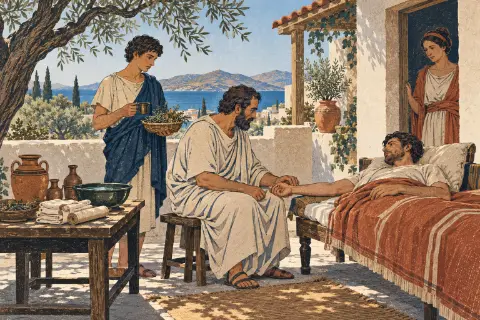
Nobody knew how to fight it. The doctors, the ἰατροί, did not know the illness, and they died in great numbers because they went near the sick. Prayers in temples and questions to oracles did not help either, and in the end people gave them up (2.47).
Test yourself: 4 words from this page
1 / 4
What does this word mean?
What Thucydides saw
Thucydides says that he had the disease himself and watched others suffer (2.48). He leaves the search for its cause to others. He describes it so that anyone could recognise it if it ever came back. His account is the main ancient evidence for the epidemic.
Healthy people suddenly felt strong heat in the head, and their eyes turned red. The throat and tongue looked bloody, and the breath smelled bad. Then came sneezing, hoarseness and a heavy cough (βήξ, in the genitive βηχός, at 2.49.3). The skin was reddish, with small blisters and sores, but the inner heat was so strong that patients could not bear even thin clothes. Many died on the seventh or ninth day. Others lost fingers, toes or eyes, and some lost their memory (2.49.8).
He also noticed something important. People who had recovered cared for the sick with more confidence, because the disease did not attack the same person twice with deadly force (2.51.6). To a modern reader this sounds close to the idea of immunity.
A city without rules
The disease also changed how people behaved. The temples where newcomers camped filled with the dead. The old customs of burial, ταφή, collapsed: some people put their own dead on a pyre built for someone else and lit it (2.52). Thucydides speaks of ἀνομία, lawlessness. Neither fear of the gods nor human law held anyone back, he says, because nobody expected to live until a trial (2.53). This is the picture of one writer, so we cannot check how far it was true of all Athenians.
The losses were huge. Thucydides counts at least 4,400 hoplites and 300 cavalrymen, and he says the number of the others could not be discovered (3.87). The disease lasted two years, weakened, and came back in the winter of 427/426 BC for at least another year. Modern writers often suggest that up to a third of the population died, but Thucydides gives no total.
Pericles was blamed and fined, then elected general again. He died two years and six months after the war began (2.65), so in 429 BC. Plutarch says that the plague wore him down slowly, after he had lost his sons Xanthippus and Paralus (Pericles 36, 38).
Old men recalled a verse: «ἥξει Δωριακὸς πόλεμος καὶ λοιμὸς ἅμ᾽ αὐτῷ», a Dorian war will come and plague with it. Some argued that the old word was λιμός, famine (2.54). In Modern Greek the two words sound exactly alike, [limós].
Which disease was it?
Despite its English name, nobody has shown that this was what doctors now call bubonic plague. Doctors reading Thucydides have proposed plague, typhoid, typhus, smallpox and measles. A 2004 review by Burke Cunha found no agreement among scholars or physicians, and it favoured measles itself.
In 1994–95, digging for the Kerameikos metro station uncovered a mass grave. The dead lay piled in a shaft with few cheap offerings. The excavator, Efi Baziotopoulou-Valavani, dated it to 430–426 BC and called it a panic burial, “quite possibly” caused by plague. One early report counts about 90 skeletons in the shaft and perhaps 150 people in the whole burial. Researchers gave one girl of about eleven the name Myrtis and rebuilt her face from her skull.
In 2006 a University of Athens team led by Manolis Papagrigorakis reported DNA close to the typhoid germ in three teeth from the grave. Critics answered in the same journal with a paper titled “No proof that typhoid caused the Plague of Athens”. Typhoid also fits Thucydides only in part, since his disease came on much faster. The question remains open.
Key dates
- 431 BCThe war with Sparta begins, and country people move inside the walls of Athens
- 430 BCThe disease reaches Athens, starting in the port of Piraeus
- 429 BCPericles dies, two and a half years after the war began
- 427/426 BCThe disease returns in winter and stays at least a year
- 1994–1995Metro works at Kerameikos uncover a mass grave
- 2006A DNA study points to typhoid, and critics reject the proof
- 2020A λοιμωξιολόγος gives Greece's daily COVID-19 briefing on television
Eight words, then and now
| Ancient Greek | Greek today | Meaning |
|---|---|---|
| deadly epidemic, plague | ||
| disease | ||
| epidemic; anciently also a stay | ||
| doctor | ||
| cough | ||
| treatment; anciently also service | ||
| burial | ||
| lawlessness; also a sinful act |
 The Peloponnesian War (431–404 BC)
 Greek medicine and the Hippocratic Oath