
How medicine came to speak Greek
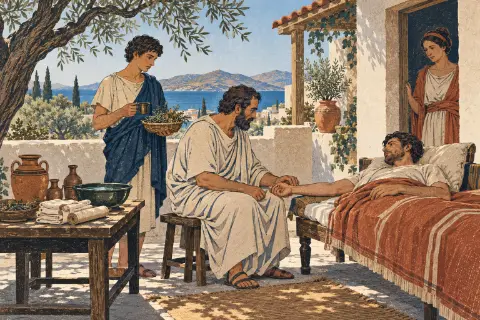
The oldest written sources of Western medicine are the Hippocratic writings of the 5th and 4th centuries BC, and they already use many technical terms. As the physician Henrik Wulff explains, Greek remained the language of medicine after the Roman conquest: the Romans had no comparable tradition, most doctors in the Empire were Greek, and the works of Galen of Pergamum (2nd century AD) were long valued as highly as the Hippocratic ones.
Early in the 1st century AD, the Roman Celsus wrote De Medicina in Latin from Greek sources. Wulff distinguishes three solutions: he copied a Greek word (pyloros), gave it a Latin ending (stomachus), or translated its image (caecum for τὸ τυφλόν, “the blind gut”).
From the Renaissance, Latin was the common language of medical books. When it later gave way to national languages, new terms were still built mostly from Greek roots, because Latin forms compounds less easily. Wulff’s example is nephrectomy, which medical Latin would have to express as excisio renis.
Test yourself: 4 words from this page
1 / 4
What does this word mean?
One organ, two registers
Modern Greek adds a further layer: many of these roots are still ordinary words. Καρδία is now καρδιά, with the sense it already has in Homer; αἷμα is αίμα, and δέρμα has kept its form. A learner therefore meets the roots of cardiology and dermatology in everyday vocabulary.
Other ancient words live on in a formal or technical register, beside a different everyday word. The Triantafyllidis dictionary of Modern Greek marks ήπαρ as anatomical and explains it simply as το συκώτι; its own example under συκώτι says that ηπατίτιδα, hepatitis, is a disease of the συκώτι. That everyday word has a Greek history too: the dictionary traces it to ἧπαρ συκωτόν, the liver of an animal fattened on figs. In the same way οστό is the learned form of ὀστοῦν, and the dictionary explains it by κόκαλο, from medieval κόκκαλον, itself from κόκκαλος, the kernel of a pine cone.
The stomach shows a more complicated split. Everyday στομάχι comes from στόμαχος, which in Homer is the throat and only later the stomach, while the medical root γαστρ- comes from γαστήρ, “belly”.
-itis: from “of the” to “inflammation”
The best-known medical ending did not originally mean inflammation. It is the feminine of adjectives in -ίτης, and such forms were often used alone, with νόσος, “disease”, understood. LSJ glosses ἀρθρῖτις as “of or in the joints”: the Hippocratic Affections (30) has it with νόσος, and the Aphorisms (3.16) use it alone for gout. Πλευρῖτις, pleurisy, appears in the Aphorisms (3.23) and in Aristophanes (Ecclesiazusae 417).
The form did not have to name a disease at all. In the Hippocratic Nature of Bones (10) and in Diogenes of Apollonia, as quoted by Aristotle (History of Animals 512a6), ἡ ἡπατῖτις is a vein, with φλέψ understood: literally “the one of the liver”.
The narrow sense “inflammation” is recent; a reference work on English affixes dates it to the 18th century, in English. Modern Greek reflects this mixed history. Triantafyllidis derives αρθρίτιδα and πλευρίτιδα from the ancient words, but γαστρίτιδα and βρογχίτιδα from New Latin, and αμυγδαλίτιδα and ωτίτιδα from French. For ηπατίτιδα it gives New Latin for today’s meaning, with ancient ἡπατῖτις behind it.
Round trips, and why a root is only a clue
Many “Greek” medical words therefore reached Greek from abroad. Triantafyllidis derives καρδιολόγος from French cardiologue, νευρολόγος from neurologue and παιδίατρος from pédiatre: the parts are ancient, but the immediate source is modern French.
Where other languages keep Latin, Greek tends to use its own material. Wulff writes that Modern Greek allows only Greek terms, so the musculocutaneous nerve is το μυοδερματικό νεύρο. French appendicite was rendered as σκωληκοειδίτιδα, from σκωληκοειδής, “worm-shaped”.
Meanings moved too, so a root is a clue and not a definition:
- νεῦρον: sinew or tendon in Homer and Plato; LSJ first records “nerve” in Erasistratus (3rd century BC), quoted by Galen.
- ἀρτηρία: the windpipe, and also the artery; Greek still says τραχεία αρτηρία for the trachea.
- μῦς: both mouse and muscle, as in Latin musculus, “little mouse”.
- καρκίνος: a crab; in the Aphorisms (6.38) an eating sore or cancer.
Key dates
- 5th c. BCThe Hippocratic writings begin, the oldest written sources of Western medicine (5th and 4th centuries BC).
- 3rd c. BCHerophilus in Alexandria and Erasistratus, whose presence there is uncertain, study the nerves; LSJ first records νεῦρον as “nerve” in Erasistratus.
- 1st c. ADCelsus writes De Medicina in Latin from Greek sources, copying, latinizing or translating Greek terms.
- 2nd c. ADGalen of Pergamum writes the works that were valued for centuries alongside the Hippocratic ones.
- 1478Celsus’ De Medicina appears in print, as Latin becomes the common language of medical books.
- 18th c.In English, words in -itis begin to be applied specifically to inflammations.
- 1802Heberden’s Commentarii appears, probably the last notable medical work in Latin in Britain.
Eight words, then and now
| Ancient Greek | Greek today | Meaning |
|---|---|---|
| belly (the organ: στομάχι) | ||
| heart | ||
| blood | ||
| bone (everyday: κόκαλο) | ||
| nerve (once sinew, tendon) | ||
| liver (everyday: συκώτι) | ||
| kidney | ||
| arthritis (ancient sense: gout) |
 Greek medicine and the Hippocratic Oath