
What was an omen?
Imagine you are about to leave on a long journey. A large bird flies past, or someone near you sneezes. Would you stop and think? Many ancient Greeks would. They believed that the gods sent signs about what was going to happen. Such a sign is called an omen, and reading signs is called divination, μαντική in Greek.
The Greek word for an omen was οἰωνός. In Homer it often means a large bird of prey, such as an eagle. Because people read signs in these birds, the word came to mean the sign itself. An expert in signs was a seer, μάντις. Homer calls the seer Calchas the very best of the bird-readers (Iliad 1.69).
Even a sneeze could count. Xenophon says that a soldier sneezed while he was speaking to the army, and all the men bowed to the god. Xenophon called it an omen from Zeus the Saviour (Anabasis 3.2.9).
Test yourself: 4 words from this page
1 / 4
What does this word mean?
Birds, livers and battles
The play Prometheus Bound, traditionally credited to Aeschylus, lists the main methods (lines 484–499): dreams, chance words (κληδών), meetings on the road, the flight of birds, and the inner organs of sacrificed animals, σπλάγχνα, judged by their smoothness, the colour of the gall and the lobe of the liver. Plato even places the seat of divination in the liver, ἧπαρ (Timaeus 71e). A chance word could be enough: a Spartan commander asked a visitor his name, heard «Hegesistratus», roughly “army leader”, and answered «δέκομαι τὸν οἰωνόν», “I accept the omen” (Herodotus 9.91). Aristophanes jokes in The Birds (719–721) that humans call a chance saying or a sneeze a “bird”, ὄρνις.
Michael Flower's study of seers presents them as often well paid and respected, and says that armies never went anywhere without one. At Plataea in 479 BC the seer Tisamenus served the Greeks. Herodotus says that the Spartans stood under Persian arrows, because the sacrifices were not good, until Pausanias prayed to Hera (9.61–62). His word for favourable results is καλά (9.36).
In 415 BC the mutilation of the Herms looked like an omen for the Sicilian voyage (Thucydides 6.27). In 413 BC the moon went dark just as the Athenians were ready to sail away from Syracuse. The seers said to wait twenty-seven days, and Nicias agreed. Thucydides remarks that Nicias was rather too inclined to such things (7.50). Few of the army ever got home (7.87).
Dreams: true, false and healing
A dream was ὄνειρος or ὄνειρον, but the Greeks knew that dreams could lie. In the Iliad (2.6) Zeus sends Agamemnon a false dream on purpose. In the Odyssey (19.562–567) Penelope says that dreams come through two gates: those through ivory deceive, those through horn come true. When Xenophon dreamed that lightning struck his father's house, he woke in terror and could read the dream both ways, as good and as bad (Anabasis 3.1.11–12).
Dreams could also heal. In the sanctuaries of Asclepius the sick slept in the hope that the god would visit them. This is called incubation. At Epidaurus accounts of cures, ἰάματα, were set up on stone slabs in the second half of the 4th century BC. The usual story is that a pilgrim sleeps in the ἄβατον, dreams of being healed and leaves well the next day. These are records of belief, and scholars warn against reading later reports back into earlier rites.
Artemidorus wrote a handbook of dream interpretation in five books, usually dated between the mid-2nd and the early 3rd century AD. He separates the ὄνειρος, which foretells, from the ἐνύπνιον, which comes from desire, fear or too much or too little food and means nothing.
Asking the god, and doubting
Omens simply happened, but you could also ask a question. Delphi is the famous oracle. At Dodona people came to hear the will of Zeus from his tall oak (Odyssey 14.327–328). More than 4,000 small lead tablets with questions have been found there, dated from the 6th to the mid-2nd century BC. Most are private: “Was it Pistos that stole the wool from the bed mattress?” “Will I, the ship and my cargo be safe on the voyage I am making to Carthage?” In 2023 the tablets entered UNESCO's Memory of the World register.
Not everyone obeyed. In Iliad 12 Polydamas reads an eagle that drops a snake as a warning. Hector replies that he does not care where birds fly: «εἷς οἰωνὸς ἄριστος ἀμύνεσθαι περὶ πάτρης», one omen is best, to fight for your country (12.243).
The vocabulary has outlived the practice, often with a new meaning. Τέρας was a portent, and is now a monster. Ὄρνις was any bird, and όρνιθα is now a hen. Μαντεύω can now simply mean “I guess”. On the night of 23–24 June, some Greek communities keep or revive the custom of κλήδονας, whose name comes from κληδών. Reports call the custom a survival from antiquity. The descent of the word is clear; an unbroken rite is much harder to prove.
Key dates
- 6th c. BCThe earliest question tablets at Dodona
- 479 BCPlataea: the Spartans wait for good sacrifices under Persian arrows
- 415 BCThe mutilation of the Herms is taken as an omen for the Sicilian voyage
- 413 BCAn eclipse of the moon delays the Athenian retreat from Syracuse
- 401 BCXenophon's dream and the sneeze during his speech to the army
- 4th c. BCAccounts of dream cures are set up on stone slabs at Epidaurus
- 2nd c. ADArtemidorus and his dream handbook (dating runs into the early 3rd century)
- 2023The Dodona tablets enter UNESCO's Memory of the World register
Eight words, then and now
| Ancient Greek | Greek today | Meaning |
|---|---|---|
| omen, once a large bird | ||
| dream | ||
| seer | ||
| monster, once a portent | ||
| midsummer fortune-telling custom | ||
| liver (συκώτι in speech) | ||
| internal organ | ||
| hen, once any bird |
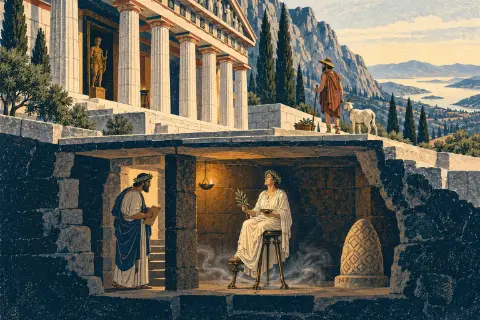 The Oracle of Delphi and the Pythia
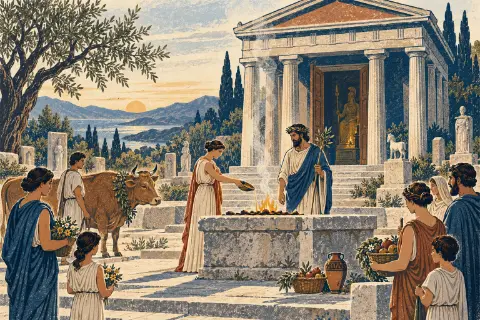 Greek religion: temples, priests and sacrifices