
An island and a dangerous coast
In the Odyssey, Homer tells of a νῆσος, an island, off the coast of Egypt, with a good harbour. Its name is Φάρος. Homer says that a ship needed a whole day to sail there. Many centuries later, in 331 BC, Alexander the Great founded a new city on that coast: Alexandria.
The geographer Strabo visited Alexandria in the 1st century BC. He describes Pharos as a νησίον, a small, long island right beside the mainland. A long causeway, the Heptastadion, a road across the water, joined it to the shore. Between the island and the coast lay the great λιμήν, the harbour.
Many ships came here, but the way in was dangerous. Strabo explains why: the coast on both sides is low and has no harbours, and there are rocks and shallow water. Sailors out at sea needed a high, bright sign to find the entrance.
Test yourself: 4 words from this page
1 / 4
What does this word mean?
The great white tower
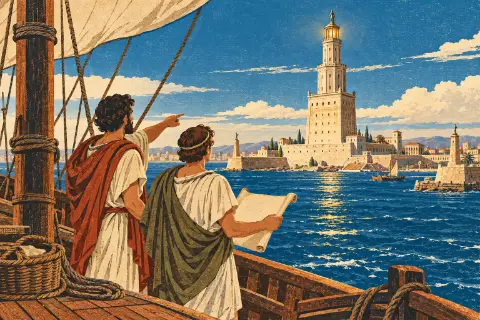
Ptolemy I, one of Alexander's generals and later king of Egypt, began planning a huge tower on the eastern tip of the island. His son, Ptolemy II, finished it around 280 BC. Strabo calls it a πύργος, a tower, of white stone, wonderfully built, with many floors. He adds that it had the same name as the island.
Nobody knows its exact height. Modern estimates run from about 100 to 140 metres. Coins from Roman times and later Arab writers suggest three parts: a square base, an eight-sided middle and a round top, but the old descriptions do not always agree. Today it is counted among the Seven Wonders of the ancient world.
Pliny, a Roman writer, says the architect was Sostratus of Cnidus, and that the king let him put his name on the tower. Some historians think Sostratus paid for it rather than designed it. Lucian, who wrote in Greek, tells another story: Sostratus carved his name in the stone, covered it with plaster, and wrote the king's name on the plaster. When the plaster fell away, his own words appeared: θεοῖς σωτῆρσιν, “to the saviour gods”, for those who sail. A σωτήρ is a saviour.
Fire in the night
What did the tower do? Pliny, writing in the 1st century AD, says that it showed fires at night, to warn each πλοῖον, each ship, about shallow water and to mark the way into the harbour. He had one worry: from far away, a fire that burns all the time can look like a star. Lucian adds that its light kept sailors away from a very dangerous part of the coast.
The ancient word for fire is πῦρ. Greeks today say φωτιά in everyday speech, but πυρ is still a word in formal Greek, and you can hear it inside πυροσβέστης, a firefighter.
Some things remain unknown. Historians debate whether a fire burned from the very beginning, although the poet Posidippus, who lived in those years, already speaks of a great fire burning all night on top. It may have burned oil, because wood was scarce. Later Arab writers describe a big mirror, but nobody can prove that it existed. Pliny also tells us that such fires were burning in other ports in his time, such as Ostia and Ravenna in Italy. The idea had spread.
Earthquakes, a fort and divers
The Pharos stood for more than 1,500 years. A σεισμός, an earthquake, can badly shake a tall tower, and Alexandria had many. Strong ones are recorded in 796, in the 950s, in 1303 and in 1323. People repaired the tower several times, but it grew weaker.
The traveller Ibn Battuta went there twice. In 1326 he could still reach the door of the first floor. In 1349 it was so ruined that he could not enter it or even climb up to the door. In 1477 the sultan Qaitbay began to build a fort on the spot, using stones from the old tower. The fort still stands there today.
From about 1960, divers began to study the remains in the sea. In 1994 the French archaeologist Jean-Yves Empereur and his team began to dig under the water. They have now recorded more than 5,000 blocks from the lighthouse and nearby buildings, some weighing up to 60 tons. They also found giant statues, and Empereur believes that they are portraits of King Ptolemy.
Key dates
- 331 BCAlexander the Great founds Alexandria.
- c. 280 BCPtolemy II finishes the tower on Pharos.
- 1st c. ADPliny writes about the fires that guide ships at night.
- 1303A great earthquake damages the tower badly.
- 1349Ibn Battuta finds the tower in ruins.
- 1477Sultan Qaitbay begins a fort on the spot.
- c. 1960Divers begin to study the remains in the sea.
- 1994Underwater excavations begin.
Eight words, then and now
| Ancient Greek | Greek today | Meaning |
|---|---|---|
| lighthouse | ||
| tower | ||
| island | ||
| harbour (via Turkish liman) | ||
| ship | ||
| fire (φωτιά in speech) | ||
| earthquake | ||
| saviour |
 The Seven Wonders of the Ancient World
 The Library of Alexandria
 The Colossus of Rhodes