

An island that would not give up
Rhodes is a large νῆσος, an island, in the south-east of the Aegean Sea, close to the coast of today’s Turkey. In ancient times its main city, also called Rhodes, was rich. Its ships traded all over the Mediterranean, and its λιμήν, its harbour, was always busy.
In 305 BC a powerful Macedonian prince, Demetrius, attacked the city. He came with soldiers, ships and huge war machines, such as wooden towers on wheels. This long attack is called a πολιορκία, a siege. It lasted about a year, but the people of Rhodes did not give up. In 304 BC Demetrius made peace and sailed away. He left many of his war machines behind. Ever since, he has been remembered as Demetrius Poliorketes, “the Besieger”.
The Rhodians thanked their protector god, Helios, the god of the ἥλιος, the sun. The Roman writer Pliny says that they paid for a giant statue of him with money from the war machines that Demetrius had left behind.
Test yourself: 4 words from this page
1 / 4
What does this word mean?
Building a giant of bronze
The sculptor was Chares, from the town of Lindos on Rhodes. He had learned his art from Lysippos, a famous sculptor. The work took 12 years, and the statue was probably finished around 280 BC.
The statue was about 70 cubits high. A cubit was an old measure, the length of a forearm, so this is more than 30 metres: about as tall as a ten-storey building. It was the tallest statue of the ancient world. The outside was made of χαλκός, bronze, a metal made from copper and tin. Inside, there were heavy stones and metal bars. They held the bronze in place and kept the giant steady.
Nobody knows exactly how Chares did it. Historians think that he made the statue in levels, starting from the feet and working upwards. Each new part of bronze was made in place, on top of the one below. People were so amazed by it that they counted it among the Seven Wonders of the World. In Greek, a wonder is a θαῦμα, a marvel.
The earthquake and the broken giant
The Colossus did not stand for long. About 56 years after it was finished, a strong σεισμός, an earthquake, shook Rhodes. Historians date it to around 227 or 226 BC. The statue broke at the knees and fell to the ground.
The Rhodians did not put it back up. The Greek geographer Strabo writes that an oracle, a message from the gods, told them not to raise it again. So the broken giant lay where it fell for hundreds of years, and visitors came to see it. Pliny writes that few people could put their arms around its thumb, and that its fingers were bigger than most statues. Inside the broken limbs, people could see great holes, like caves, and the stones that had held it steady.
What happened to the bronze in the end? A Byzantine chronicle says that in 653 or 654 AD Arab soldiers took Rhodes, and that the bronze was sold to a merchant and carried away on 900 camels. This story was written down long after the event, and some historians doubt it.
Did it really stand over the harbour?
You may have seen pictures of the Colossus standing with one foot on each side of the harbour entrance, while ships sail between its legs. This is a legend from much later times, not history. No ancient writer says that the statue stood like this. The idea became popular in the Middle Ages, when pilgrims saw the remains of old walls and towers by the harbour and thought they were parts of the statue. Later artists drew the famous picture again and again.
A bronze statue of that size could not have stood with its legs so far apart over the water. In fact, nobody knows exactly where the Colossus stood. One recent study suggests that it stood on a hill in the city, in a sanctuary of Helios, where a castle from the Middle Ages stands today. Other experts think it stood near the harbour. Nothing of the statue has ever been found.
Key dates
- 305–304 BCDemetrius the Besieger attacks Rhodes for about a year, then gives up.
- c. 280 BCAfter 12 years of work, Chares finishes the bronze statue of Helios.
- c. 227 BCAn earthquake breaks the Colossus at the knees (some date it to 226 BC).
- 1st c. ADStrabo and Pliny describe the giant pieces still lying on the ground.
- 653/654 ADA later chronicle says the bronze was sold and taken away on camels.
Eight words, then and now
| Ancient Greek | Greek today | Meaning |
|---|---|---|
| giant statue; a giant | ||
| bronze; copper | ||
| sun | ||
| harbour (via Turkish liman) | ||
| earthquake | ||
| wonder, marvel | ||
| siege | ||
| island (from little νησίον) |
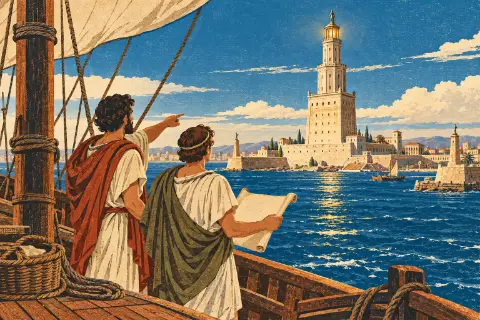 The Seven Wonders of the Ancient World
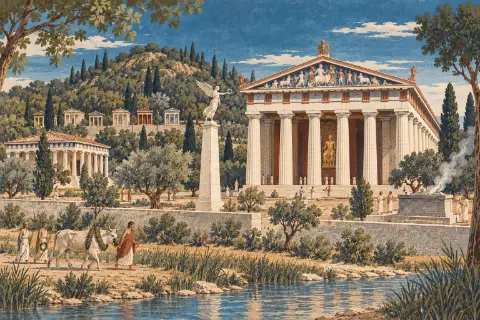 Olympia: the sanctuary of Zeus