

What were the Seven Wonders?
Long ago, Greek travellers loved to visit amazing buildings and works of art, and they made lists of the best ones. The oldest list we know is written on a piece of papyrus, an ancient kind of paper, from the 2nd century BC. It names seven θεάματα, sights: things you must see with your own eyes.
Later writers called them θαύματα, wonders. A θαῦμα is something so great that it makes you stare in surprise. The number was always ἑπτά, seven, but the list was not always the same. The first lists included the τεῖχος, the great wall, of the city of Babylon. Much later, in the 6th century AD, the Lighthouse of Alexandria took its place.
This is the list that most books use today: the Great Pyramid of Giza, the Hanging Gardens of Babylon, the Temple of Artemis at Ephesus, the Statue of Zeus at Olympia, the Mausoleum at Halicarnassus, the Colossus of Rhodes and the Lighthouse of Alexandria. Five of them were made by Greek builders and artists. All seven were famous for their size, their beauty and the great skill of the people who made them.
Test yourself: 4 words from this page
1 / 4
What does this word mean?
Two wonders from Egypt and Babylon
The oldest wonder is the Great Pyramid of Giza in Egypt. The Greeks called this shape a πυραμίς, a pyramid. It was built as a tomb for the pharaoh Khufu, who ruled around 2550 BC. When it was new, it was about 146 metres high. It was already about 2,400 years old when the first Greek list was written, and it is the only wonder still standing today. Archaeologists have found the town where its workers lived. They were not slaves, as many people think, but paid workers with plenty of food.
The second wonder is a mystery. Greek writers describe a beautiful κῆπος, a garden, in Babylon, in today’s Iraq, with trees growing on high terraces like the steps of a theatre. Only one writer, Josephus, says that King Nebuchadnezzar II built it. Archaeologists have found no trace of it in Babylon, and the clay tablets found there do not mention it. Stephanie Dalley, a historian at Oxford, thinks the garden was really in Nineveh, almost 500 kilometres to the north, in the palace of the Assyrian king Sennacherib, around 700 BC. Not everyone agrees, so the question is still open.
Five wonders made by Greeks
The Temple of Artemis stood in Ephesus, a Greek city on the coast of today’s Turkey. Herodotus says that the rich king Croesus paid for most of its columns. In 356 BC a man called Herostratus set it on fire. Plutarch says it burned on the day Alexander the Great was born. The people of Ephesus built a new temple of μάρμαρον, marble, and the women even gave their jewellery to pay for it. Its columns were about 18 metres high.
The Statue of Zeus at Olympia was made by the Athenian sculptor Pheidias around 430 BC. The god sat on a throne. He was about 13 metres high and covered in gold and ivory. Our page on Olympia tells its story.
The Mausoleum was a giant tomb at Halicarnassus, today’s Bodrum in Turkey. It was made for Mausolus, a ruler of the region of Caria, who died around 353 BC. Pliny says that his wife Artemisia had it built. Four famous Greek sculptors decorated its four sides, and on top stood a stepped pyramid with a chariot pulled by four horses. Its name gave us the word μαυσωλεῖον, a grand tomb.
The last two Greek wonders were finished around 280 BC: the giant bronze sun god of Rhodes, and the tall tower with a fire on top that guided ships into the port of Alexandria. Each one has its own page on this site.
What is left today?
Of the seven wonders, only the Great Pyramid still stands. Earthquakes, fire and wars destroyed the others. The Statue of Zeus was probably taken to Constantinople, where a fire burned it in AD 475. The Temple of Artemis had disappeared by about the 3rd century AD. The tower of Alexandria was broken by earthquakes in the 14th century, and divers have found its huge stones on the seabed.
Some pieces survive in museums. In 1856 archaeologists working for the British Museum found statues and carved scenes from the Mausoleum. In 1869 John Turtle Wood found parts of the Temple of Artemis, including a carved column base. Today you can see them in London. At Bodrum and at Ephesus, only a few stones and foundations are left where the great buildings once stood.
The wonders also live on in words. A huge tomb is still called a mausoleum in many languages, and in Greek the word θαύμα is used every day, as you will see below.
Key dates
- c. 2550 BCThe pharaoh Khufu builds the Great Pyramid of Giza as his tomb.
- c. 700 BCKing Sennacherib makes a terraced garden at Nineveh, perhaps the Hanging Gardens.
- c. 430 BCPheidias begins the gold and ivory Statue of Zeus at Olympia.
- 356 BCHerostratus sets fire to the Temple of Artemis at Ephesus.
- c. 353 BCMausolus dies, and work goes on at his great tomb in Halicarnassus.
- c. 280 BCThe Colossus of Rhodes and the Lighthouse of Alexandria are finished.
- 2nd c. BCThe oldest surviving list of seven ‘sights’ is written on papyrus.
- 475 ADA fire in Constantinople destroys the Statue of Zeus.
Eight words, then and now
| Ancient Greek | Greek today | Meaning |
|---|---|---|
| wonder; also miracle today | ||
| sight, spectacle | ||
| seven (εφτά in speech) | ||
| pyramid | ||
| garden | ||
| city wall | ||
| marble | ||
| grand tomb (from Mausolus) |
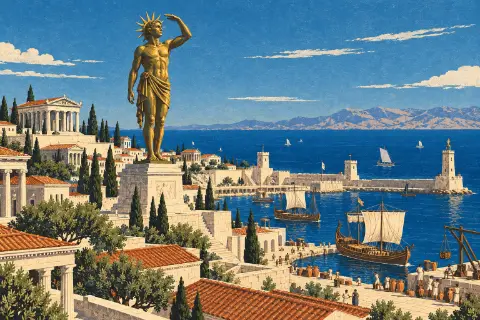 The Colossus of Rhodes
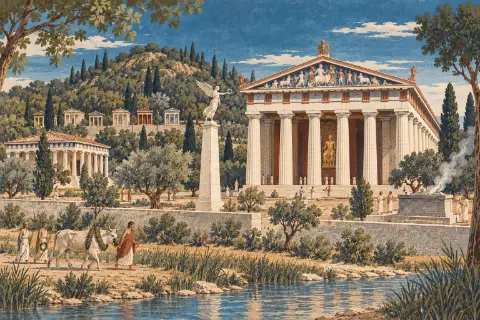 Olympia: the sanctuary of Zeus