
A huge empire and nobody to rule it
Alexander died in Babylon in 323 BC. His wife Roxane was expecting a baby, but he had no grown son. A famous story says that his companions asked who should have the kingdom, and he answered «τῷ κρατίστῳ», “to the strongest”. Arrian (7.26) gives this only as something other writers reported, and he notes that Ptolemy and Aristobulus did not record it.
The army made Alexander's half-brother Arrhidaeus king. Perdiccas, who held the dead king's ring, became regent: a person who rules on behalf of a king (Diodorus 18.2). He then shared out the provinces among the generals, the στρατηγοί. Ptolemy got Egypt, Lysimachus got Thrace, and Antigonus got lands in Asia Minor (18.3). A province was traditionally run by a σατράπης, the old Persian title for a governor.
The peace did not last, because they disagreed about whether the empire should stay united, and under whom. Perdiccas was killed by his own officers in 321 or 320 BC. Alexander's body went to Egypt too: Ptolemy met the funeral procession in Syria, and Diodorus (18.28) says he buried the king in Alexandria, while Pausanias places the burial at Memphis.
Test yourself: 4 words from this page
1 / 4
What does this word mean?
From generals to kings
Modern historians divide the fighting into several Wars of the Successors, the Διάδοχοι, and their dates differ slightly. Alexander's royal heirs did not survive them. Arrhidaeus was executed in 317 BC, and around 310 BC (sources give 311 or 310) Roxane and her son Alexander IV, a boy of about twelve, were killed too.
After a sea victory off Cyprus in 306 BC, Antigonus and his son Demetrius were hailed as kings, and Antigonus sent Demetrius a διάδημα, the royal headband. Ptolemy, Lysimachus and Seleucus soon took the title as well, while Cassander still signed his letters with his plain name (Plutarch, Demetrius 18).
In 301 BC Antigonus died in battle at Ipsus, and Seleucus won Syria. In 281 BC Seleucus defeated Lysimachus at Corupedium, but was murdered by Ptolemy Keraunos months later. After about 280 BC three large kingdoms, βασίλεια, remained:
- the Antigonids in Macedonia;
- the Ptolemies in Egypt;
- the Seleucids in Asia.
Smaller states grew beside them, such as Pergamon in Asia Minor and, from about 250 BC, a Greek kingdom in Bactria.
Greek from Egypt to Afghanistan
Alexander and his Successors founded new cities far from Greece: Seleucus founded Antioch and Seleucia on the Tigris. Their official and everyday language was a broadened form of the Attic of Athens, which grammarians called the κοινή, the “common” γλώσσα. The Portal for the Greek Language describes its reach as running from the Aegean coast of Asia Minor to the plains of the Punjab.
Inscriptions show how far it went. The Rosetta Stone (196 BC) gives a decree for Ptolemy V in hieroglyphs, Demotic and Greek. At Kandahar, in today's Afghanistan, the Indian king Ashoka had edicts cut in Greek around 258 BC. At Ai Khanoum, also in Afghanistan, a man called Clearchus set up sayings he had “copied carefully” from Delphi, among them «παῖς ὢν κόσμιος γίνου», “As a child, be orderly”.
In Alexandria, Ptolemy I founded the Μουσεῖον, a royal research centre. Callimachus catalogued the Library's books, Eratosthenes ran it from about 240 BC, and Archimedes in Syracuse sent his results there. The translation of the Hebrew Bible into Greek began there in the 3rd century BC. According to Britannica, the Koine is the basis of Modern Greek.
Rome, Cleopatra and a modern name
Rome took these states step by step. At Pydna in 168 BC it defeated Perseus, the last Antigonid king. In 146 BC it sacked Corinth. In 133 BC Attalus III left Pergamon to Rome in his will. In 64 BC Pompey made Syria a Roman province, though Tigranes of Armenia had already broken the Seleucid state, traditionally dated to 83 BC.
Egypt came last. Plutarch (Antony 27) says that Cleopatra VII spoke to many peoples without an interpreter, while the kings before her had not even tried to learn Egyptian. After the sea battle of Actium on 2 September 31 BC, Octavian besieged Alexandria in 30 BC, and she and Antony took their own lives.
Nobody at the time said “Hellenistic”. The German historian J. G. Droysen made Hellenismus the name of the whole age in the 1830s. The word had already been used for the Greek of non-Greeks, and the ancient Ἑλληνιστής meant someone who used Greek (Acts 6.1). The usual dates are 323 to 31 or 30 BC, but they are a convention: Greek culture carried on under Rome, and some historians doubt that the period has any real unity.
Key dates
- 323 BCAlexander dies in Babylon; the provinces are shared out among the generals
- 306 BCAntigonus and Demetrius are hailed as kings; others follow
- 301 BCBattle of Ipsus: Antigonus is killed
- 281 BCCorupedium: Seleucus defeats Lysimachus, then is murdered
- 196 BCThe decree on the Rosetta Stone, with a Greek version
- 168 BCPydna: Rome defeats Macedon
- 146 BCRome sacks Corinth
- 31–30 BCActium, then the death of Cleopatra; Egypt falls to Rome
Eight words, then and now
| Ancient Greek | Greek today | Meaning |
|---|---|---|
| successor; heir to the throne | ||
| the common Greek language | ||
| kingdom (anciently: palace) | ||
| general, army commander | ||
| royal headband; today a tiara | ||
| Persian governor; figuratively a despot | ||
| language; also the tongue | ||
| Greek user; today a Hellenist |
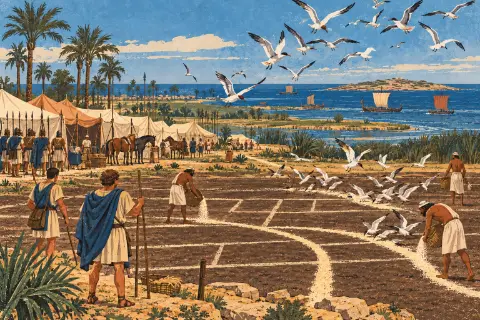 Alexander's conquests, on a map
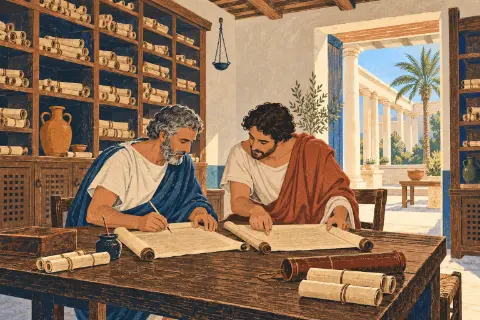 The Library of Alexandria