
The first sentence: what Herodotus says he is doing
The work names itself in its opening words: Ἡροδότου Ἁλικαρνησσέος ἱστορίης ἀπόδεξις ἥδε, «this is the display of the inquiry of Herodotus of Halicarnassus». So the title «Histories» is not his own phrase. Here ἱστορίη is singular and Ionic, and LSJ takes it as the knowledge gained by inquiry. The noun is rare: it occurs five times in the Perseus text (the opening, 2.99, 2.118, 2.119, 7.96), and only at 7.96 does LSJ suggest, with a «probably», the sense of a written account. The verb ἱστορέω, «to ask, to inquire», is commoner: the priests tell him about Helen ἱστορέοντι, «when I asked» (2.113). Aristotle quotes the line with «of Thurii» instead of Halicarnassus (Rhetoric 3.9), after the colony in southern Italy.
The rest of the sentence states the aim. What people have done must not fade with time (ἐξίτηλα), and great, marvellous deeds, τὰ μὲν Ἕλλησι τὰ δὲ βαρβάροισι, some by Greeks and some by people who were not Greek, must not lose their fame (ἀκλεᾶ). Last comes the question behind the book: δι᾽ ἣν αἰτίην, the reason why they fought each other. Herodotus first reports the Persian and Phoenician tales of stolen women (1.1–5), declines to judge them, and starts from the man he himself knows to have begun the wrongs against the Greeks (1.5.3): Croesus of Lydia (1.6).
Test yourself: 4 words from this page
1 / 4
What does this word mean?
The nine books: what is in each
The division into nine books is not his: Hellenistic scholars made it. Diodorus (11.37.6) is the first to state it outright, and Lucian (How to Write History 42), in the 2nd century AD, is the first to say that the books were called Muses.
- 1 Clio: Croesus and Solon's warning (1.29–33), the fall of Lydia, Cyrus and the rise of Persia.
- 2 Euterpe: Egypt, its river, customs and kings, in one long digression.
- 3 Thalia: Cambyses in Egypt, the debate on forms of government (3.80–82), Darius becomes king.
- 4 Melpomene: Darius against the Scythians; Libya.
- 5 Terpsichore: the Ionian Revolt, and the Athenian ships that were «the beginning of evils» (5.97).
- 6 Erato: the fall of Miletus and the battle of Marathon (6.102–117).
- 7 Polymnia: Xerxes' invasion and Thermopylae (7.201–233).
- 8 Urania: Artemisium and Salamis.
- 9 Calliope: Plataea, Mycale and the siege of Sestos; the book closes on Cyrus' advice about soft lands and soft men (9.122).
The thread is Persian expansion, with digressions on the peoples it reached. Xerxes' war fills nearly a third of the work. The story stops in 479 BC, although Herodotus published it in the 420s, so it is not an account of his own time.
Seeing, judging, asking, hearing: can we trust him?
At 2.99 Herodotus lists his tools: ὄψις τε ἐμὴ καὶ γνώμη καὶ ἱστορίη, «my own sight, my judgement and my inquiry». From there on he will give the Egyptian accounts as he heard them. At 2.29 he draws the line on the map: as far as Elephantine he went as an eyewitness (αὐτόπτης), beyond it he inquired ἀκοῇ, by hearsay. His rule comes at 7.152: ἐγὼ δὲ ὀφείλω λέγειν τὰ λεγόμενα, πείθεσθαί γε μὲν οὐ παντάπασι ὀφείλω, «I must report what is said, but I am not bound to believe all of it». He also argues in his own voice: at 7.139 he says he is forced to give an opinion that most people will resent, that Athens saved Greece.
How far to trust him has been debated since antiquity. Cicero calls him pater historiae and in the same sentence says that his work holds countless fabulae (De legibus 1.5). Plutarch wrote a whole essay, On the Malice of Herodotus. Since Jacoby (1913) many scholars have taken his citations of informants literally, which implies very wide travels. Fehling (1989) treats them as a literary technique, and Fowler (1996) as pointers to where Herodotus thought the information could be found; on those views he travelled much less. Numbers are a separate problem: his 5,283,220 men for Xerxes' force, with its followers (7.186), are far above the modern estimates of 70,000–300,000 for the Persian army.
Reading the Ionic
Herodotus writes in Ionic. A student who knows Attic notices the differences at once; all these examples come from passages cited on this page.
- η for Attic long α: ἱστορίης, ἡμετέρη (1.32), πρηγμάτων (1.32).
- Vowels left uncontracted: ποιέειν (Attic ποιεῖν), ἱστορέοντι (Attic ἱστοροῦντι).
- κ for π in some pronouns and adverbs: ὁκότερα (7.139), κότε (9.122), for Attic ὁπότερα, πότε.
- No aspiration after a prefix: ἀπικνέεται (2.113), for Attic ἀφικνεῖται.
- Other vowels: θωμαστά for θαυμαστά, ξεῖνος for ξένος, ἀπόδεξις for ἀπόδειξις.
Two short passages to try. Solon to Croesus: πᾶν ἐστὶ ἄνθρωπος συμφορή, «man is altogether chance» (1.32.4). And the Athenians to the Spartans, in words Herodotus gives them, on what makes τὸ Ἑλληνικόν: ὅμαιμόν τε καὶ ὁμόγλωσσον, the same blood and the same language, with shared shrines, sacrifices and ways of life (8.144.2).
Key dates
- c. 484 BCUsual date for Herodotus' birth at Halicarnassus; an estimate based on Gellius 15.23
- 499 BCThe Ionian Greeks revolt against Persia (Book 5)
- 490 BCThe battle of Marathon (Book 6)
- 480 BCXerxes invades: Thermopylae, Artemisium, Salamis (Books 7–8)
- 479 BCPlataea and Mycale; the narrative closes with Sestos (Book 9)
- 444 BCThurii is founded in southern Italy; Aristotle's text later calls Herodotus «of Thurii»
- c. 425 BCUsual date for the publication of the Histories, in the 420s
- 1st c. BCDiodorus mentions the nine books; Cicero calls Herodotus pater historiae
Eight words, then and now
| Ancient Greek | Greek today | Meaning |
|---|---|---|
| inquiry; today history, story | ||
| inquire; today narrate, paint scenes | ||
| display; today proof, receipt | ||
| cause, blame | ||
| non-Greek; today brutal | ||
| sight; today look, side | ||
| hearing, hearsay | ||
| judgement; today opinion |
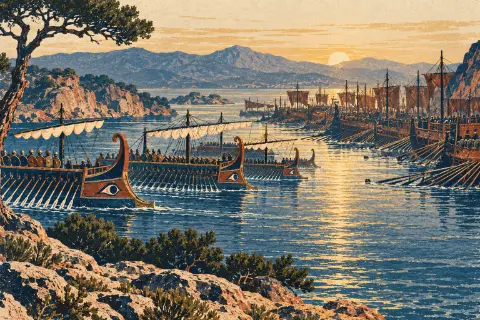 The Persian Wars (490–479 BC)
 The Battle of Marathon and the first marathon
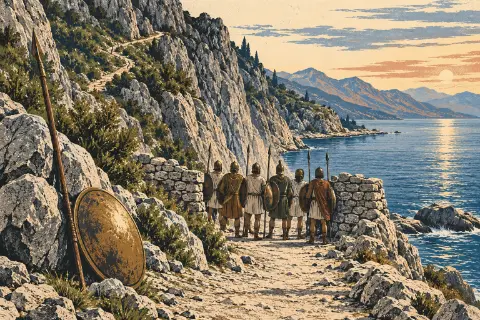 Thermopylae: the 300 at the pass (480 BC)