
Kouroi and korai: the smiling statues
Walk into the National Archaeological Museum in Athens and you meet rows of young people made of stone. Most of them come from the 6th century BC, the Archaic period, and most are carved in marble, μάρμαρον. The young men are called κοῦροι (kouroi), from κοῦρος, “young man”. The young women are called κόραι (korai), from κόρη, “girl”. They all stand straight, look ahead and smile.
A kouros is usually naked. His arms hang down beside his body, and his left foot is a little in front of the right. A kore is dressed. With one hand she lifts her long garment, and in the other she holds a flower bud or a fruit in front of her chest.
These statues had two jobs. Some were gifts to a god, set up in a sanctuary. Others stood over the grave of an important person, as a grave marker, a σῆμα. The kouros from Anavyssos, for example, shows Kroisos, a man who died in battle. Greek sculptors had learned from Egypt and the East, and the stiff, frontal pose still shows it.
Test yourself: 4 words from this page
1 / 4
What does this word mean?
Greek statues were painted
Today these statues look white or grey, so many people think that Greek sculpture was meant to be white. It was not. A close look at the surface of many ancient statues and reliefs shows traces of paint. Colour, χρῶμα in Greek, was part of the work, not an extra.
Some statues still show it. The large kouros from Sounion wears sandals that were only painted on his feet. The kore Phrasikleia, found in 1972 at Merenda in Attica, wears jewellery and a red dress. The patterns on her clothes are carved so clearly that researchers could draw the whole colourful decoration again. Close study of the Peplos Kore from the Acropolis showed that she wears the dress of a goddess, probably Artemis.
On the Acropolis of Athens, the korai fell when the Persians burned the city in 480 BC. Archaeologists found them in the late 19th century, almost where they had fallen, and several still have traces of colour. In 2007–2008, the exhibition “Gods in Color” at Harvard showed full-size painted reconstructions of ancient sculptures, so visitors could imagine how they first looked.
The classical style: a body that moves
In the early 5th century BC, the Greek sculptor, the γλύπτης, began to leave the stiff Archaic pose behind. Statues became deeper and were made to be seen from all sides: as the National Archaeological Museum puts it, sculpture “conquers the third dimension”. The smile disappeared, and faces became calm and serious. This is the Classical style.
The biggest change was in the legs. A classical statue rests its weight on one leg, while the other leg is relaxed and drawn back. Hips and shoulders tilt in opposite directions, and the body seems alive. The Roman writer Pliny the Elder (Natural History 34.55–56) says this idea, a statue standing on one leg, was the special invention of Polykleitos of Argos. Polykleitos also made a statue that artists called the κανών, the “rule”, because they took the right proportions of the body from it, as if from a law. It is usually identified with his Doryphoros, the spear-bearer, although Pliny names the two works separately.
Other sculptors of the 5th century BC are still famous. Myron made the Discobolus, the discus-thrower. The Athenian Pheidias made the Athena Parthenos, a statue 12 metres tall in gold and ivory.
Lost bronzes and later copies
Many of the most famous Greek statues were not made of marble but of bronze. Ancient Greek used one word, χαλκός, for both copper and bronze. Original bronzes are rare today. One of the few is the great bronze god found on the seabed off Cape Artemision in Euboea: he is either Zeus with his thunderbolt or Poseidon with his trident, and no one can say for sure which. The bronze youth of Antikythera also came out of the sea, from a shipwreck.
We know many lost works only through later copies, often Roman, in marble. The Diadoumenos found on Delos, an athlete tying a victory ribbon round his head, is a marble copy made around 100 BC of a bronze by Polykleitos. The copyist added a tree trunk next to his leg, because marble needs more support than bronze. So when you look at a “Greek statue” in a museum, ask the label: is this the original, or a copy made centuries later?
Greek still has a special word for a statue that honours a person: ανδριάντας, from ancient ἀνδριάς.
Key dates
- 7th c. BCStone statues begin to replace the old wooden ones.
- 6th c. BCThe age of the marble kouroi and korai.
- c. 530 BCThe Peplos Kore is carved for the Acropolis of Athens.
- 480 BCThe Persians burn the Acropolis; its korai fall to the ground.
- c. 450–425 BCPolykleitos makes his bronze Diadoumenos.
- c. 100 BCA marble copy of the Diadoumenos is made on Delos.
- 1972The kore Phrasikleia is found at Merenda in Attica.
Eight words, then and now
| Ancient Greek | Greek today | Meaning |
|---|---|---|
| kouros statue (ancient: youth) | ||
| daughter, girl | ||
| sculptor | ||
| marble | ||
| copper (bronze: μπρούντζος) | ||
| statue honouring a person | ||
| rule, model | ||
| colour, paint |
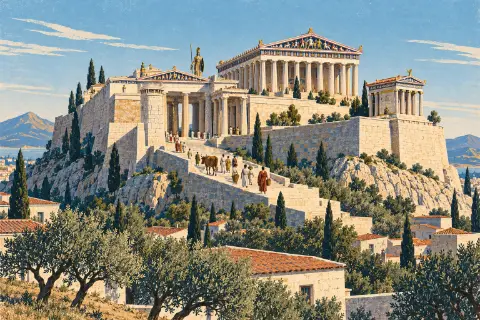 The Acropolis of Athens
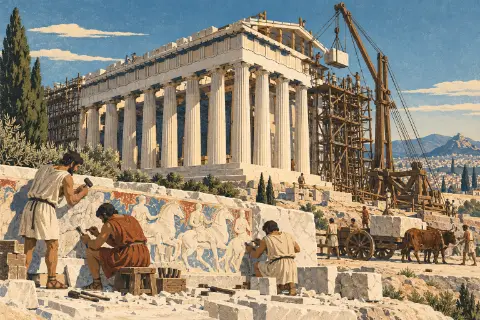 The Parthenon: building, sculptures and story
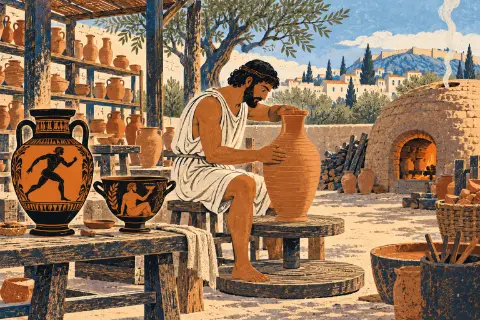 Greek pottery: black-figure and red-figure