
Same word, new job
Greek words can live for a very long time. Their spelling often stays almost the same, but their meaning can move. Take σχολή. For Plato and Aristotle it first of all meant free time, the hours when you did not have to work. Today a Greek student studies at a σχολή of a university, such as the Ιατρική Σχολή, the faculty of medicine, and a child goes to the σχολείο.
Or take ἐκκλησία. In the ancient cities this was the assembly, the meeting of all the citizens. Today εκκλησία is the word for a church. When a service ends, Greeks can say «Σχόλασε η εκκλησία», “church is out”. That short sentence holds two of our words: the verb σχολώ, “to finish work”, comes from the same family as σχολή.
How does a meaning change? People use a word for something close to the old meaning, and the new use slowly takes over. The ἐκκλησία was a group of people called together. Christians used the word for their community, and later for their building. So a word can look familiar and still surprise you.
Test yourself: 4 words from this page
1 / 4
What does this word mean?
σχολή, πομπή, ιδιώτης: three different stories
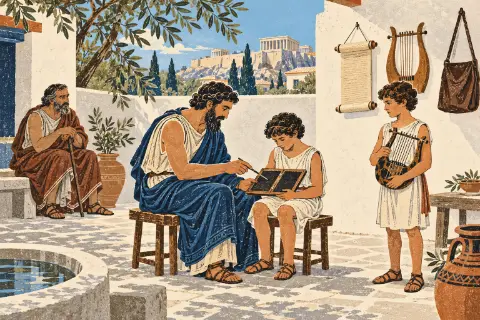
σχολή. The Liddell–Scott–Jones dictionary (LSJ) starts with “leisure”; Aristotle quotes the proverb οὐ σχολὴ δούλοις, “no leisure for slaves” (Politics 1334a). Then the word moved to what leisure was used for: learned discussion, lectures, and next the group that heard them. The modern “faculty” was shaped by French faculté and German Fakultät. The old sense survives in popular σχόλη, a day off work.
πομπή. From πέμπω, “I send”, it meant an escort in Homer, then a solemn procession (Herodotus 5.56, Thucydides 6.56). The formal sense lives on: «η πομπή του Επιταφίου», the Good Friday procession. In popular Greek, mostly in the plural, πομπές are disgraces. Ancient πομπεύω could already mean “abuse with coarse jokes” (Demosthenes 18.124), since such jokes belonged to some festival processions. In medieval Greek it meant parading someone for public mockery, and the Triantafyllidis dictionary derives the sense of disgrace from that. It does not say whether the ancient jokes led there.
ἰδιώτης. From ἴδιος, “one’s own”: a private person as opposed to an office-holder (Herodotus 1.59), or a layman as opposed to an expert, «ἰατρὸς καὶ ἰδιώτης» (Thucydides 2.48). LSJ also gives “ignoramus” (Demosthenes 4.35). In Greek the main sense hardly moved: ιδιώτης is still a private individual, «Κράτος και ιδιώτες». The psychiatric term ιδιώτης came from French idiot, from Latin idiota, itself from ἰδιώτης.
Splits, shifts and slow drifts
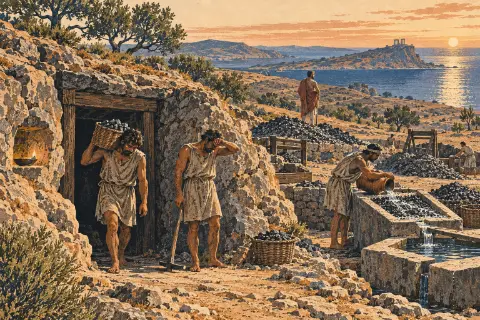
Sometimes one word splits in two. Ancient δουλεία meant slavery. In medieval Greek the final vowels were run together, and the result, δουλειά, today means work or a job. The learned form δουλεία kept the old sense, so Modern Greek has both, and the dictionary plays on the pair: «Η δουλειά όταν καταπιέζει τον εργαζόμενο γίνεται δουλεία». LSJ also records “service for hire” for δουλεία in the Septuagint.
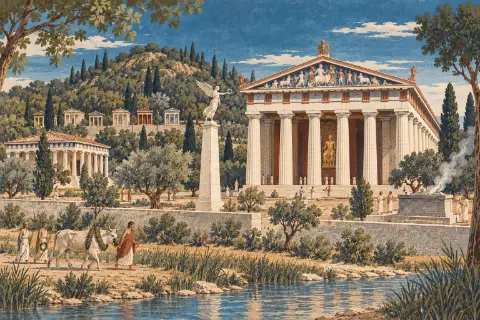
Sometimes a word narrows. ἄγαλμα was a glory or delight in Homer, then a pleasing gift for the gods, then the statue of a god (Herodotus 1.131), and then any statue (Plato, Meno 97d). Today άγαλμα is just a statue: the older senses have gone from the everyday word.
Sometimes a word moves to something quite new. καιρός was due measure and then the critical moment. The sense of a period of time is Hellenistic, and the sense of weather is medieval: «Τι καιρό κάνει;» Similarly, ψάρι goes back to ὀψάριον, a diminutive of ὄψον, cooked food eaten with bread. It came to mean fish in the Hellenistic period, and later replaced ἰχθύς in everyday speech.
Dictionaries usually date such changes by period, not by year, because a new sense is only recorded after people have begun to use it.
Meanings borrowed from abroad, and false friends
Some ancient words received their modern sense from another language. ὑπουργός meant “rendering service”, an assistant (Hippocrates) or a servant (Polybius). Today υπουργός is a government minister, a sense modelled on Italian ministro and French ministre, the king’s helper. ἄτομος meant “uncut, indivisible”: άτομο as “a person” follows French individu, and the chemist’s atom follows French atome. Linguists call this a semantic loan: the form is Greek, the new meaning is imported.
If you are learning Ancient Greek, or moving from it to Modern Greek, these are the false friends to watch:
- In Thucydides, ἐκκλησία is an assembly, never a church.
- In a Greek newspaper, υπουργός is a minister, not a helper.
- In a forecast, καιρός is the weather; in Pindar, it is the moment to act.
- In Thucydides, δουλεία is slavery; at the office, δουλειά is just your work.
- In Plato, σχολή is first of all leisure, though it can already mean discussion.
The safest habit is to look the word up twice: in LSJ for the ancient text, and in the Triantafyllidis dictionary for today’s use, where the note at the end of each entry gives its history.
Eight words, then and now
| Ancient Greek | Greek today | Meaning |
|---|---|---|
| leisure (now: faculty) | ||
| procession (now also: disgrace) | ||
| private person, layman | ||
| assembly (now: church) | ||
| slavery (δουλειά now: work) | ||
| delight, offering (now: statue) | ||
| critical moment (now also: weather) | ||
| assistant (now: minister) |
 School and education in ancient Greece
 Slavery in ancient Greece
 Olympia: the sanctuary of Zeus