
From the κῶμος to the festival contest
The word κωμῳδία is already in Aristophanes (Acharnians 378). It is generally derived from κῶμος, a revel or band of revellers, and ᾠδή, song. Aristotle (Poetics 1448a) reports that Dorians linked it instead to κώμη, village; the standard dictionary, LSJ, calls this wrong. The beginnings remain obscure, and Aristotle says so himself: early comedy went unnoticed because nobody took it seriously, and the archon granted it a chorus only late (1449b).
The firm dates are few. An official comic contest began at the City Dionysia in 486 BC (some sources say 487/6) and at the Lenaia around 440 BC. Comedy should not be confused with the satyr play (σατυρικό δράμα), which closed a tragic poet’s set of plays. Nor did the σάτυρος, the follower of Dionysus, give us σάτιρα: that modern word came through Italian from Latin satira.
The period labels are later than the plays. Aristotle contrasts old and new comedies in the Nicomachean Ethics (1128a): the old laughed at obscene language (αἰσχρολογία), the new preferred insinuation (ὑπόνοια). Later writers, among them Marcus Aurelius (11.6), use the three terms Old, Middle and New (ἀρχαία, μέση, νέα). Treat the boundaries between them as approximate.
Test yourself: 4 words from this page
1 / 4
What does this word mean?
Aristophanes and Old Comedy
Only one poet of Old Comedy survives in complete plays. Cratinus and Eupolis are known from fragments, whereas eleven comedies by Aristophanes remain, dated 425 to 388 BC, out of about forty (the Suda says 44). His targets were living people. In Acharnians 377–378 the hero, speaking for the poet, recalls what he suffered from Cleon because of “last year’s comedy”; the outcome of that dispute is unknown. In Knights (424 BC) Cleon appears as a Paphlagonian slave, and lines 230–232 joke that no mask-maker dared to copy his face. Clouds (423 BC) came last in its contest; Plato’s Socrates (Apology 19c) later recalls its stage “Socrates” claiming to walk on air.
Handbooks describe the usual order of a play:
- πρόλογος: the actors set out the problem.
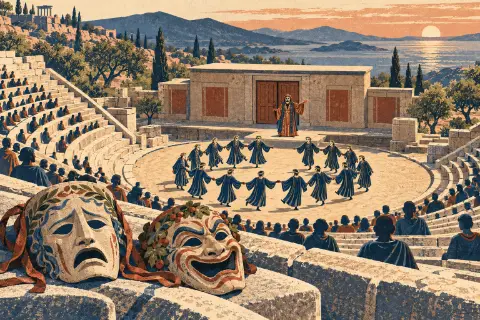
- πάροδος: the chorus enters, by tradition 24 strong and often costumed, as wasps or birds.
- ἀγών: a formal clash of opinions; in Frogs 883 Aeschylus and Euripides face an ἀγὼν σοφίας, a contest of wisdom.
- παράβασις: the chorus turns to the audience.
- ἐπεισόδια: short scenes mixed with choral songs.
The parabasis: the chorus turns to the audience
At a break in the action the chorus drops its role and speaks directly to the spectators, often in the poet’s name. Aristophanes has the verb for this: to step “towards the audience”, πρὸς τὸ θέατρον παραβῆναι (Knights 508; compare Peace 735 and Thesmophoriazusae 785). LSJ cites the noun παράβασις for this scene only from later authors, such as Plutarch and Hephaestion. The image behind it is not agreed: LSJ says the chorus “came forward”, while others explain that it “steps aside” from its role.
Two examples show the range. In Clouds 518, in the revised text that survives, the chorus opens with ὦ θεώμενοι κατερῶ πρὸς ὑμᾶς ἐλευθέρως τἀληθῆ, “spectators, I will tell you the truth freely”, and the poet’s complaint about the play’s defeat follows. In Frogs 686–688 the “sacred chorus” claims the right to advise the city and urges it to make the citizens equal (ἐξισῶσαι τοὺς πολίτας). How far such passages give Aristophanes’ own views is debated. The parabasis was never compulsory: Liddell and Scott note its absence from Lysistrata, Assemblywomen and Wealth, and no surviving play after Frogs (405 BC) has one.
From Aristophanes to Menander
After the Peloponnesian War comedy changes. The texts of Assemblywomen (c. 392 BC) and Wealth (388 BC) carry the note χοροῦ, “of the chorus”, where a choral song is no longer written out. Platonius, a later critic, blames the decline of political attack on fear of lawsuits and a shortage of men willing to fund choruses; one ancient explanation, not a proven cause. No complete play survives between 388 and 316 BC, so Middle Comedy is known from titles and fragments.
New Comedy, from the 320s BC, moves into the private house. Its plots rest on coincidence and on stock characters: the young man in love, the clever slave, the boastful soldier, the talkative cook, the parasite. Menander (c. 342–291 BC; dates vary slightly) is credited with 108 plays by the Suda, but only eight victories are known. His first production is dated 321 BC, and his Δύσκολος, “the bad-tempered man”, won at the Lenaia of 316 BC.
Menander did not come down through medieval manuscripts. He returned from Egyptian papyri: the Cairo codex was published in 1907, and a Bodmer codex of the 3rd century AD gave us the Δύσκολος in 1958, the one play that survives almost complete. Plautus and Terence adapted Greek originals for Rome, at least ten of their plays coming from Menander and Philemon. The titles still speak Modern Greek: βάτραχοι are frogs, σφήκες are wasps, and δύσκολος, once peevish, now mainly means difficult.
Key dates
- 486 BCComedy becomes an official contest at the City Dionysia
- c. 440 BCComedy is added at the Lenaia
- 425 BCAcharnians, Aristophanes’ earliest surviving play
- 423 BCClouds comes last in its contest
- 405 BCFrogs: Aeschylus against Euripides in the underworld
- 388 BCWealth, Aristophanes’ last surviving play
- 316 BCMenander’s Dyskolos wins at the Lenaia
- 1958The Dyskolos is published from the Bodmer codex
Eight words, then and now
| Ancient Greek | Greek today | Meaning |
|---|---|---|
| comedy | ||
| chorus’s address; today a violation | ||
| chorus; today mainly dance | ||
| satyr, follower of Dionysus | ||
| peevish; today mainly difficult | ||
| frog | ||
| wasp | ||
| contest; today also a match |
 Greek theatre: tragedy, comedy and masks