
A festival for a god
The Διονύσια were festivals of Dionysus, the god of wine. Athens and its countryside held several of them. In winter, in the month of Poseideon (December–January), villages kept the Rural Dionysia. In Aristophanes’ comedy The Acharnians, the farmer Dicaeopolis holds his own: his daughter carries a basket, his slaves carry a fertility symbol, and his wife watches from the roof.
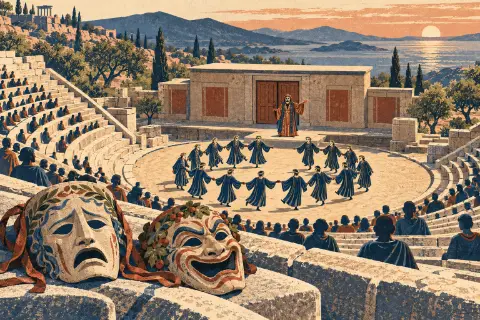
The greatest was the City Dionysia, held in spring, in the month of Elaphebolion (March–April), in the Theatre of Dionysus on the slopes of the Acropolis. Tradition says that the tyrant Pisistratus founded or enlarged it around 534 BC, but some scholars date its official drama contests to about 501 BC, after the tyrants had fallen. It was a religious occasion above all: a law quoted by Demosthenes (21.10) forbade anyone to seize a debtor’s goods during the festival days.
Test yourself: 4 words from this page
1 / 4
What does this word mean?
From the procession to the plays
An old story said that the wooden statue of Dionysus had come to Athens from Eleutherae, on the border with Boeotia (Pausanias 1.38.8). Before the festival it was taken to a temple outside the city and carried back by torchlight. The great procession, the πομπή, had baskets, wine, fertility symbols and bulls for sacrifice, while the sponsors walked in their finest clothes.
Aeschines (3.67) mentions a προαγών, a “pre-contest”, on the eighth day of the month. He also recalls (3.154) that in earlier days, just before the tragedies, a herald brought forward young men whose fathers had died in war. The law in Demosthenes lists the procession, the boys’ choruses, the revel (κῶμος), the comedies and the tragedies. Beyond this, the timetable is uncertain: modern accounts give five days or seven, and the historian M. L. Damen warns that we do not know how many days the festival took.
A contest with rules
The festival was an ἀγών, a contest. The Athenian tribes provided sponsors for choruses of men and of boys (Constitution of the Athenians 56.3), who performed the διθύραμβος, a hymn to Dionysus. Ancient evidence points to fifty men in such a chorus. Three tragic poets competed, each with three tragedies and a satyr play, though the rules changed over time.
The archon, a senior official, chose three of the richest citizens as χορηγοί for tragedy, and once also five for comedy. Each paid to train and equip a chorus. Judges were normally chosen by lot, but Plutarch (Cimon 8) tells how one year the archon made the ten generals judge instead, and the young Sophocles won. We do not know exactly how the prizes were decided. There were first, second and third places, and a winning sponsor’s name could be recorded on stone.
What the plays had to do with the god
A popular saying claimed that tragedy had “nothing to do with Dionysus”. It was nearly true of the plots: as Damen notes, all but one of the thirty-three surviving classical tragedies deal with myths not centred on him. Scholars still argue about how far drama grew out of his worship at all. Audiences were large, in the thousands. When Plato’s Socrates speaks of “more than thirty thousand Greeks” admiring a winning poet (Symposium 175e), it is a teasing compliment, not a count.
The festival’s words are still in use. A χορηγός today is the sponsor of an arts or sports event. Critics can still “write διθυράμβους” about a show they love. An αγώνας can be a football match, a κριτής judges a competition, and a πομπή is a formal procession, such as that of the Επιτάφιος through the streets.
Key dates
- c. 534 BCTraditional date for drama at the City Dionysia under Pisistratus; some scholars prefer c. 501 BC.
- 486 BCComedy joins the contest, as the victory lists suggest.
- 458 BCAeschylus stages the Oresteia, the only complete trilogy that survives.
- c. 449 BCActors begin to compete for a prize of their own.
- c. 440 BCDrama contests also begin at the winter festival, the Lenaia.
Eight words, then and now
| Ancient Greek | Greek today | Meaning |
|---|---|---|
| dance; chorus | ||
| tragedy | ||
| comedy | ||
| contest; sports match | ||
| chorus funder; sponsor | ||
| hymn to Dionysus; lavish praise | ||
| judge | ||
| procession |
 Greek theatre: tragedy, comedy and masks