
A genre born in Athens
The word τραγῳδία is usually explained as “goat-song” (τράγος, goat, and ᾠδή, song), but nobody knows why: a goat as a prize, a goat sacrifice and singers dressed as satyrs have all been proposed. Aristotle (Poetics 1449a) says that tragedy grew out of the leaders of the dithyramb, a choral song for Dionysus. A later tradition, preserved on the Parian Marble, names Thespis as the first tragic poet, about 534 BC, but that inscription was carved some three centuries later and mixes history with legend.
In the fifth century, three poets were chosen each year for the City Dionysia, and each presented a tetralogy: three tragedies and a satyr play. Plots were almost always taken from myth, above all the royal houses of Thebes, Argos and Troy. Aeschylus’ Persians (472 BC), about the defeat of Xerxes, is the only surviving tragedy on recent history. Hundreds of tragedies were written, yet complete plays survive by only three authors, and our picture of the whole genre rests on them.
Test yourself: 4 words from this page
1 / 4
What does this word mean?
The parts of a tragedy
In Poetics 1452b Aristotle lists the parts into which every tragedy is divided. Spoken scenes for the actors alternate with songs for the chorus:
- πρόλογος (prologue): everything before the chorus enters, often a speech that sets out the situation.
- πάροδος (parodos): the first song of the chorus, sung as it comes in.
- ἐπεισόδιον (episode): a scene of dialogue between two choral songs, where the action moves forward.
- στάσιμον (stasimon): an ode sung by the chorus between episodes, often reflecting on what has just happened.
- ἔξοδος (exodos): the whole final part, after the last song of the chorus.
He adds the κομμός, a lament shared by chorus and actors. A typical play therefore runs prologue, parodos, several episodes separated by stasima, and exodos. The spoken parts are mostly in iambic trimeter, a metre close to everyday speech, while the choral odes use lyric metres and were sung and danced. Violent deaths usually happen out of sight and are reported by a messenger, the ἄγγελος, whose long speech is one of the set pieces of the genre.
Pity, fear and catharsis; error and hybris
Aristotle’s definition (Poetics 1449b) says that tragedy is the imitation, μίμησις, of a serious and complete action which, through pity and fear (δι᾽ ἐλέου καὶ φόβου), brings about the κάθαρσις of such emotions. What κάθαρσις means here is one of the most debated questions in literary criticism: a medical “purging”, a religious “purification” and an intellectual “clarification” have all been defended, and the surviving Poetics never explains it.
The best plot, he says (1453a), shows a man neither outstandingly good nor wicked who falls from good fortune to misfortune not through vice but through some ἁμαρτία, an error, as Oedipus does. Its strongest moments are περιπέτεια, a reversal of the situation, and ἀναγνώρισις, a change from ignorance to knowledge (1452a): the messenger from Corinth comes to cheer Oedipus and, by revealing who he is, does the opposite.
ὕβρις is not a term of the Poetics; it belongs to the plays themselves. In Aeschylus’ Persians (821) the ghost of Darius says that hybris, once it flowers, bears a crop of ruin (ἄτη). Reading every hero’s ἁμαρτία as proud ὕβρις is a later habit that many scholars reject. Behind it all stands μοῖρα, a person’s allotted portion, and the question of how far humans shape their own fate.
Aeschylus, Sophocles, Euripides
Aeschylus (c. 525–456 BC) fought at Marathon and, by tradition, at Salamis. Aristotle credits him with adding a second actor, which made real dialogue possible. He wrote at least seventy plays; seven survive under his name, though many scholars doubt that Prometheus Bound is his. Among them is the Oresteia of 458 BC, the only complete trilogy we have.
Sophocles (c. 495–406 BC) won his first victory in 468 BC and went on to an unmatched number of first prizes. Aristotle says that he introduced the third actor, and he is said to have fixed the chorus at fifteen. Seven of his plays survive, among them Antigone and Oedipus the King, Aristotle’s favourite example.
Euripides (c. 485–406 BC; some sources give c. 480) won only five victories, one of them after his death, yet his plays seem to have been staged more often than theirs in later antiquity. Nineteen plays come down under his name, including Medea and the Bacchae, although Rhesus is probably not his. His characters argue, doubt and sometimes behave badly, and a god often appears at the end to settle what humans could not.
Key dates
- c. 534 BCThespis, by later tradition, wins the first tragic contest at the City Dionysia
- 484 BCAeschylus’ first victory, according to the Parian Marble
- 472 BCAeschylus’ Persians, the earliest surviving tragedy
- 468 BCSophocles wins his first victory
- 458 BCAeschylus’ Oresteia, the only complete surviving trilogy
- 441 BCEuripides’ first victory
- 406 BCEuripides and Sophocles die within months of each other
- 4th c. BCAristotle’s Poetics defines tragedy and its parts
Eight words, then and now
| Ancient Greek | Greek today | Meaning |
|---|---|---|
| arrogant outrage; today an insult | ||
| emotional cleansing | ||
| fate, one's lot | ||
| tragic error; today sin | ||
| reversal; today adventure | ||
| recognition of the truth | ||
| episode; today also incident | ||
| pity, mercy |
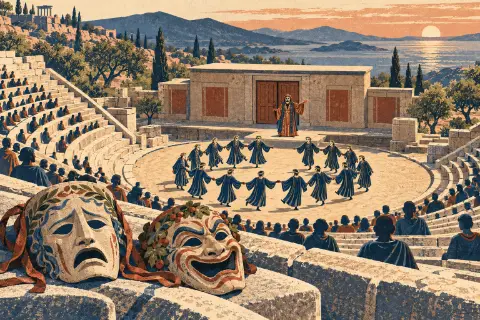 Greek theatre: tragedy, comedy and masks