
The island that floated
Delos is tiny: about 5 kilometres long and only a little more than 1 kilometre wide. Its one hill, Kynthos, is just 113 metres high. Yet for the Greeks this νῆσος, this island, was one of the most important places in their world.
A myth explains why. The goddess Leto was going to have twins, and their father was Zeus. Hera, the wife of Zeus, was furious, so no land dared to welcome Leto. Only Delos said yes. An old poem, the Homeric Hymn to Apollo, tells us that Leto put her arms around a φοῖνιξ, a palm tree, and gave birth to Apollo.
Later poets added more. Pindar and Callimachus say that Delos once floated on the sea. Callimachus says that its first name was Ἀστερίη, because it had jumped from the sky into the water like an ἀστήρ, a star. After the birth it stood still. In his poem, sailors gave it a new name, because it no longer sailed around ἄδηλος, unseen. So the Greeks heard the word δῆλος, “clear, visible”, in the name Delos. Remember that this is a story, not history.
Test yourself: 4 words from this page
1 / 4
What does this word mean?
Lions, a lake and strange rules
The Greek word for sacred is ἱερός, and a holy place is a ἱερόν, a sanctuary. People used this place long before the classical Greeks: remains from 1400–1200 BC lie under the sanctuary of Apollo. Near the end of the 7th century BC, the people of the island of Naxos gave Apollo splendid gifts. Among them was a row of marble λέοντες, lions, looking towards a holy λίμνη, a lake. We do not know how many there were: writers today say at least nine, and some say sixteen. The lions you see outside now are copies. The originals are in the island's museum, safe from the weather. The lake, which Herodotus calls “wheel-shaped”, is gone too: it was dried up in 1925, after an outbreak of malaria.
Delos also had unusual rules. A holy island had to stay “clean”, so the Athenians “purified” it twice. In the 6th century BC, the Athenian ruler Peisistratos dug up the graves within sight of the sanctuary. In the winter of 426/425 BC, the Athenians removed every grave on the island. The historian Thucydides adds a surprising rule: from then on, nobody was allowed to die or to give birth on Delos. People had to cross to the next island, Rheneia, which is very close.
Treasure and slaves
In 478/477 BC, after the wars against Persia, Athens and many Greek cities formed an alliance. Because they kept their shared money on Delos and met in the sanctuary, we call it the Delian League today. Around 454 BC, the money was moved to Athens. By then the allies were becoming more like subjects of Athens.
The island's richest years came later. In 167/166 BC, Rome gave Delos to Athens and made it a free port, a harbour where traders paid no taxes. The Delians themselves were sent away. Merchants arrived from many lands.
This wealth had a terrible side. Delos became a great market for δοῦλοι, enslaved people. The geographer Strabo wrote that it could take in and send off tens of thousands of them in a single day. We cannot check his number, but it shows how famous the market was.
The end was violent. In 88 BC, during the war between Rome and King Mithridates, his soldiers attacked the island, which had no walls. The writer Pausanias says that they killed the men and enslaved the women and children. In 69 BC it was raided again. By the 2nd and 3rd centuries AD, only a small settlement was left.
Delos today
For centuries, Delos was covered with stones and bushes. About a hundred travellers wrote about it between the 15th and the 19th century, and many of them found it a hard place to visit. In 1873, the French School at Athens began to dig, and its work has gone on, with breaks, ever since. Greek archaeologists and scholars from other countries have worked there too. Even so, only about a third of the ancient site has been uncovered. Much of the town is still under the ground.
In 1990, Delos joined the UNESCO World Heritage List. Building is forbidden on the island, except for buildings needed for the archaeological work. So there is no modern town here, as there is on other Greek islands. Visitors usually arrive on a day trip by boat from nearby Mykonos.
When you walk there, look for the row of lions and for the ruins of Apollo's ναός, his temple. Greek still uses these words. The island is still called Δήλος, a holy place is still an ιερό, and a ναός is still a temple or a church. A νησί is what Greeks call an island today, from the ancient νησίον, a little island.
Key dates
- 1400–1200 BCMycenaean remains are left under the later sanctuary
- 7th c. BCThe people of Naxos dedicate the marble lions to Apollo
- 478/477 BCThe Delian League begins, with its money kept on Delos
- c. 454 BCThe League's money is moved to Athens
- 426/425 BCAthens removes all graves; no births or deaths allowed
- 167/166 BCRome gives Delos to Athens and makes it a free port
- 88 BCThe soldiers of King Mithridates destroy the town
- 1873The French School at Athens begins to excavate
Eight words, then and now
| Ancient Greek | Greek today | Meaning |
|---|---|---|
| island (via νησίον, islet) | ||
| sacred, holy | ||
| lion (via λεοντάριον) | ||
| star | ||
| palm tree | ||
| temple; today also a church | ||
| lake | ||
| to declare, make clear |
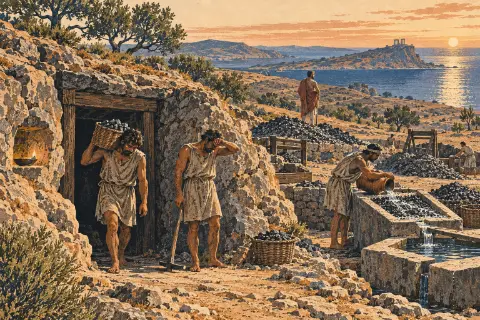 Slavery in ancient Greece
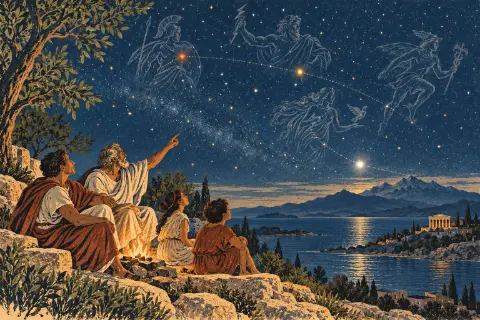 Greek and Roman gods: the names compared
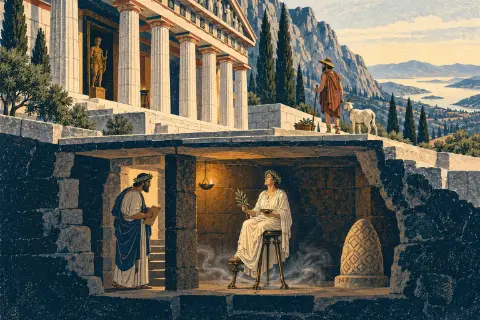 The Oracle of Delphi and the Pythia