
A Greek colony between two continents
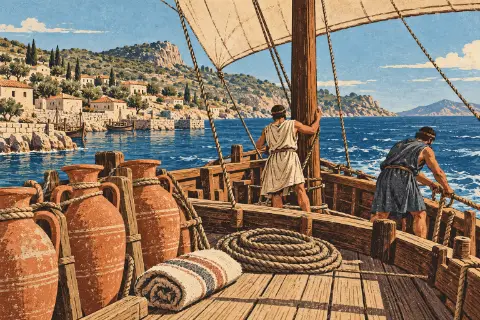
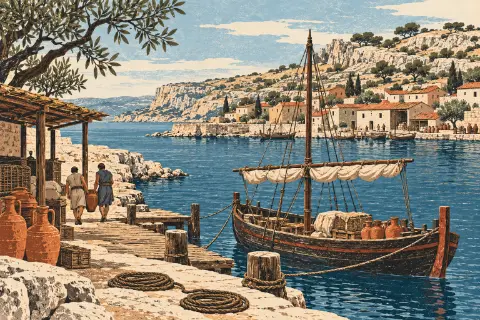
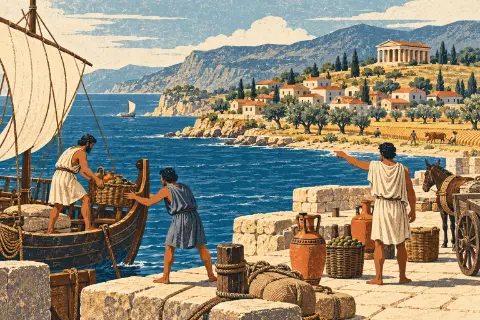
In the 7th century BC, Greeks from the city of Megara sailed east. They built a new town on a narrow strip of sea between Europe and Asia. This strip of sea is the Βόσπορος (Bosporus). The town was Βυζάντιον (Byzantion), on the European side. It was small at first. A town founded by Greeks far from home was an ἀποικία (apoikia), a colony.
Later writers say that the leader was a man called Byzas. We cannot be sure that he was real. Books also give slightly different dates, often around 660 BC. But we are quite sure about Megara, because Byzantion used the same names as Megara for its months and its public institutions.
Test yourself: 4 words from this page
1 / 4
What does this word mean?
The land of the blind
The Roman writer Tacitus tells a story. The Greeks asked the oracle of Apollo where to build their city. The answer was: opposite the land of the blind. Across the water stood Chalcedon, a Greek town that was already there. Its people had come first, yet they had chosen the worse place. So they had to be τυφλοί (blind)! Herodotus tells it differently. For him, a Persian general named Megabazus made this joke, when he heard that Chalcedon was seventeen years older.
Why was the place so good? The Greek geographer Strabo describes a long bay beside the walls, shaped like a stag's horn. He calls it τὸ Κέρας, the Horn; today we say the Golden Horn. The current pushed shoals of πηλαμύς, a small kind of tuna, into it. There were so many that people could catch them by hand. In Greek today this fish is the παλαμίδα.
The town that guarded the Black Sea
Fish were not the only wealth. Every ship going to or from the Black Sea had to pass Byzantion. The Greek historian Polybius wrote that no merchant could sail in or out against the town's will. From the Black Sea came cattle, slaves, honey, wax and salted fish. Going the other way were olive oil and wine. Grain moved both ways, and Athens badly needed it.
So stronger powers wanted this town. It came under Persian rule around 513 BC. After the Persian Wars it joined the league led by Athens. In 340 BC Philip II of Macedon besieged it, but he had to pull back. In 220 BC, when Byzantion made passing ships pay money, the island of Rhodes went to war, and Byzantion gave in.
Three names for one city
In 324 AD Constantine became sole ruler of the Roman Empire. He wanted a new capital in the east, and he chose Byzantion. He made it much bigger, and in 330 it became the capital. Its new name was Κωνσταντινούπολις (Constantinople), the city of Constantine. It stayed a capital for more than a thousand years. In 1453 the Ottomans took it, and it became the capital of the Ottoman Empire.
The name Istanbul grew slowly. Some books say that the city was renamed in 1453, but the Ottomans still wrote names like Kostantiniyye in official papers. The date usually given for the official name is 1930, when the Turkish post office stopped accepting letters addressed to Constantinople. Many scholars think that the name Istanbul comes from the Greek words for «to the City», εἰς τὴν Πόλιν, though others think it comes straight from the Greek name Κωνσταντινούπολις. So a Greek colony gave the city its first name, and perhaps also its latest one.
Key dates
- 7th c. BCGreeks from Megara found Byzantion on the Bosporus.
- c. 513 BCByzantion comes under Persian rule when Darius I crosses into Europe.
- 340 BCPhilip II of Macedon besieges the city, then pulls back.
- 220 BCRhodes goes to war over the money Byzantion charges passing ships.
- 330Constantine makes the enlarged city his new capital.
- 532–537The great church of Hagia Sophia, Ἁγία Σοφία, is built.
- 1453The Ottomans take the city, and it becomes their capital.
- 1930Turkey's post office insists on Istanbul, the usual date for the official name.
Eight words, then and now
| Ancient Greek | Greek today | Meaning |
|---|---|---|
| Byzantion, the Greek colony | ||
| city of Constantine | ||
| city (η Πόλη: Istanbul) | ||
| citizen (Πολίτης: Istanbul Greek) | ||
| colony | ||
| blind | ||
| small tuna-like fish | ||
| horn |
 Greek colonies around the Mediterranean and the Black Sea
 Massalia: how Greeks founded Marseille
 Magna Graecia: the Greeks of southern Italy and Sicily