
A kingdom in danger
Macedon, Μακεδονία, was a kingdom north of the Greek city-states. Around 360/359 BC it was in serious trouble. King Perdiccas had been killed fighting the Illyrians, and more than 4,000 Macedonians had died with him (Diodorus 16.2). Neighbours were raiding the land, and two rivals wanted the throne. The man who took charge was the king's younger brother, Philip. Livius, a modern reference site, dates his birth to 382 BC, which makes him about 22, and says that he began as regent for a young nephew.
As a boy, Philip had lived in Thebes as a hostage, a person held to make sure a treaty was kept. Diodorus says he stayed with the father of the general Epaminondas; another tradition names the Theban Pammenes. Historians often suggest that he learned about warfare there, but that is a reasonable guess, not something we can prove.
Philip did not fight all his enemies at once. He paid some of them to stay quiet, gave up Amphipolis for the moment, and trained his men (Diodorus 16.3). Then he defeated the Paeonians and the Illyrians (16.4).
Test yourself: 4 words from this page
1 / 4
What does this word mean?
Phalanx, gold and marriages
Diodorus (16.3) says that Philip held constant drills and was the first to organise the Macedonian phalanx, φάλαγξ, a block of infantry in close order. The weapon linked with it is the σάρισα, a long pike. Diodorus does not name it in that passage. Polybius (18.29), writing much later, gives fourteen cubits in practice, and one modern account gives 18–20 feet, about six metres. Historians still discuss its length and how early Philip's men carried it.
Money paid for all this. In 357 BC Philip captured Amphipolis. He then took over Crenides, Κρηνίδες, renamed it Philippi, Φίλιπποι, after himself, and developed its gold mines; modern accounts date this to about 357–356 BC. Diodorus (16.8) says the mines brought in more than 1,000 talents. The gold coin named after him, the Φιλίππειον, paid mercenaries and bribes. Diodorus (16.53) adds that Philip liked to say that gold, far more than arms, had enlarged his kingdom.
Marriage was another tool. Around 357 BC he married Olympias, a Molossian princess and the future mother of Alexander, after earlier marriages to the Illyrian Audata and to Phila (Athenaeus 13.557). War had its price too: at the siege, πολιορκία, of Methone an arrow cost him an eye (Diodorus 16.34).
Demosthenes against Philip
In 348 BC Philip took Olynthus by bribing its officials, plundered it and sold its people as slaves (Diodorus 16.53). In 346 BC Athens made peace with him, the Peace of Philocrates. That same period saw the end of the Phocian War, and Philip received the Phocians' two votes on the Amphictyonic Council, which looked after Delphi (16.59–60).
In Athens, the orator, ῥήτωρ, Demosthenes spoke against him for years. His First Philippic (351 BC) asks the Athenians what news could be more startling than a Macedonian defeating them and settling the affairs of Greece (4.10). The Third (341 BC) says that Philip is not a Greek, nor even a barbarian from a respectable place, but «ὀλέθρου Μακεδόνος», a Macedonian pest (9.31).
That is an attack, not a neutral description. Herodotus (5.22) says that the Macedonian royal house was Greek and that the judges at Olympia accepted this, and Plutarch (Alexander 3) tells of Philip's racehorse winning at the Olympic games. Nor did every Athenian agree with Demosthenes: Isocrates urged Philip himself to bring the Greeks together against Persia (5.16).
Chaeronea and a murder at the theatre
Philip suddenly seized Elateia, and Demosthenes persuaded Athens to seek an alliance, συμμαχία, with Thebes (Diodorus 16.84–85). The armies met at Chaeronea in August 338 BC. Diodorus gives Philip more than 30,000 infantry and at least 2,000 cavalry, and says that Alexander, then about eighteen, broke the enemy line first. Plutarch (Alexander 9) reports that he was said to be the first to break the Theban Sacred Band. Polyaenus describes a pretended retreat instead, so modern writers try to combine the accounts. More than 1,000 Athenians died and at least 2,000 were captured (16.86). The travel writer Pausanias (9.40.10) saw the Thebans' common grave, with a lion on top; the lion has been restored.
Philip freed the Athenian prisoners without ransom but put a garrison in Thebes (16.87). At a congress in Corinth the Greeks elected him commander for a war on Persia (16.89). Then, in 336 BC, at a wedding festival in Aegae, his bodyguard, also named Pausanias, stabbed him at the theatre (16.92–94). Diodorus tells a story of private revenge; Plutarch (Alexander 10) reports that most of the blame fell on Olympias and some on Alexander.
In 1977 Manolis Andronikos found a rich tomb at Vergina, ancient Aegae, and attributed it to Philip. Others have proposed his son Arrhidaeus, and the debate continues.
Key dates
- 382 BCPhilip is born (date as given by Livius).
- 360/359 BCPerdiccas dies fighting the Illyrians, and Philip takes power.
- 357 BCPhilip captures Amphipolis and marries Olympias.
- 351 BCDemosthenes delivers his First Philippic.
- 348 BCOlynthus falls and its people are enslaved.
- 346 BCAthens and Philip make the Peace of Philocrates.
- 338 BCPhilip defeats Athens and Thebes at Chaeronea.
- 336 BCPhilip is murdered at Aegae, and Alexander succeeds him.
Eight words, then and now
| Ancient Greek | Greek today | Meaning |
|---|---|---|
| Macedon; northern Greek region | ||
| fierce verbal attack | ||
| long Macedonian pike (historical term) | ||
| phalanx; also a finger bone | ||
| king | ||
| alliance | ||
| siege | ||
| public speaker |
 Alexander's conquests, on a map
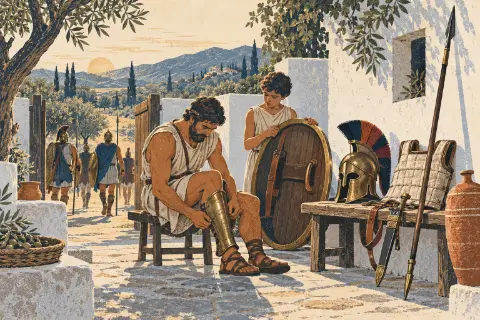 The hoplite: a Greek soldier's equipment