
Who wrote these speeches, and who spoke them
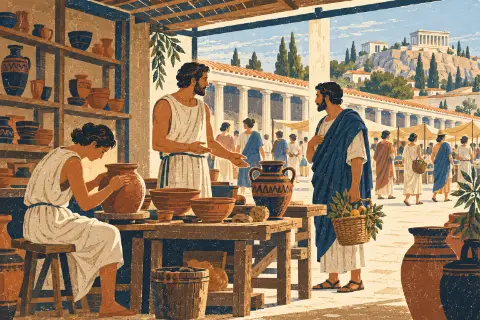
Lysias (c. 445–c. 380 BC) was the son of Cephalus, a wealthy Syracusan who, Lysias says, came to Athens at the persuasion of Pericles (12.4). The family lived there as metics, free foreign residents. Under the Thirty, in 404 BC, Lysias escaped to Megara, and his brother Polemarchus was ordered to drink hemlock without trial (12.17). From about 403 BC he worked as a λογογράφος, a writer of speeches that his clients delivered in their own voices. S. C. Todd links this career to the loss of the family fortune and to the experience of delivering, or at least circulating, Against Eratosthenes.
The numbers need care. About 425 speeches circulated under his name in antiquity, and ancient critics accepted 233. Modern editions print 34 or 35, some of them disputed. K. J. Dover (1968) argued that the speeches cannot be split cleanly into authentic and spurious, so we must work with degrees of probability. He also allowed that client and writer might sometimes compose a speech together. Usher (1976) and Worthington (1993) answered that the writer alone shaped the circulated text, though Worthington allows for a few joint works, and Todd also rejects Dover's theory.
Test yourself: 4 words from this page
1 / 4
What does this word mean?
Five speeches, by section number
Numbers give speech, then section.
- Lysias 1, On the Murder of Eratosthenes. Euphiletus admits killing his wife's lover, as punishment under the laws (1.4). He has the law read from the Areopagus stele (1.30); his accusers say he had his servant fetch the young man that day (1.37). Ath. Pol. 57.3 sends such pleas to the Delphinion, and Todd places the trial there.
- Lysias 12, Against Eratosthenes. Lysias speaks himself, as the title says (ὃν αὐτὸς εἶπε Λυσίας), against a former member of the Thirty; dated to 403 BC. Read the short cross-examination about Polemarchus (12.25) and the close (12.100).
- Lysias 16, For Mantitheus. A young man under scrutiny, δοκιμασία, before the Council answers the charge of serving in the cavalry under the Thirty (16.3), and says a scrutiny calls for an account of one's whole life (16.9). He mentions the Corinth expedition of 394 BC (16.15), so the speech is later.
- Lysias 22, Against the Grain Dealers. Dealers are accused of buying more than the fifty φορμοί the law allows (22.5). The speaker questions one in court («μέτοικος εἶ; ναί») and closes: convict, and you will buy cheaper (22.22). The date is debated.
- Lysias 24, For the Disabled Man. Before the Council, a man defends his allowance against an accuser who says he rides horses and earns enough (24.4–5). He speaks of one obol (24.13, 24.26), while Ath. Pol. 49.4 gives two.
How to read Lysias for an exam
The Centre for the Greek Language's guide describes his plain Attic style, a model for the later Atticists. In On Lysias 8, Dionysius of Halicarnassus praises his ἠθοποιία, the drawing of character, and says he can find no person in Lysias who is «οὔτε ἀνηθοποίητον οὔτε ἄψυχον», without character or lifeless. These points come from the texts themselves:
- The address names the audience: ὦ ἄνδρες δικασταί for a court (12.1, 22.1), ὦ βουλή for the Council (16.1, 24.1).
- Watch the legal idiom. «δίκην οὔτε ἐδικασάμεθα οὔτε ἐφύγομεν» (12.4): we never sued anyone, and never stood as defendants. Here φεύγω does not mean «flee».
- Headings such as ΜΑΡΤΥΡΕΣ (16.9) or ΝΟΜΟΣ (1.30) mark where testimony or a law was read out; the speech does not give their wording.
- In 16.18, κομᾷ, «wears his hair long», is Hamaker's emendation. The manuscripts have τολμᾷ.
- Do not merge the two men called Eratosthenes without argument. The one in speech 1 comes from Oe (Ὀῆθεν, 1.16) and is called a νεανίσκος (1.37); the one in speech 12 sat among the Thirty. Their identity has been debated (Avery 1991, Kapparis 1993).
- Each speech gives one side, and it was written for delivery before the vote, so the text alone does not tell you the verdict.
From Lysias' courtroom to today's Greek
Much of this vocabulary is still in use, often with a shift. μάρτυς gave μάρτυρας, still a witness in court and also a martyr, a sense that arose in Koine. ἀγών could be a trial (τὸν ἀγῶνα τουτονί, 24.1); αγώνας now means a struggle or a match, though δικαστικός αγώνας survives. βουλή is the Council of 16.1, and Βουλή is now a parliament. ἀδύνατος in 24.13 is a man counted among the disabled; αδύνατος now means weak, thin or impossible. τεκμήριον (22.11) stays as τεκμήριο, a piece of evidence. λόγον διδόναι (16.9) is close to today's «δίνω λόγο», to answer for something, and the ἠθοποιία of Dionysius has become acting.
As for who translates him: in Greece, the published scope for Β΄ Λυκείου humanities in 2026–27 covers For Mantitheus except §§14–17, according to the education site Alfavita, and the Institute of Educational Policy lists teaching scenarios on the same speech. In Italy, publishers sell Lysias anthologies for the liceo classico. Selections differ: Carey's Cambridge edition prints speeches 1, 3, 7, 14, 31 and 32, so check your own reading list.
Key dates
- c. 445 BCLysias is born, on the usual modern dating; ancient biographers put it earlier.
- 404 BCUnder the Thirty, Lysias flees to Megara and Polemarchus is ordered to drink hemlock.
- 403 BCAgainst Eratosthenes; his work as a speech writer apparently begins.
- 394 BCThe expedition to Corinth, which For Mantitheus recalls (16.15).
- c. 380 BCLysias dies; the exact date is uncertain.
- 2026/27The Greek scope for Β΄ Λυκείου humanities includes For Mantitheus.
Eight words, then and now
| Ancient Greek | Greek today | Meaning |
|---|---|---|
| accusation; also category | ||
| speech, word, account | ||
| witness; later also martyr | ||
| trial (today: struggle, match) | ||
| Council (today: parliament) | ||
| disabled (today: weak, thin) | ||
| proof, piece of evidence | ||
| drawing character (today: acting) |
 Citizens, metics and slaves in ancient Athens