
A farmer's year in Hesiod
A farmer was a γεωργός. The word joins γῆ, earth, and ἔργον, work: an earth-worker. Some farmers owned their land. The poorest citizens had none, and some worked on other people's farms for pay. Rich farmers also used slaves.
Around 700 BC the poet Hesiod wrote Works and Days, a poem full of advice for farmers. They had no printed calendar, so he told them to watch the sky. When the stars called the Pleiades rise, in early May, start the harvest. When they set, in November, start ploughing.
Birds helped too. Hesiod says that the call of the crane, high in the clouds, is the sign for ploughing and for the winter rain. That call, he adds, bites the heart of a man who has no oxen. It is easy to ask a neighbour for oxen, Hesiod says, and just as easy for the neighbour to refuse.
Test yourself: 4 words from this page
1 / 4
What does this word mean?
Grain: plough, sickle and threshing floor
In autumn the farmer ploughed with an ἄροτρον, a wooden plough pulled by two oxen, and sowed wheat or barley. The grain grew through the winter rains. Fields were sometimes left unsown for a while, so that the soil could recover and hold more water.
In May and June came the harvest. Workers cut the grain with a curved knife, a sickle, called a δρέπανον. Then they carried it to the ἅλως, the threshing floor: a flat floor of hard ground or stone, where animals walked over the grain to separate the seeds. Hesiod wants the floor to be round and in a windy spot.
Finally the grain was measured and stored in jars. Hesiod warns his brother: work on time, or one day you will go begging at other people's houses.
The olive: a tree worth protecting
The olive tree, the ἐλαία, was special for Athens. Herodotus tells the story: Athena and Poseidon fought for the land, and an olive tree on the Acropolis was a proof of Athena's claim. In 480 BC the Persians burned it. The next day, the Athenians said, a new shoot as long as a forearm had grown from the trunk.
The oil, the ἔλαιον, was used for cooking, in lamps and in perfumes. Winners in the athletic and horse contests of the Panathenaia in Athens received oil from sacred olive trees as their prize. Plutarch says that Solon's laws allowed Athenians to sell only oil abroad, not their other produce. They also said that an olive tree must stand nine feet from a neighbour's land, because its roots spread so far.
Olive trees often give a big crop only every second year, so a good year was valuable. Aristotle reports a story about the thinker Thales: he saw that a big crop was coming, rented all the oil presses cheaply in winter, and made a lot of money at harvest time. An Athenian vase now in the British Museum, from about 520 BC, shows people gathering olives.
Vines, wine and words that stayed
In the Odyssey, Odysseus proves who he is by naming the trees his father gave him as a boy: 13 pear trees, 10 apple trees, 40 fig trees and 50 rows of vines. The vine was the ἄμπελος, and a bunch of grapes was a σταφυλή.
Hesiod gives a recipe for wine. In September, bring the grapes home. Leave them in the sun for ten days and nights, then in the shade for five. On the sixth day, pour these “gifts of Dionysus” into jars. People also crushed grapes with their feet in vats. Wine could be stored in big jars called πίθοι, and the modern word πιθάρι comes from πίθος.
Many of these words live on. Ἔλαιον became λάδι, through the small form ἐλᾴδιον. Ἄροτρον became αλέτρι. Popular Greek even has old farm names for months: June is Θεριστής, the reaper; July is Αλωνάρης, the thresher; and September is Τρυγητής, the grape picker. The old word for wine, οἶνος, was replaced in speech by κρασί, from κρᾶσις, “mixing”: wine mixed with water.
Key dates
- c. 700 BCHesiod writes Works and Days, a poem of advice for farmers.
- 6th c. BCSolon's laws let Athenians sell only olive oil abroad.
- c. 520 BCAn Athenian vase shows people gathering olives.
- 480 BCThe Persians burn Athena's olive tree on the Acropolis.
Eight words, then and now
| Ancient Greek | Greek today | Meaning |
|---|---|---|
| olive, olive tree | ||
| oil (through ἐλᾴδιον) | ||
| vine, vineyard | ||
| bunch of grapes | ||
| farmer | ||
| plough (formal Greek: άροτρο) | ||
| sickle | ||
| threshing floor |
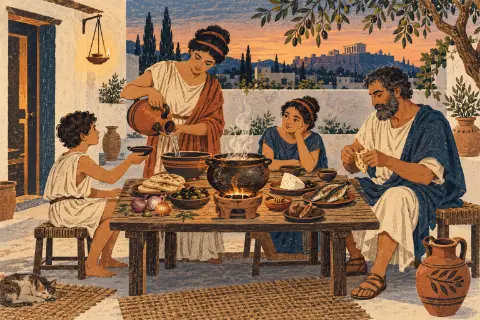 What did ancient Greeks eat?
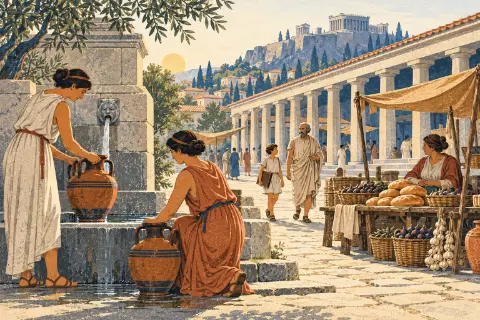 Daily life in ancient Athens: a day in the city